
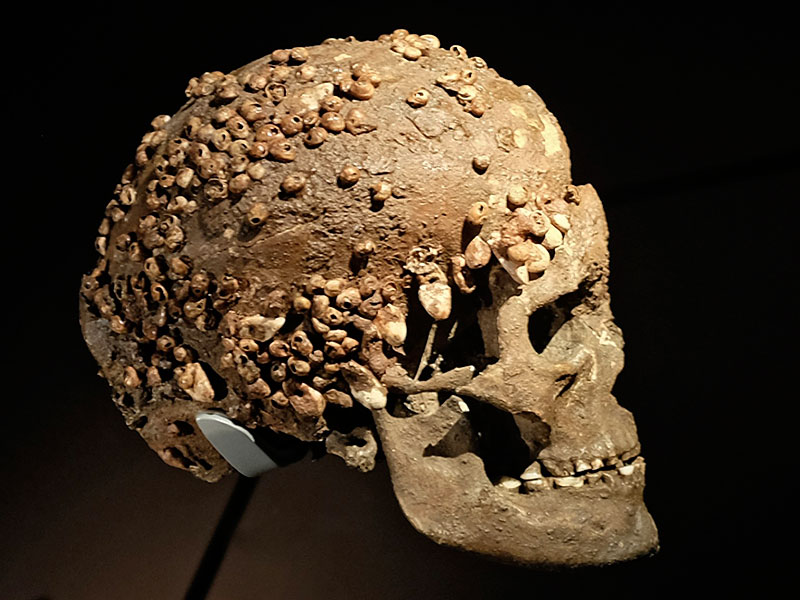
Les Eyzies (Dordogne). Upon entry, a glossary provided, a few maps and a timeline set the tone. At the National Museum of Prehistory, the message is intended to be clear and didactic, without giving in to scientific rigor. The approach is necessary to address a very complex question: how to talk about death? Even more so in prehistory, when no written source can provide information on funerary practices… By relying on the material traces that have come down to us, the exhibition manages to provide an exhaustive overview of these practices, from the first testimonies of the Paleolithic to those of the Mesolithic, around 8,000 years ago. Practices which, far from being a simple technical gesture, already carry within them a symbolic dimension. “ The objective of the exhibition is to reveal these complex thoughts, to focus on the relationship that ancient societies had with death. It is a reflection of their way of life, their way of thinking, and certainly their relationship to the world.», Supports Nathalie Fourment, director of the museum, who is curator with Brad Gravina, engineer in charge of the Early and Middle Paleolithic collections.
Throughout the windows, the visitor becomes aware of the attention paid to the body of a young child suffering from a bone lesion, found with that of an adolescent in the cave of Qafzeh (Israel). The care with which two babies were successively buried, associated with elements of adornment and undoubtedly wrapped in a shroud, on the site of Krems (Austria). Or the incredible discovery represented by the unearthing of the grave of the child of La Madeleine (Tursac, Dordogne), whose skeleton displayed hundreds of shells and perforated teeth. The flagship piece of the exhibition remains the spectacular skull of the Lady of Cavillon [voir ill.]on loan from the National Museum of Natural History (MNHN), which was covered with more than 300 shells and deer teeth, undoubtedly threaded over a sort of fishnet covering his head.
The strength of the exhibition lies in the variety of pieces presented as well as in that of the mediation devices: numerous bones, ornaments accompanying the deceased, well-chosen casts and facsimiles… A virtual tour of the Cussac cave (Haute-Vienne), where human remains were found in bear burrows, even presents the most recent results of the archaeological work in progress. The whole thus finds its right balance, treated with rigor for the connoisseur and made accessible for the neophyte, who benefits from very detailed diagrams and labels.
The route is also enriched by a quick foray into the funerary gestures of later societies, pertinently compared with those of prehistoric societies. Peruvian protective figure, Merovingian ornaments, Beninese tambourine made of human skull and animal gut…, so many objects which question the relationship of past societies to death, without ever making us forget the limits of our knowledge.


