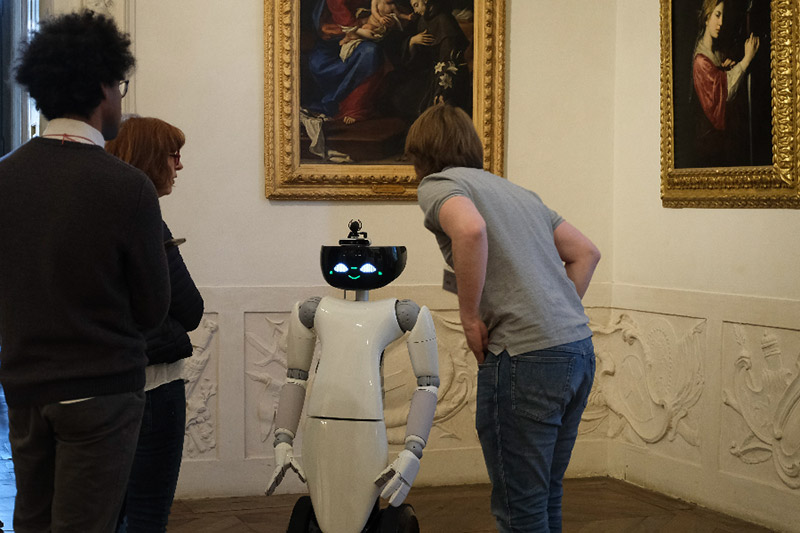
In Turin, the historic setting of Palazzo Madama now serves as a laboratory for an unexpected experience. Since the end of March, the place has welcomed R1, a humanoid robot responsible for accompanying visitors on their journeys. Designed by the Italian Institute of Technology (IIT) in Genoa, this new type of guide is still in the testing phase, but it is already attracting attention.
R1 was designed to operate in restricted interior spaces. The robot measures 1.25 meters, can extend up to 1.45 meters and weighs 50 kilos. Its structure combines plastic, carbon fiber and metal, while its mobility on wheels allows it to reach a speed of around 1.5 meters per second, a format considered suitable for the circulation of the palace and its proximity to visitors.
R1 has several infrared cameras which reconstruct the space in three dimensions, two lasers used to detect obstacles on the ground and taller elements such as windows, as well as pressure sensors distributed over its surface. Its head also concentrates cameras, microphones, a speaker and an RGB LED matrix which supports communication with the public. The whole thing allows the robot to find its way, avoid obstacles and adapt its trajectory. The museum served as a testing ground because it forces the machine to move through a historic building, interact with a very varied audience, and adapt to situations that are never completely standardized.
The experience takes place on the first floor of Palazzo Madama. Its deployment required software adjustments to manage navigation and connectivity in large historic exhibitions. The robot accompanies visitors from room to room, turns its head towards people to reinforce the impression of exchange, adjusts its route if the environment changes and can even remap itself during its journey. Its main microphone also allows it to select the language of the visit, while its mediation functions cover explanations on the works, the artists, the historical periods, but also on the history of the palace itself.
The museum, however, insists on one point. R1 is not intended to replace human guides. Its role is primarily to assist staff, particularly during busy times, when attendance can increase by around 30%. In a historic building where flows are sometimes difficult to manage, the robot can help orient the public, absorb some of the simple requests and improve the accessibility of the visit, without replacing the expertise of a mediator or curator.
After six weeks of testing, more than 80% of users reported positive interactions with the machine. This phase is not the first. R1 had already been tested at Palazzo Madama during previous tests, notably in 2022 then in May 2024.
Located in Piazza Castello, Palazzo Madama brings together elements from different eras, from the Roman gate to the medieval fortress, including the 15th century castle for the princes of Acaja and the baroque facade of Filippo Juvarra. It was then the seat of the Senate of the Kingdom of Sardinia and then of the Kingdom of Italy, before housing from 1934 the Civic Museum of Ancient Art and its collections ranging from the Middle Ages to modern decorative arts.