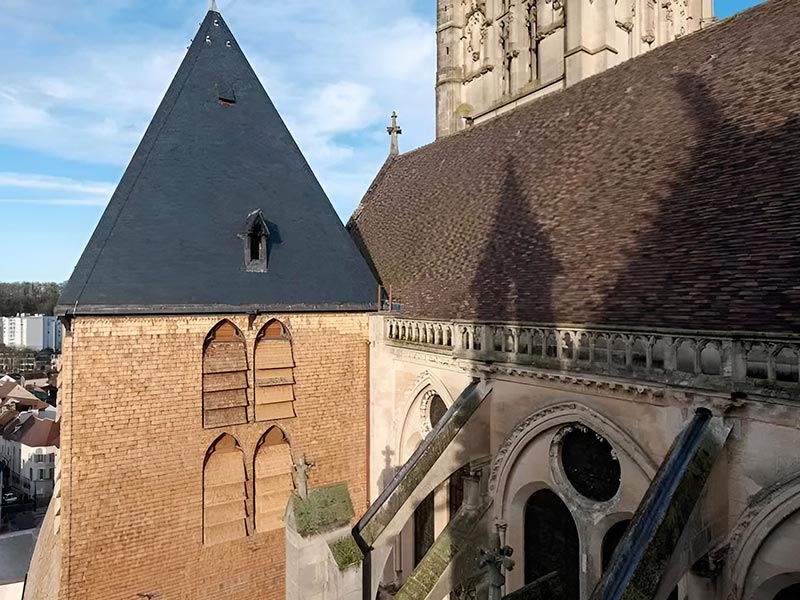
Meaux (Seine-et-Marne). The Black Tower has rarely lived up to its nickname so badly. It is a blonde shade, almost golden in the sunlight, that the emblematic wooden bell tower of Meaux Cathedral now sports. Just restored, the building will regain its dark shade as its chestnut shingles acquire a patina over time. On the other hand, the site ensured the sustainability of this unique construction, originally designed as temporary, built in the 15th century to house the bells after the demolition of the Romanesque bell tower. Although the half-timbered structure has survived the centuries, its condition has gradually deteriorated, while its last restoration campaign dates back to the end of the 1970s.
Dendrochronological study
Weakened by bad weather, the tower was placed under nets in 2010, as a precaution. “The dilapidation of the roofs was very advanced, and infiltrations had caused the rotting of certain structural timbers. The masonry parts were also damaged, since the stones at the level of the course were damaged or missing. explains Maud Grisel, architect from the Michel Trubert agency, responsible for project management. Above all, the spire of the bell tower had subsided by eighteen centimeters due to a weak point in its design and the deterioration of the assemblies of wooden pieces. “From the outside, although some parts appeared healthy, we realized that they were actually rotten to the core. This required a larger replacement of wood than had been envisaged during the initial examinations.. We always try to favor a restoration in situ, when we can. But given the deformation and alteration of the arrow, we were obliged to remove it and restore it in the workshop. »
The Black Tower of Saint-Étienne de Meaux Cathedral in 2010.
From January 2024, the state of the Black Tower is therefore analyzed in detail, with a dendrochronological study carried out on certain woods. “We wanted to attest to the dating of the pieces, to combine the results with our historical knowledge. And we have thus established that the oldest woods had been felled in 1469, which corresponds to the period of construction of the tower, points out the architect. It is truly a very beautiful discovery, which allows us to confirm the age of the tower but also (the fact) that the structures in place are, for the most part, original. » The whole challenge then consists of restoring with respect for the ancient material, favoring traditional techniques. On the entire site, around 30% of the wood was replaced, and only in the most deteriorated parts. The esentage (cladding) in chestnut shingles was carried out identically, by rehabilitating its rainwater system.
Costing a total of 3.6 million euros, the restoration operation focused mainly on the top of the spire up to the upper part of the southern western massif. Resumption of the vault and its decoration of false joints, restoration of the masonry and sculpted elements (gargoyles and cabbage leaves of the cornices), consolidation of the framework, reopening of the bell bays… The roof has for its part regained its slate covering, while the limestone base of the tower has been cleaned and fortified in places. “In agreement with the project management (the Île-de-France regional directorate of Cultural Affairs), our intervention extended over three levels below the course, to replace certain damaged stones”, specifies Maud Grisel. After restoration of the north tower in 2019, then the central portal in 2021, additional work remains to be carried out on the lower part of the southern massif of the cathedral.