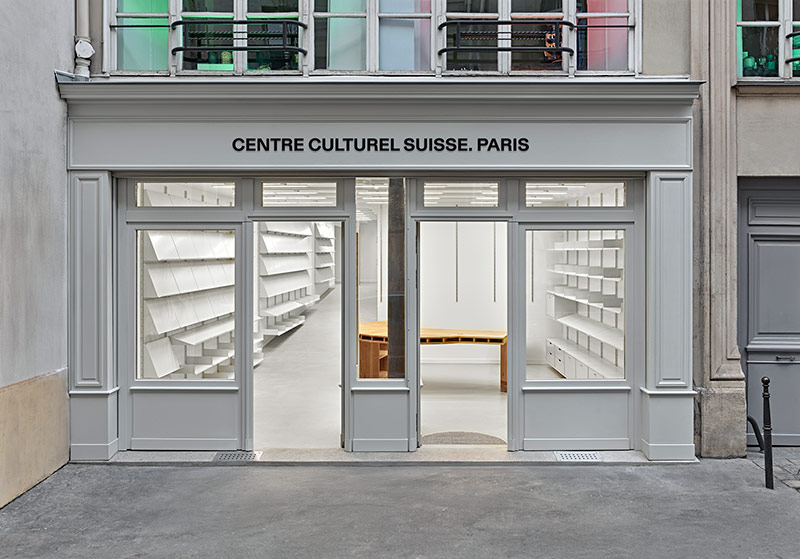
Paris. It is a brand new Swiss cultural center which is preparing to reopen its doors in the heart of the Marais after four long years of closure. Nestled since 1985 at the end of a medieval cul-de-sac, on the ground floor of a former private mansion built in the 17th century for Jean d’Alméras de La Saussaye, advisor and secretary to King Henry IV, the Paris branch of the Pro Helvetia foundation was in an advanced state of dilapidation from both a building and technical installations point of view. The cultural center also suffered from poor visibility with its two different entrances to access the bookstore and the exhibition and performance rooms, installed in a warehouse adjoining the private mansion and built at the end of the 19th century in place of the old gardens. The renovation project was therefore based on a triple challenge: creating circulation between the different spaces inside the building, improving accessibility and giving a new face to the site.
To carry out this major project, Pro Helvetia was able to count on the expertise of the Parisian agency ASBR as well as the Basel architect duo Truwant + Rodet. After a one-year study phase, the project started in 2023 with a forecast budget of 6.8 million Swiss francs (€7.5 million), entirely financed by the Federal Office of Construction and Logistics, Pro Helvetia being a public law foundation mandated by the Swiss Confederation.
Three years of work were necessary for the “new” Swiss Cultural Center to see the light of day: the architects were faced with difficulties in transporting construction materials due to the impossibility of mounting a construction crane, the center being located near other private mansions classified as historic monuments. Likewise, the discovery in the old warehouse of a twisted historic frame required that it be redesigned as faithfully as possible.
Single access
If he wasn’t “it is not possible to touch the exterior volume”, according to Jean-Marc Diébold, the director of the Swiss Cultural Center, due to the heritage character of the district, the demolition of several walls at the rear made it possible to connect the different spaces and to rethink the entire visit route: entry and exit are now via a single access located at 32, rue des Francs-Bourgeois, where the bookstore was already located. A new corridor benefiting from a long PMR (people with reduced mobility) ramp compensates for differences in ground levels while meeting the requirements of universal accessibility. Visitors then cross the first exhibition room (with a surface area of 45 m2) then the interior courtyard, which will host a refreshment bar as well as various events, before arriving at the main space of the cultural center: the hall, in the old warehouse.
The building has also undergone significant renovations. The stage allocated to the live performance (250 m2), on the ground floor, and the exhibition room upstairs (270 m2) are entirely modular and adapted to multidisciplinary programming at the heart of the cultural project: “We are very attached to the diversity of cultural forms in programming”confides Jean-Marc Diébold. The stage can thus accommodate performances and shows in various formats (frontal, bi-frontal, quad-frontal), but also large installations. Upstairs, a large removable chair rail allows the space to be reconfigured according to projects and a glass roof concealment system promotes the creation of varied ambiances. The hall has also been made accessible to PRMs thanks to the construction of an elevator.
The number of employees has almost doubled between 2022 and 2026: made up of seven members before closure, the team can now count on twelve professionals to keep the establishment running – several mediators have notably been recruited with a view to reopening.
On this occasion, the Swiss Cultural Center wanted to shine the spotlight on artistic trajectories that are little shown in French institutions. Three Swiss visual artists of different generations are thus benefiting from solo shows: the Zurich sculptor Akosua Viktoria Adu-Sanyah, the multidisciplinary artist Mai-Thu Perret and the painter and photographer Ingeborg Lüscher.