Versailles (Yvelines). In the shadow of the Sun King, there is his son, the Grand Dauphin (1661-1711). Although he never acceded to the throne of France, the man called Monseigneur remains the only legitimate child of Louis XIV to have reached adulthood. The key role he occupies in the royal court does not prevent him from suffering from a bad reputation, and above all from a very weak posterity. But as is often the case, unknown does not rhyme with uninteresting: by devoting a very first exhibition to him, the Palace of Versailles highlights a character who is certainly less flamboyant than his father, but worthy of interest in many respects. The exhibition paints the portrait of an educated prince, esthete, and fine collector. These multiple facets are presented in a well-articulated journey which retraces the entire life of the Grand Dauphin, from his birth celebrated with great pomp in Fontainebleau until his sudden disappearance, at the age of forty-nine. All with clarity, opting for a tripartite division which uses the acerbic formula of the memoirist Saint-Simon who described the prince in these terms: “ Son of a king, father of a king, and never a king.”
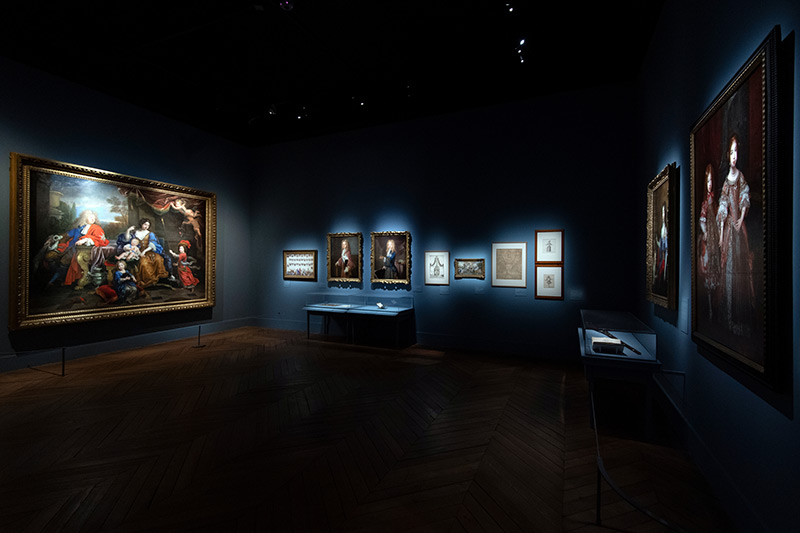
From his education (modern for the time) to his training in the art of war, including the creation of his descendants and the maturation of his tastes in decorative arts…, the exhibition is dense but does not overwhelm. As the Dauphin is not known for its feats of arms, the axis is ultimately less political than societal, which makes it all the more accessible for the visitor. The choice of hanging a portrait of the prince in each section of the route targets the subject well, forming a sort of visual frieze signed by the most prominent artists, from Pierre Mignard (1612-1695) to Hyacinthe Rigaud (1659-1743).
View of the “Le Grand Dauphin” exhibition at the Palace of Versailles.
© Palace of Versailles / Didier Saulnier
Far from being confined to the portrait gallery, the exhibition brings together a wide range of works: tapestries, furniture, richly illustrated works, decorative objects… Against a royal blue background stands out a very precious illuminated manuscript recording the prayers to be said during a royal birth. Further on, in a crimson red atmosphere this time, the elaborate card game with which the child prince learned to recognize the coats of arms of the great families of Europe is displayed.
Among the 250 pieces on display, pride of place is given to objects with which the Grand Dauphin surrounded himself during his lifetime, today kept at the Louvre, at the Prado Museum (Madrid) or scattered in other institutions and private collections. Several unpublished works stand out from this rich selection, presented in France for the first time, like a superb ceremonial portrait of the young Dauphin found in a private Spanish collection. But the most remarkable part remains, without doubt, that which brings together some of the exceptional pieces that the patron prince had acquired to decorate his residences: large Florentine bronzes (see ill.) from the Wallace Collection in London (which find their original pedestals here), marquetry furniture, Chinese porcelain, crystal vases, gems, precious stones…
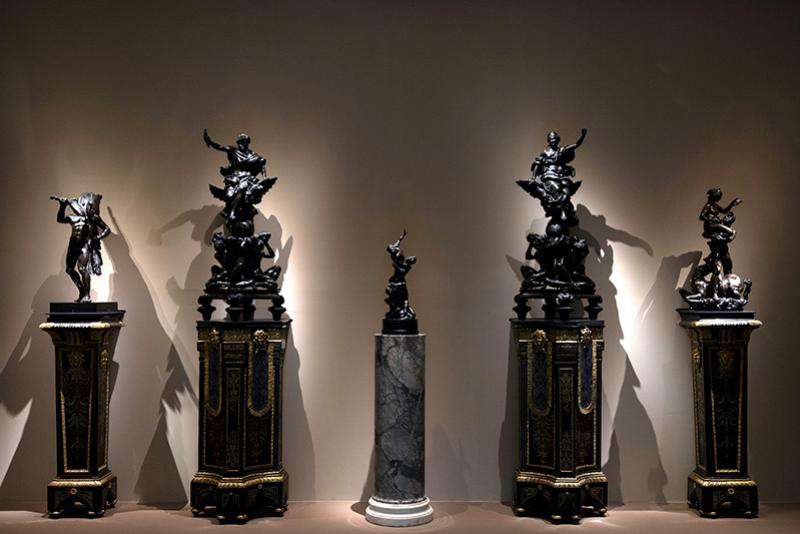
View of the “Le Grand Dauphin” exhibition at the Palace of Versailles.
© Palace of Versailles / Didier Saulnier
At the crossroads of history and fine arts
“ It is an exhibition which is intended to be both historical, since it sheds light on a historical personality, but also fine arts. Through the prince’s collections, we question the question of taste in the Grand Siècle, that of the evolution of style, underlines Lionel Arsac, curator at the Palace of Versailles and curator of the exhibition. Through the places he decorated, through the work he ordered, the Dauphin bridged the gap between the Louis XIV style and the style of Louis XV’s younger years. He was one of the great patrons of this revival of the arts around 1690-1700. » Thus, a pair of chests of drawers finely veneered with ebony and amaranth, jewels of the personal collection of King Felipe VI, left Spain for the first time. The legendary cabinet of mirrors, the most famous room in the Dauphin’s Versailles apartment, which has now disappeared, is evoked in a shimmering room with subdued lighting, which reveals, among other things, the oldest Chinese vase attested in Europe (dating from the 13th century).
Among its strong points, the exhibition pushes research further into the restitution of all these lost decorations. The scenography, by Philippe Pumain, plays a significant role: the paintings by Jean-Baptiste de Champaigne (1631-1681) which decorated the apartment of the Grand Dauphin in the Tuileries, since dismantled, find their original arrangement here on the picture rails. Likewise, the architecture of the Château de Meudon, the prince’s favorite residence, is reproduced on the walls, while paintings, statues and drawings of the gardens bring the royal domain, which has now disappeared, back to life.
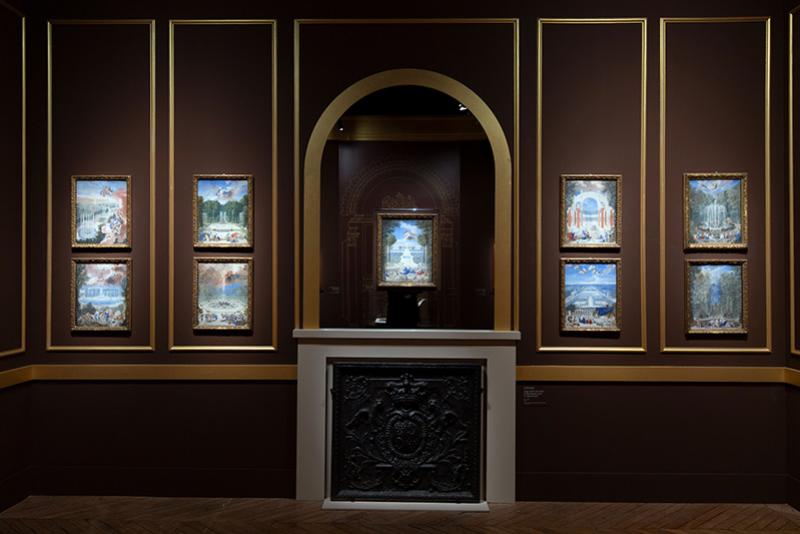
View of the “Le Grand Dauphin” exhibition at the Palace of Versailles.
© Palace of Versailles / Didier Saulnier