Bilbao,
Ambitious from childhood, from a child Helen Frankenthaler decided Paul Feeley classes, also an artist, who shared generation with abstract expressionists.
He dared to invite Clement Greenberg, a powerful critic of The Nation and Pollock defender, to go, and he did (they say that under the promise of appetizer quite). Despite how much they separated them, they began a relationship that lasted near a five years and that would have to do with Frankenthaler went to the inaugurations of the New York school in the Betty Parsons Gallery; Pollock’s rejection of easel painting would encourage her to be more daring in her techniques and procedures.
That was the beginning of a trajectory that would make it one of the main figures of American abstract expressionism, under the continuous mantra of the absence of rules; A journey that now reviews the Guggenheim Bilbao museum in collaboration with the Palazzo Strozzi Florentino and the artist’s foundation, in a sample of which pieces of contemporary authors are also part of the sample with which it was related and maintained Mark Rothko or David Smith.
This exhibition coincides, Frankenthaler’s major in Spain, with the incorporation to the Guggenheim funds of two of his works; He elaborated, in addition to paintings on canvas and paper with his own technique of soak and stainsculptures, ceramics, tapestries and engravings marked by fluidity and the presence of signs, symbols and scenes that point without revealing. Ambiguity and mystery were, in fact, two of his greatest searches: he was interested in those compositions that, as certain texts, could raise different readings in their different spectators and that could be part of open processes, a notion he learned from the same Pollock.
The route of this Bilbao, chronological proposal starts with Mountains and sea (1952), abstract image but inspired by the landscapes of New Scotland in which it already let the pigment be gradually absorbed by the fabric, or Open wall (1953), in which this wall, theoretically static and impenetrable, opens and is furred by strips of light and color. Frankenthaler would announce that for her the pictorial experience was born to light space and limits, beyond the desire to be carried away by certain genres: The backbone of the painting, which makes a response, has very little to do with the subject itself, and rather with the interaction of spaces and the juxtaposition of shapes.
That did not mean that certain environments will not be more than inspiring: the summers who spent in the sixties in Cape Cod, along with Motherwell, who was her husband for thirteen, opened new paths to her painting, patents in the clear optimism of Tutti-Frutti (1966) or the monolithic descent of the rectilinear bands of The human limit (1967).
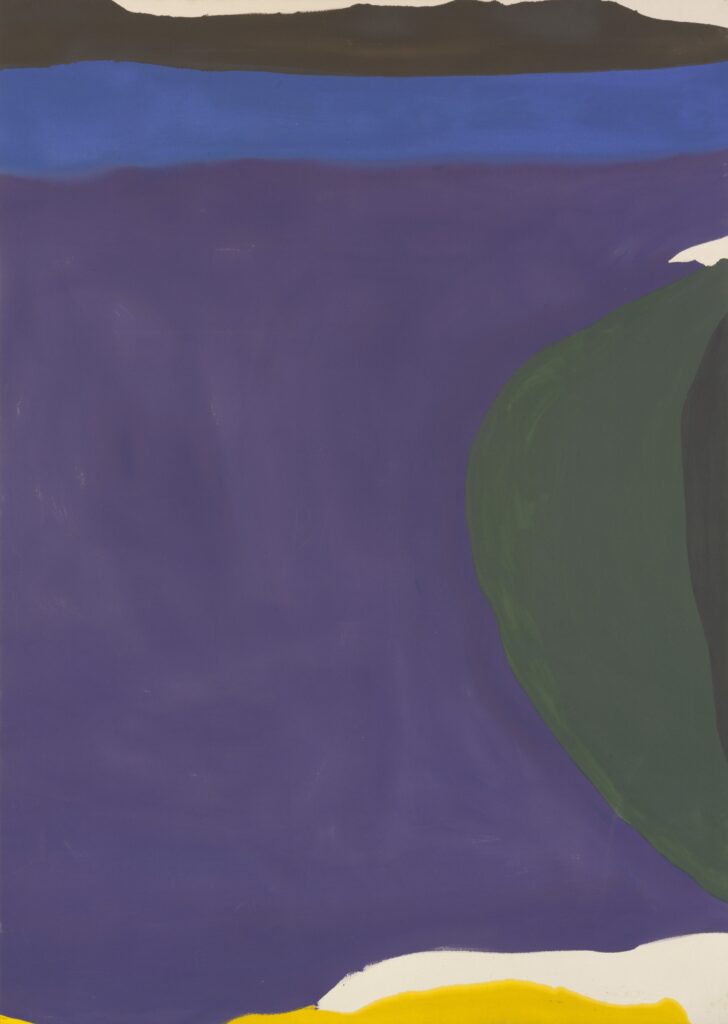
He knew how to give a place in those creations to humor and imperfections. In the province they often visited them the aforementioned sculptor David Smith, with whom Frankenthaler shared that motto of There are no rules that should affect all disciplines, materials and methods, and even tone: their works could be both celebratory and gloomy. Smith we will contemplate in Bilbao Without title (Zig VI)where he turned stacked and welded beams in a child toy when making them rest on small wheels; also a Portrait of the hawk that she never wanted to get rid of. It will not go to our meetings one of the two works of the author to join the Guggenheim collection: Santoriniwhich created after a visit to Aegean combining amorphous and geometric ways in its personal plasma of land, sea and sky.
Those pieces of other creators who are part of the exhibition were in some cases friendly gifts; Other times Frankenthaler herself acquired them and only two correspond to loans from other institutions, which accounts for the importance of her circle of friendships. We will see from Motherwell Iberia (1958), painted the same year when the couple traveled to our country for their honeymoon; And Rothko would be his catalyst when starting in the Field Painting coloras Pollock was when we undertake the direction of the body exercise of the painting.
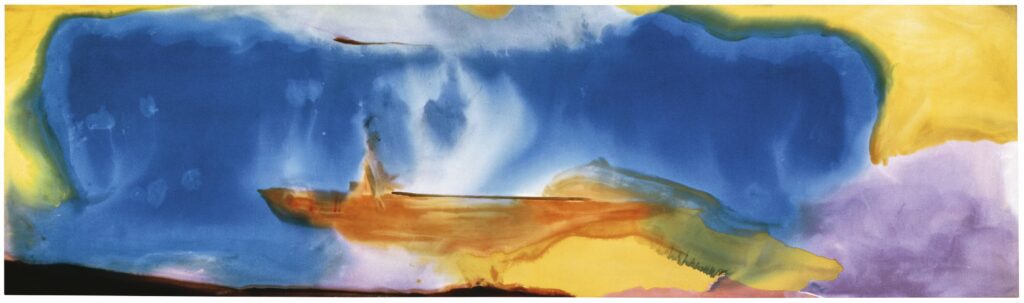
If their summers with Motherwell were linked to Cape Cod, those after their divorce would dedicate them to travel through Europe. Over time he ended Ocean Drive West #1 (1974). At the same time, it would carry out paintings with stripes that evoked urban verticality, but also images that suggested cavities, geological formations, chasms … or childbirth channels; Again it will be the public who can grant their vision. One of his greatest creations in Bilbao is Mobile blue (1973), with its more than six meters in length. The stains technique transcended in it, which already dominated, to pour paint and draw with absolute confidence, pretending to give depth to the plan of the canvas through the light games.
As he advanced in experience and age, it would be vital for Frankenthaler both to maintain their urban contacts and move away from them near the sea, and would survive their interest in stages very different from the history of art: from the Paleolithic to Monet’s girls, passing through Tiziano, Velázquez or Rembrandt. In them, to questions from the critic Barbara Rose, he said he found the light, in addition to a tonal universe: translucent veils, transparencies, another space management. Without those analyzes to teachers, it will be difficult to understand eighty work as Eastern Luz, Cathedral, Madrid either Contemplating the stars.
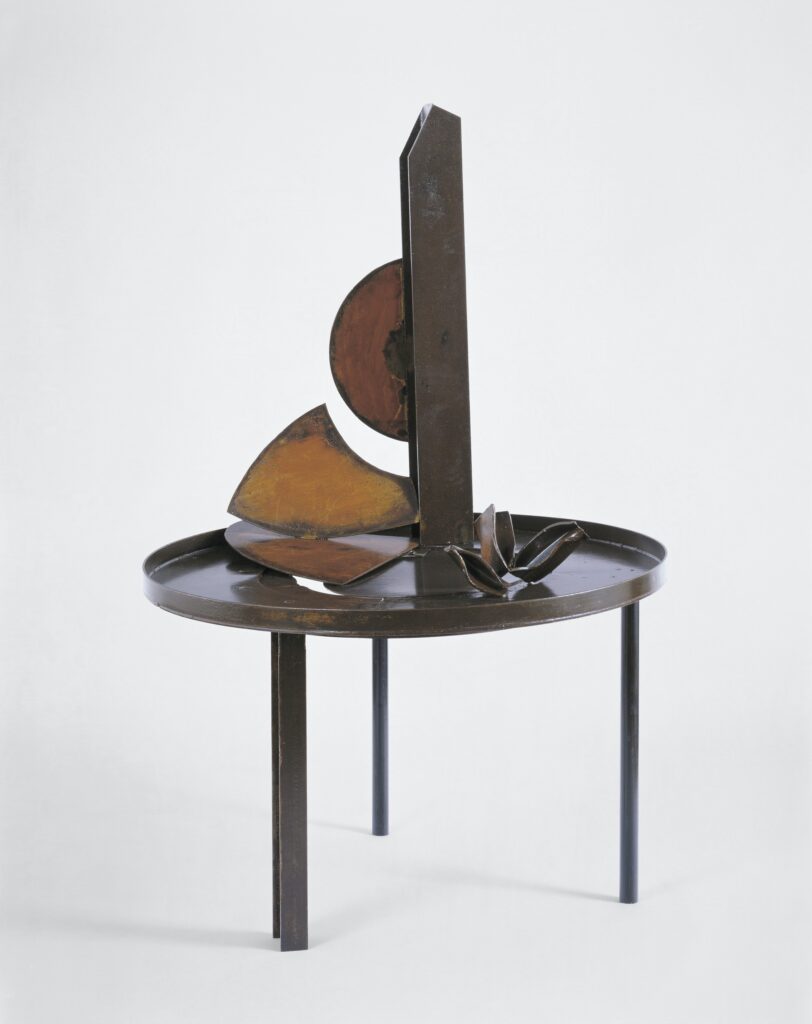
In their incursions into sculpture, David Smith and Anthony Caro, who was his intimate friend since the end of the fifties. His work Climbing the staircase (1979-1983) is exhibited with three pieces of Frankenthaler in that technique, the three of the seventies: Matisse Table, London Heart Map and Yardall of them executed in the workshop of the first, with their materials and their assistants. As on canvas, intuition was his guide.
That spontaneity, which was the beginning of all his works, could evolve in the pictorial in different directions: either resolving with small touch -ups and in a single session (such as the aforementioned Mountains and sea), either on more worked, dense or scraped surfaces that, regardless of the hours they implied, seemed, according to Frankenthaler, which had just been born.
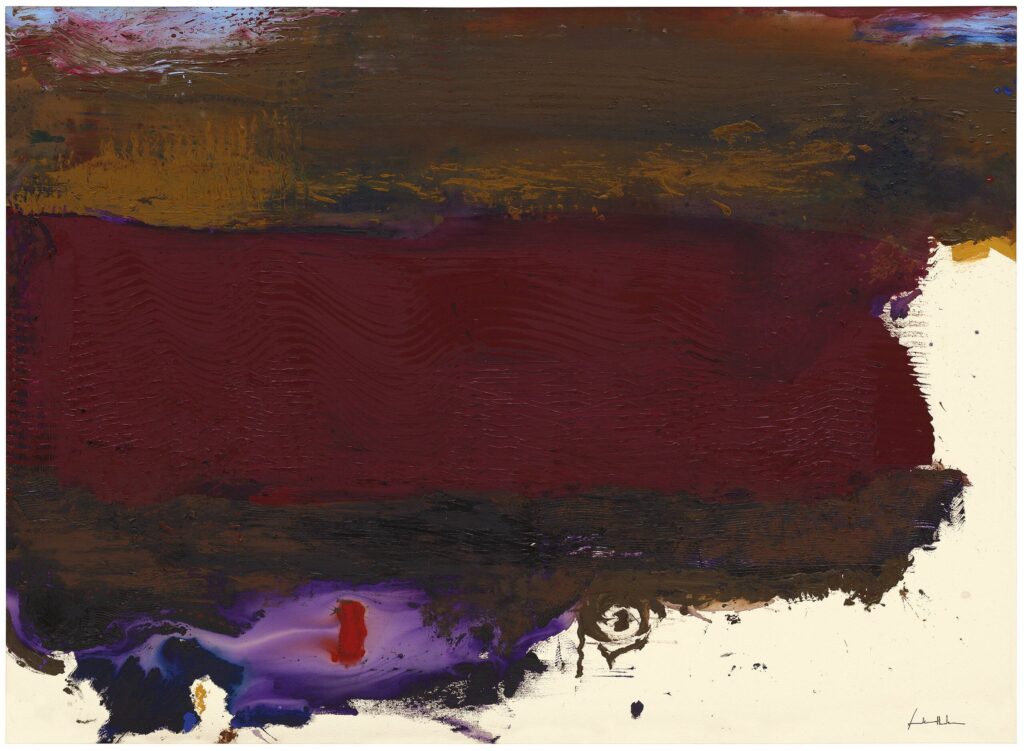
This is the case of Janus and Yin Yangboth of 1990, in which he worked with layers in layers, color funds and transparent vectors at a time. Some of its areas seem to entry to parallel universes. Greater density offer The trace of the rake and Fantasy Gardenthanks to the mixture of gel and acrylic and its manipulation with instruments such as rakes, sponges, spoons or spatulas: irregularity and roughness also determine, also, Sleep borrowed and Maelstromof 1992, the year in which the second of Frankenthaler’s pieces that Guggenheim has acquired is dated. It’s about Requiemin which dark colored layers emerge from a slope and mortuary darkness is attenuated by a light that seems inextinguishable.
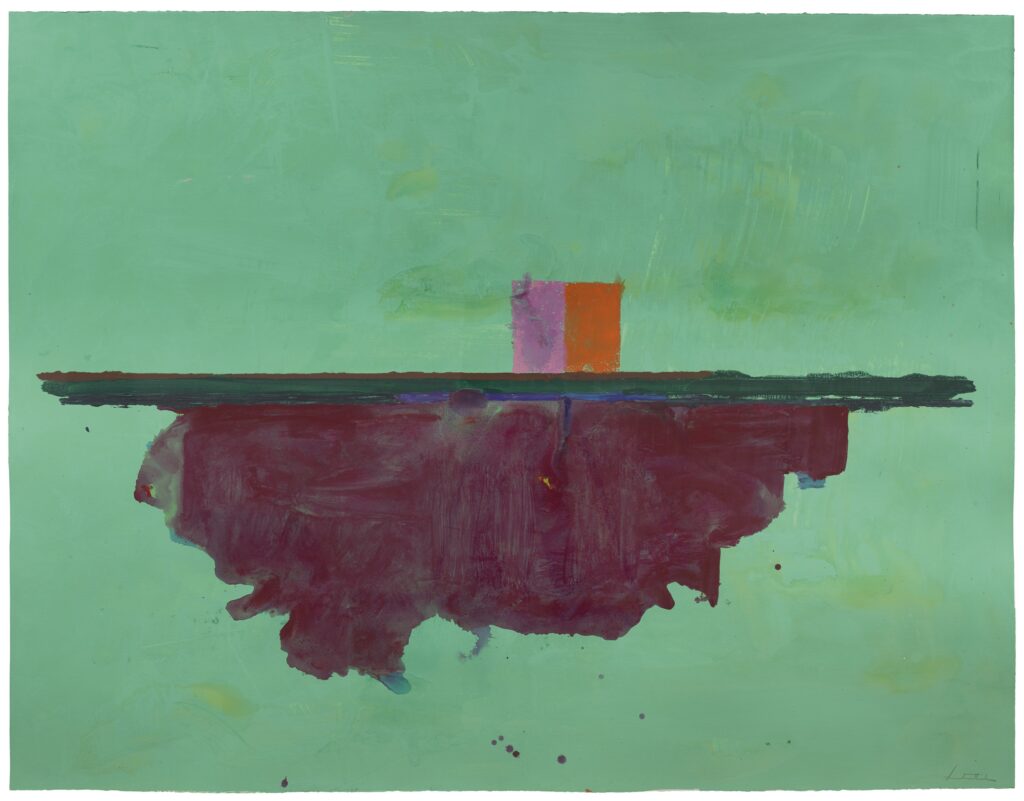
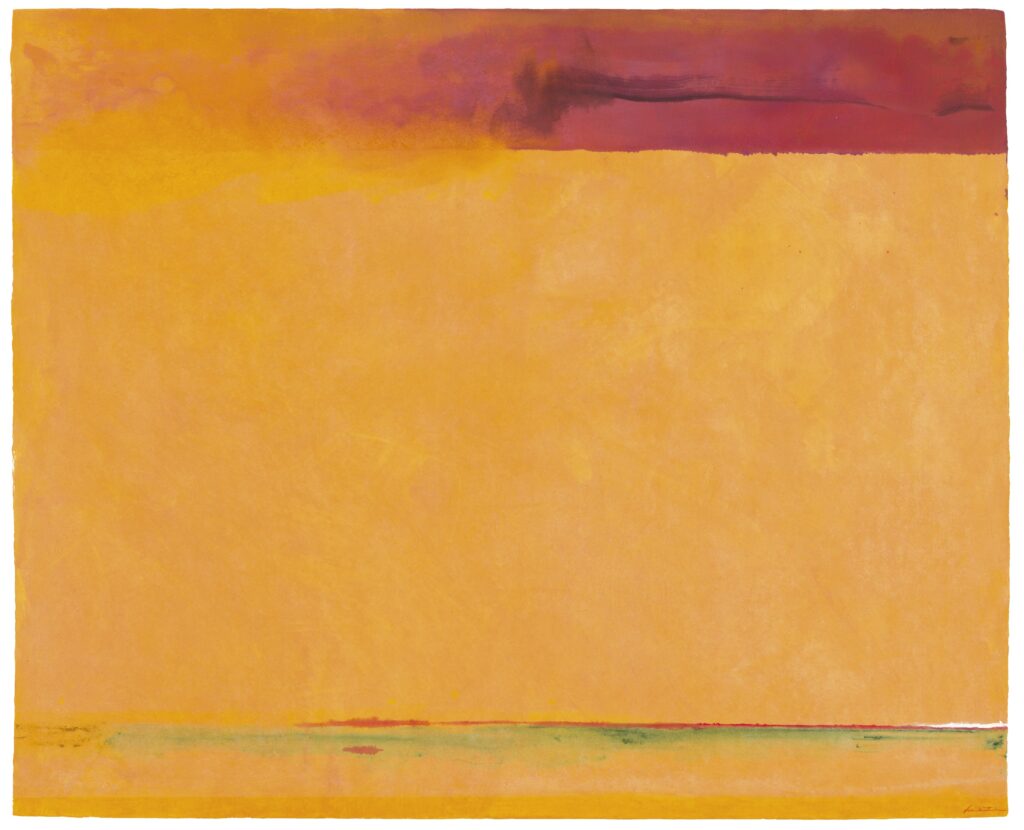
The exhibition culminates, which is not the first of the artist in this museum (he gave him another in 1998), with some of his work on paper, support in which he developed when the performance on canvas or land ras was excessively cumbersome. Also in the pieces, optimistic, who followed their marriage to Stephen Dubul in 1994, such as Solar impulse and Cassis.
His latest works, already in the 2000s, allude to a constant search for beauty, to the transience of time and the closeness of the irreversible: we will contemplate Southern Exposure either Driving East. It is difficult to guess if it is a dawn or a sunset.
“Helen Frankenthaler: paint without rules”
Guggenheim Museum Bilbao
Avenida Abandoibarra, 2
Bilbao
From April 11 to September 28, 2025