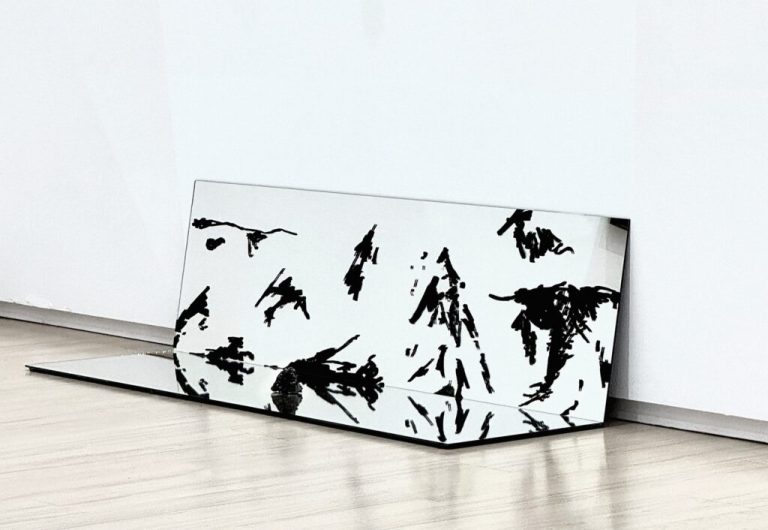
Delme (Moselle). When reading the title of the exhibition currently presented at the Delme Synagogue, some might imagine that the art center establishes a dialogue between visual arts and popular song. Far from it. “Paroles, Paroles” is a demanding exhibition, dry at times: it mobilizes a confusing corpus of works, diverting the common understanding of the notions of language, performance and reading. “ Another relationship involves visitors to the exhibition, warns the room sheet distributed at the entrance. Certain fragments of language are difficult to read, hear or pronounce, requiring our participation: approaching to listen, reading aloud to decipher. »
The visitor is therefore invited to adopt a “relational approach” to the exhibition while the artifacts play on his perceptual habits and forms of language that are familiar to him, based on syntax and linearity. But is such an attitude towards works that seem at first sight to have little “meaningfulness” possible without adequate mediation systems? Should art centers reconnect with communicational and contextualizing mediation? Here, for each work, the room sheet provides valuable information to understand the artists’ approach, translated in simple words in a well-designed children’s booklet.
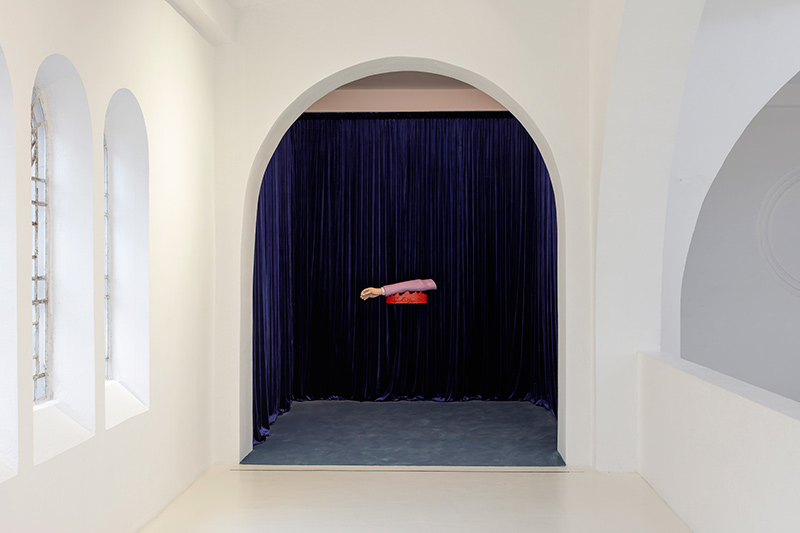
View of the “Words, Words” exhibition at the Delme Synagogue.
© OH Dancy
But the texts free themselves from the history of art and literature. Many of the works exhibited, however, largely borrow a vocabulary inherited from the experiments of the 1960s and 1970s. With its play on layout and onomatopoeia, the collection of poems to.aA (1966) is not directly in line with concrete poetry of the 1950s, which considered poetry as a visual object and ignored rhythm and syntax, and with the experiments of the Fluxus group, such as the poetry anthologies of Emmett Williams? The layout and aesthetics of the collages All life time is work time (2025) by Costanza Candeloro, which evokes women’s domestic work by drawing on magazines from the 19th and 20th centuries, are they not reminiscent of the art of feminist activists of the 1970s like the Hackney Flashers? The invisible sound installation Standpoint (2017-2026) by Marianne Mispelaëre is also an heir to the experiments on empty space of the 1970s. If mediation in an art center cannot be reduced to writing the history of art, contextualization has the merit of delivering essential keys to understanding.
A complex experience
The biggest problem with the exhibition concerns the second floor of the Synagogue: the entire space is blank with the exception of two small chapels housing installations. The fact that the picture rails are devoid of labels and that no scenographic element accompanies the visitor in his discovery of Mispelaëre’s sound installation can complicate the visiting experience. In the context of an exhibition mobilizing this type of work, it would have been enriching to take an interest in the proliferation of new forms of mediation that have emerged in recent years: experiments in sensitive mediation, “liction” and “enaction” are full of promising ideas.