Discovered in 1974 near Xi’an, China, Emperor Qin Shi Huang’s terracotta army, made up of some 8,000 life-size warriors and horses, would not have been made by adult men alone. A study published on October 13 in the Journal of Cultural Heritage by researchers from Shandong University and the Qin Shi Huang Mausoleum Museum reveals, through the analysis of fingerprints preserved in clay, that women and children under the age of 15 also participated in the making of these sculptures dating from the 3rd century BCE.
The statues in question belong to the famous “army” made up of thousands of life-size soldiers, chariots and horses. They had been made at the request of Qin Shi Huang to be integrated into an immense funerary complex, built in anticipation of his death, and were to protect the emperor in the afterlife. The terracotta army was buried with the sovereign when he died in – 210.
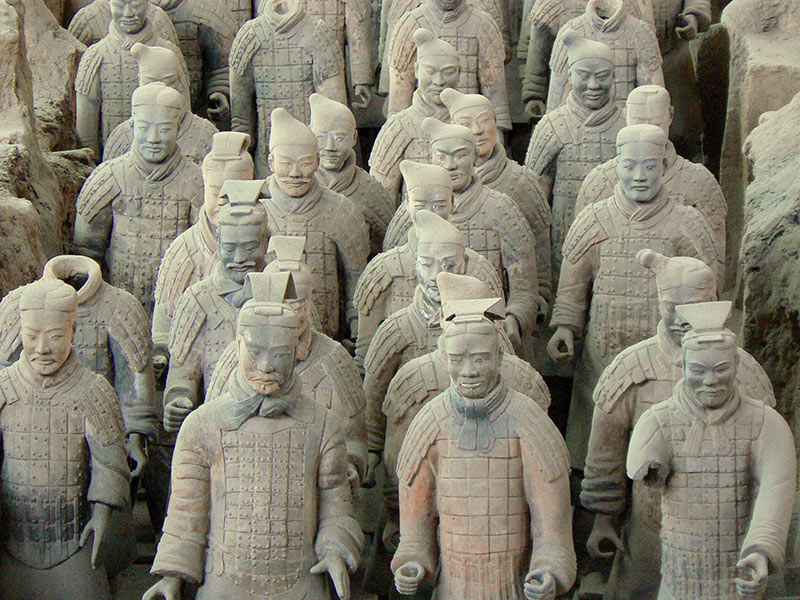
Terracotta soldiers from the mausoleum of the Chinese Emperor Qin Shi Huangdi.
The archaeologists proceeded by analyzing 79 fingerprints printed in the clay, from a sample of 36 statues of soldiers, out of the 8,000 in the set. To determine age and sex, the average width of the papillary ridges – that is, the spacing between the lines of the print – was measured. In children, the crests tend to be closer together, as spacing increases during growth, while adult males have slightly wider crests on average than adult females. According to these observations, only 45% of the prints studied belong to adult men, while 32.7% were attributed to women, and 22.3% to children under 15 years old.
The researchers favored a method based on a Bayesian mixture model, which makes it possible to identify hidden subpopulations within continuous data, while admitting an element of uncertainty. If the study offers a biological index attesting to the diversity of the labor mobilized in the creation of the statues, the prints do not necessarily reflect the number of distinct individuals, but the frequency of manipulations. Another limitation of the study is the use of a reference database constituted from a modern European population. The hypothesis of female and juvenile participation nevertheless agrees with certain written testimonies, such as inscriptions found on lacquered objects from the Qin period, indicating “adult woman”, “young girl” or “young boy”.