Martigues (Bouches-du-Rhône). More than 12,000 people have already visited the major retrospective dedicated to Ernest Pignon-Ernest (1942-), the artist who, for sixty years, has put his mastery of drawing to the service of his interventions in public spaces. The painter engaged in non-violent protest and denunciation came to Martigues in 1982, when the city, which was reopening its museum, invited him to create a work there. On the wall of the staircase remains this monumental drawing in black stone in which he mixed, among others, Martegale– the portrait of a seated woman derived fromArlesiennea painting by a 19th century painter called Pierre Jean, kept at the museum – and Prometheuswhich was inspired by the nearby Lavéra refinery, and for which he took the photography of the physicist J. Robert Oppenheimer by Philippe Halsman.
To accompany his intervention in the museum, Pignon-Ernest created in the city, with the help of Michel Sohier, a great specialist in this art, a screen printing workshop open to Martégaux. There, on scraps of everyday presses The Marseillaisewere reproduced Martegale And Prometheusas well as a rejuvenated version of Martegalethe portrait of a pregnant woman. The museum has the screen prints of these three works, including a probably unique copy of the last one. His team collected testimonies from Martégaux who experienced the production and collage of screen prints. The short film Pignon Ernest pastes images in Martigues (1983), by Jean-Pierre Riffet, is also made available to visitors (also available online on the cinearchives.org website). The film follows the artist and those who accompany him in the manufacture and collage of the works, thus documenting their inscription in the city, their reception by the Martégaux and their natural disappearance.
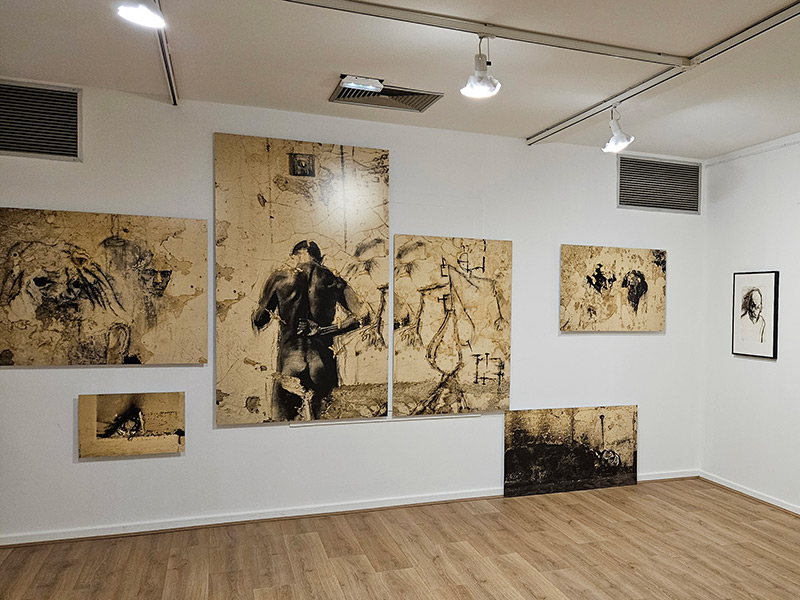
View of the exhibition “Carte blanche to Ernest Pignon-Ernest” at the Ziem Museum.
© Adagp Paris 2026
Courtesy Ernest Pignon-Ernest and Galerie Lelong
Around this strong moment, the director of the museum, Céline Laudin, has built a route retracing the major interventions of the painter, starting from his first drawings on newsprint executed during the Algerian war. In 1966, for his protest against the installation of a nuclear missile launch base on the Albion plateau, he used the stencil technique and did not yet think of keeping a photographic trace of his intervention – he is currently appealing to the public to find photos taken on this occasion. Disappointed by the possibilities of the stencil, he then turned to screen printing. For each intervention discussed, the preparatory sketches and drawings, screen prints and photographs allow us to understand the work process. The drawings are generally rarely exhibited and sometimes have never been shown, but this can also be the case for photographs, such as those which document the intervention in the cathedral of Haiti, in 2019.
In addition to this retrospective, Ernest Pignon-Ernest is the curator of a museum drawings cabinet. He chose to show mainly little-known works by Félix Ziem (1821-1911) echoing his own production.
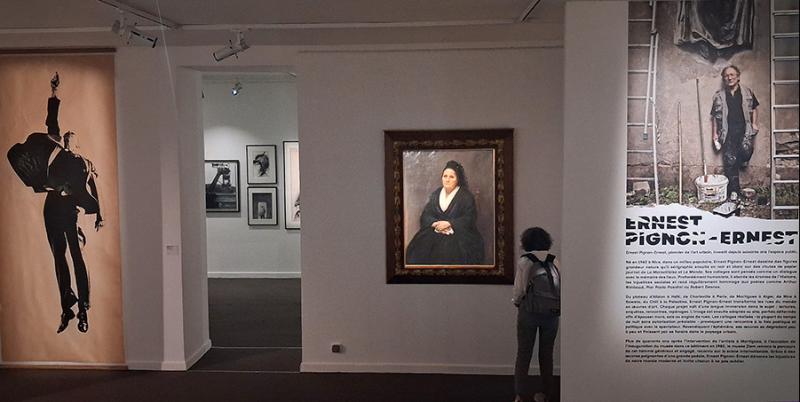
View of the exhibition “Carte blanche to Ernest Pignon-Ernest” at the Ziem Museum.
© Adagp Paris 2026
Courtesy Ernest Pignon-Ernest and Galerie Lelong