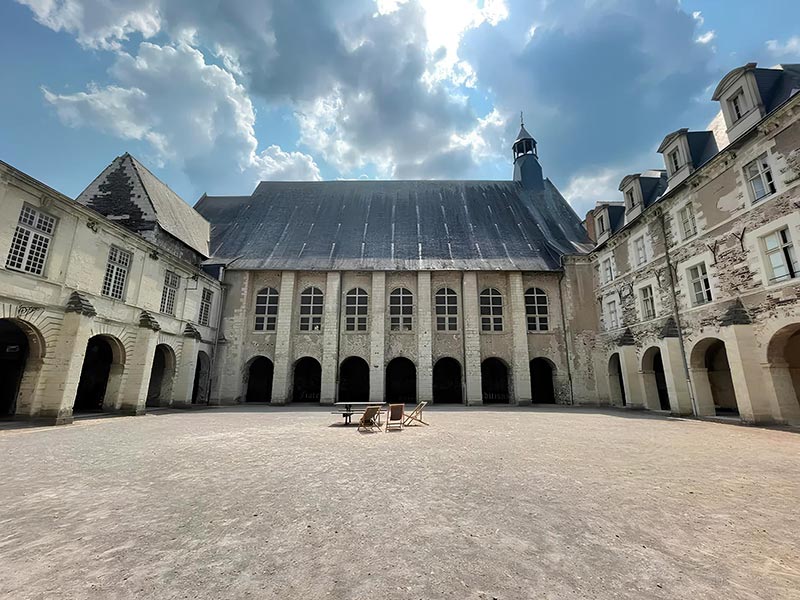
Angers (Maine-et-Loire). “Little Fontevraud Angevin”, “one of the most important abbeys of Anjou”… there is no shortage of names to describe the Ronceray abbey (see ill.), which has long remained hidden from view. Its discreet church, accessible only to a few researchers, had until now only been opened on an exceptional basis for a contemporary art exhibition. “If it was not open to the public, it was because the building was very dilapidated. The conditions were not at all right to welcome visitors”explains Stéphanie Vitard-Gibiat, head of the Angers Heritage service. Confiscated during the Revolution, the abbey church gradually deteriorated: loss of part of its apse, wood from the belfry sold, collapse of the bell tower, collapse of certain vaults… The School of Arts and Crafts of Angers was established there despite everything in 1815, but without having the means for restoration. So, when the City bought it for a symbolic franc in 1998, the building was in a very poor state. Summary studies are carried out, emergency work undertaken and some electrical interventions carried out. All in all, makeshift operations, far from meeting the scale of needs.
A thousand-year-old abbey
In 2020, the project to open it to visitors finally took shape. Three years of studies first prove necessary: health and heritage diagnostics as well as archeology studies of the building still in progress. “We first had to provide more knowledge about this building, since we are sorely lacking, points out Stéphanie Vitard-Gibiat. It is an extremely old abbey, which will soon celebrate its millennium. It is often said that the first vaulted buildings were discovered in the south of France, in the Catalan countries, but here we are in the north of the Loire. It is therefore an important site from the point of view of art history and architectural history! »
Ronceray Abbey being, in essence, a closed place from its creation in 1028 until the departure of the nuns in 1792, the first action was therefore to uncover all the bays hitherto covered with boards. The project, carried out for a year under the direction of the architect François Jeanneau (ArchiTrav), focused mainly on the restoration of the exteriors: repair of the portals and their decorations, rework of the moldings, corbels and cornices, recreation of the pediments and niches. Inside, several adjustments have been made to allow it to be opened to the public. A glass airlock was installed at the entrance to the south portal, as well as a wooden window for the ticket office. “We chose light oak wood, a decision taken so as not to mislead the visitor between the old parts and the broughtcontemporary buildings »indicates Stéphanie Vitard-Gibiat. These interventions pave the way for cultural use of the site, which will now host concerts and exhibitions in its 300 m² nave. A small interpretation space has also been set up to retrace the history of the abbey through documents, models and lapidary objects.
This first phase, completed for 1.4 million euros, is only the prelude to a larger project. “ The work will be spread over several years. The budgetary decisions have not yet been made, but it will be necessary in particular to undertake sanitation work, because the site is quite humid. underlines Stéphanie Vitard-Gibiat. The second part, and not the least, concerns the preservation of the painted decoration. To stabilize it initially, but also to reveal all of these paintings covered with whitewash at the end of the 18th century. Only certain parts were unearthed in the 1960s, revealing a rich decor whose oldest elements date back to the 13th century. “There are historical coats of arms, a whole decorative, plant and ornamental program with geometric meanders. No doubt also allegorical programs and legends with a wolf, a moon, a stork… But this requires additional studies. » The abbey has not yet finished revealing its secrets.