New York. Race, cultural appropriation, state violence, borders, migrations, colonialism, racial identities, memorial identities, gender, indigeneity, instability of the virtual world… Since 2017, the busy Whitney Museum of American Art – Fitch estimates the number of visitors at 940,000 in 2025 – has taken advantage of its biennial to shed light on the questions of the time, often from a progressive or activist angle. The event is never neutral: controversies, as in 2017 when the artist Dana Schutz was accused of cultural appropriation, give way to tensions within the establishment, as in 2019 where the vice-president of the board of directors, Warren B. Kanders, at the head of a military equipment company, was accused of toxic philanthropy and forced to resign. More generally, the Whitney, led by Scott Rothkopf, echoes protest speeches, particularly since the Trump years. However, the 2026 vintage, which runs until August 23, displays, at first glance, a certain neutrality. Is it for the sake of discretion, at a time when each museum daring to contradict the fiercely anti-DEI administration, receives, at the very least, invective? More likely, a clever way of letting the messages express themselves through the profiles of the artists and the works.
Marcela Guerrero and Drew Sawyer, the two curators of the exhibition, decided to abandon any idea of a title in order, according to them, to stick to the“the mandate of the Biennale in taking the temperature of what is happening in American art”. It is therefore without bias that they would have set out to travel across America in search of artists who form a panorama of current art. In reality, and they admit it, their journey itself traces the contours of a commitment.
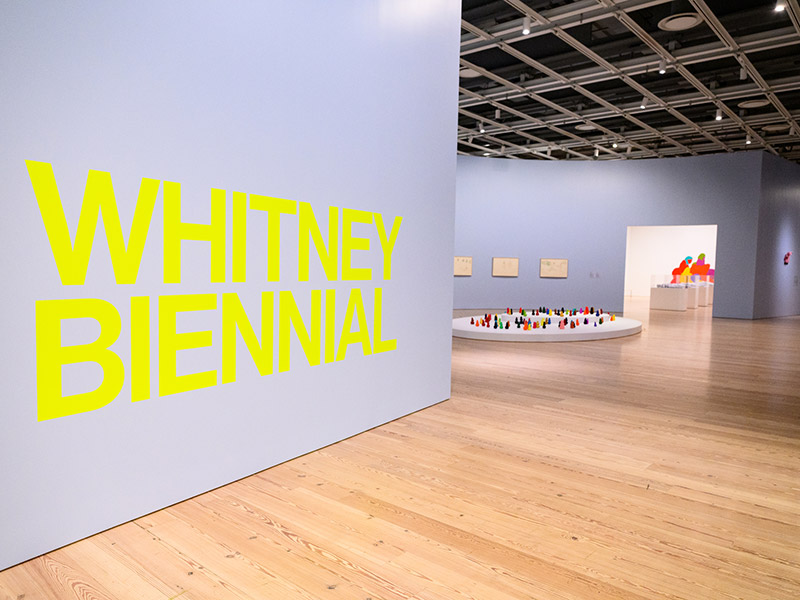
View of the Whitney Biennial with a foreground of the sculpture by Anna Tsouhlarakis, She must be a matriarch (2023).
© Jason Lowrie / BFA
Starting point: Puerto Rico, birthplace of Marcela Guerrero, who became the first Latin exhibition curator in the history of the Biennale. Hawaii, Afghanistan, Vietnam… a tour follows in an America of ideas and not exclusively of soil, because Guerrero and Sawyer affirm: “The art of the United States is not the domain of American artists. » They invite us to “thinking about American art with a more global perspective, via places where the United States has had histories of intervention, occupation or reflection”.
A cosmopolitan America
In the end, after 300 workshop visits and video exchanges, the curators selected 56 artists, 21 of whom were not born on American soil, transforming the façade of neutrality into a subjective approach. They take up, among other things, a desire to define America, going beyond the United States, claimed since 2015, particularly in the Latin cultural community. The latest demonstration to date, last February, during halftime of the Super Bowl where the Puerto Rican singer Bad Bunny recited the names of all the countries on the continent in front of more than 130 million spectators after exclaiming: “God Bless America!” »
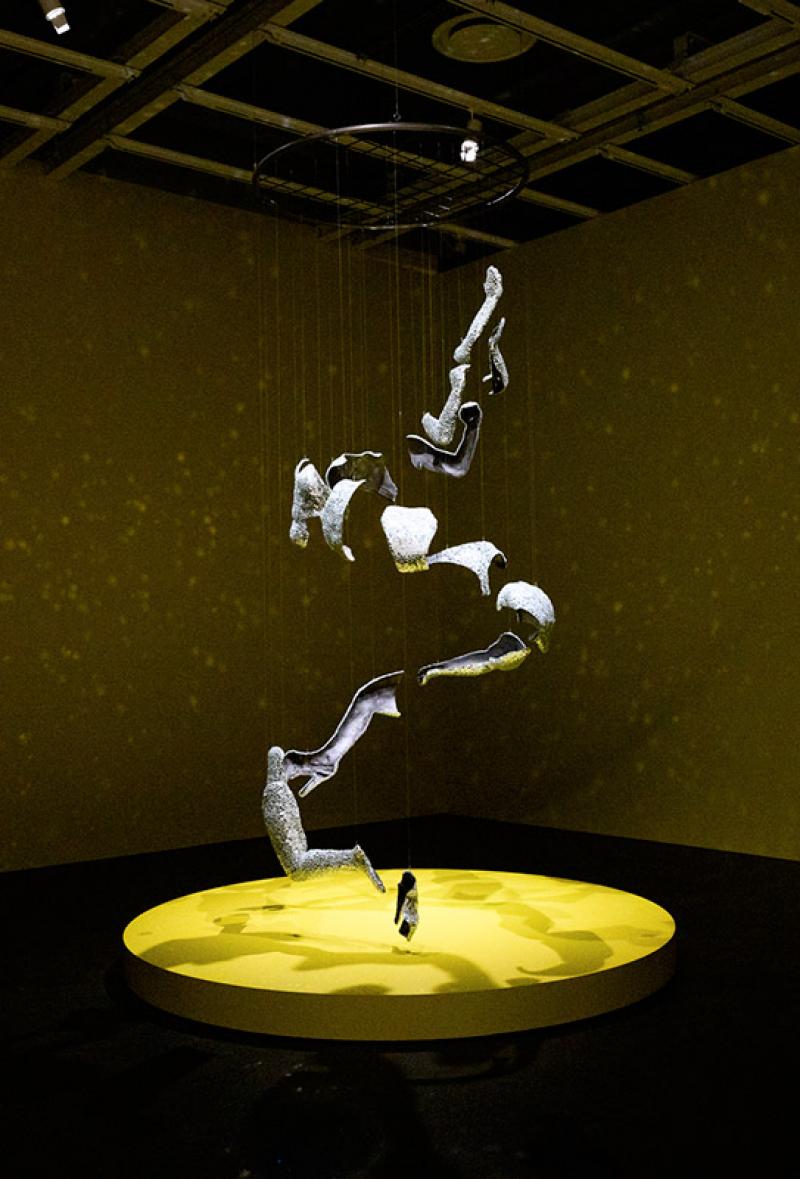
Young Joon Kwak, Divine Dance of Soft Revolt (Anna, Travis, Me)2024, installation view at the Whitney Biennial.
© Darian DiCianno / BFA
By entering this “untitled” 2026 biennial, the visitor discovers an idea of America which is expressed through the ethnic groups that compose it, but also the effects it has on the world. The exhibited works also convey the individual struggles of the artists. Thus, a hilarious parodic feminism is revealed in the monumental ceramic work (see ill.) by the Greek artist of Navajo origin, Anna Tsouhlarakis. Further on, a sculpture (see ill.) by Young Joon Kwan, a native of Queens, addresses erotic phantasmagoria queer. As for the visual and sound installation by Basel Abbas & Ruanne Abou-Rahme, two artists who live between Brooklyn and Ramallah, it offers a lyrical portrait of Palestine, composed of images of landscapes and inhabitants in their daily lives. More faithful to the archetype of the American artist, Andrea Fraser, born in Montana, offers an allegory of art through sculptures of sleeping infants, in gray wax, which visitors, from above, can observe. The public circulates and absorbs, or not, the underlying messages.
Throughout the journey, the effect of the works is uneven. Lovers of figurative painting will move on. The 2017 biennial demonstrated the return of the genre, but it seems that it is exhausted today, giving way to a notable eclecticism: many multidisciplinary installations, works in volume, multiplication of various materials. Some, gigantic sculptures, with an assertive plastic character, are very accessible; other more conceptual proposals can be held at bay and require a delve into the cartels. The exhibition offers, with a little too much caution, an interesting but barely perceptible decentering in direct contact with the works.