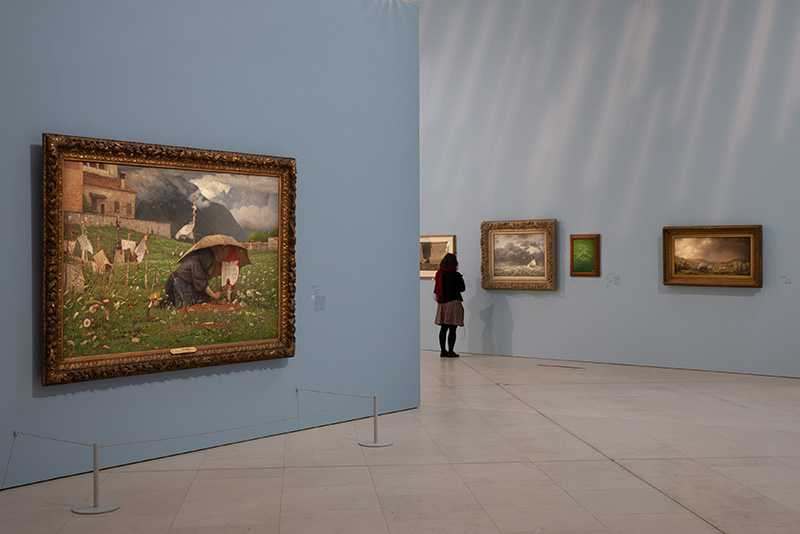
Nantes. The title, “In the rain. Painting, living and dreaming”, while being poetic, remains a little vague. According to Marie-Anne du Boullay, curator at the Nantes Museum of Arts and curator of the exhibition with Jeanne-Marie David, curator at the Rouen Museum of Fine Arts (next stage of “Under the Rain”), painting refers to the visual, living to the sensitive and dreaming to the imagination. By combining painting, photography, sound fragments and cinematographic extracts, the event favors a sensory approach.
However, even if the route opens with a few storms, there is no deluge. Certainly, in The Challenge: a bull in the storm on the moor (David Cox, 1850), the curtain of rain, by interposing itself between the subject and the gaze, forms a semi-transparent veil which partially alters the readability of the scene. However, all of the works selected, mainly from the 19th century, evoke drizzles more than real showers. If we take up the distinction established by Zola between five types of precipitation – which we find in the preface to the rich and original catalog – namely showers, fine rain, straight rain, lukewarm rain and devastating hail, this last category is practically absent in Nantes.
George Michel (1778-1843), The Argenteuil Mill1830, oil on canvas, 100 x 86 cm, Pau, Museum of Fine Arts.
© Pau, Museum of Fine Arts
The paving stones, the umbrellas
Often occurring in an urban context, the rain barely seems to disturb passers-by, most often carrying an umbrella. More than intense emotions aroused by threatening skies, it is delicate variations around a “civilized” rain which are presented here to the eye.
The artists endeavor to represent the inconveniences that the vagaries of the sky impose on the movements of city dwellers. Among them, comedians, first and foremost Honoré Daumier, tirelessly exploit the misadventures of the bourgeoisie.
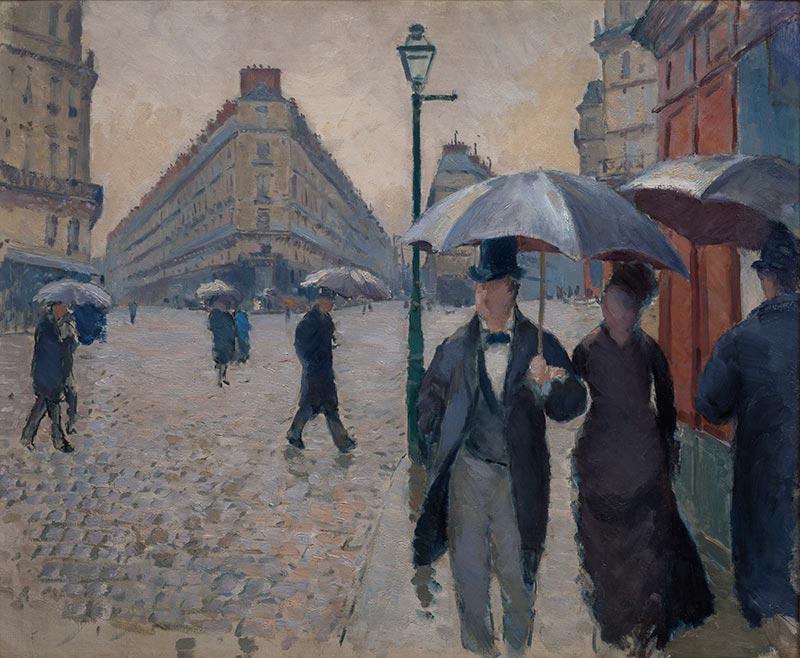
Gustave Caillebotte (1848-1894), Paris Street. Rainy weather1877, oil on canvas, 54 × 65 cm, Musée Marmottant Monet, legacy of Michel Monet, 1966.
© Studio Christian Baraja SLB
Faced with the difficulties caused by weather disturbances, the city is transforming. More precisely, it is the new Haussmannian districts – bourgeois districts par excellence and emblems of urban modernity – which become the preferred scene. It is the introduction of paving stones which, by facilitating the evacuation of water, makes it possible to improve traffic on the boulevards. For painters, then photographers, these wet and shiny surfaces offer the opportunity to play with reflections and light halos (Boulevard Poissonnière in the rainJean Béraud, 1889). But it’s mostly the little oil on canvas Paris street, rainy weather (1877, [voir ill.]) by Gustave Caillebotte who offers a remarkable illustration. In Nantes, there is also a preparatory study for this famous painting where, as critics of the time ironically noted, the rain is absent. And for good reason: it is above all the effects of rain that interest the artist. Among them, the use of the umbrella; while protecting passers-by, it often constitutes a barrier against human contact – unless it encourages them… For Caillebotte, unlike the other impressionists, rain is also a time of melancholy. Let us add that the 19th century was a pivotal moment in the history of innovations linked to the umbrella: this functional object then became a visible social marker.
A little further away, the viewer discovers a group of prints, some of which are very delicate by Utagawa Hiroshige (1797-1858). However, let us end with the rare contemporary works scattered throughout the rooms, the three Showers by Jean Dubuffet (1958). Here, the literal representation of rain gives way to a swarm of black dots on a gray background. A wet dream?