Giverny. Despite this year commemorating the centenary of the death of Claude Monet (1840-1926), the public is not subject to a surge of major exhibitions. In Le Havre, the MuMa will explore the painter’s youth in Le Havre this summer and, in Paris in the fall, the Orangerie will focus on his relationship to time through the series. The only major event, organized by the Musée d’Orsay, is currently taking place in Japan and focuses on landscape. In Giverny, the Museum of Impressionisms had to find a theme linked to its quality as the painter’s most lasting (forty-three years) and most fruitful place of residence. The exhibitions organized so far from this angle have mainly addressed the subject of water lilies. Why, then, not be interested in what preceded it: the installation of Monet’s family on this peninsula between Seine and Epte?
To Giverny to escape creditors
It was therefore over a very brief period – from 1883 to 1890 – that Cyrille Sciama, director of the museum, and Marie Delbarre, who is a conservation research assistant there, worked. This is a turning point in the painter’s life. In 1879, he lost his wife and mother of his two sons, Camille Doncieux. He left for Poissy in 1881, accompanied by Alice Hoschedé, mother of six children, separated from her husband and who looked after a sick Camille a lot. Then, in 1883, the blended family fled the creditors of Poissy to settle in the village of Giverny. The journey shows what this big leap was, far from Paris, agonizing for the painter, then the interest he has in this corner of Normandy and finally the happiness and the beginning of prosperity.
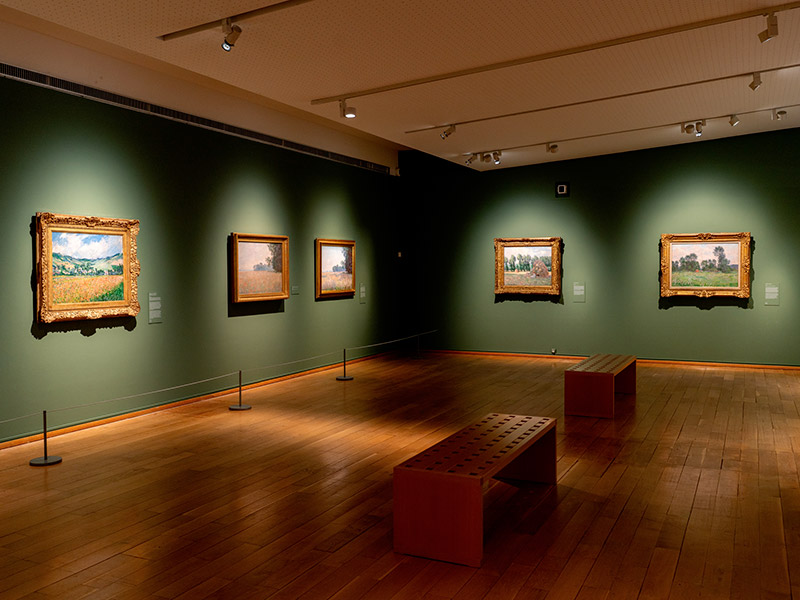
Claude Monet (1840-1926), Poppy fields. Surroundings of Giverny1885, oil on canvas, 65 x 81 cm, Paris, Musée d’Orsay, on deposit at the Rouen Museum of Fine Arts.
© GrandPalaisRmn / Martine Beck-Coppola
Above all, the curators present little-known works that document important changes in the artist’s practice. They are due to his new environment, which Marie Delbarre shows in an essay in the catalog. Monet begins working in series, his gaze moves closer to his subjects or, when he is distant from them, interprets them more and more in almost abstract forms. At the same time, he abandons representations of modernity, factory chimneys or urban crowds. Trains hardly interest him anymore. The Train to Jeufosse (1884) was to appear in the exhibition but its owner, who had agreed to lend it (it appears in the catalog), stopped giving any sign of life when sending the work. We can barely make out in this painting the train that Monet regularly takes to go to Paris.
With this exception, bringing their paintings back to their place of creation has excited institutions and collectors. This is what convinced the Walker Art Gallery in Liverpool to temporarily divest itself of The Epte in Giverny (1884) and Kurashiki’s Ohara Art Foundation to send The Haystack (1885). While it has become very difficult to obtain Monet, these loans – like that of theSelf-portrait of Claude Monet wearing a beret (1886), very well known but rarely shown – was happy news. Thus, this exhibition of less than thirty works (a quarter of which comes from the Marmottan Museum), succeeds perfectly in emphasizing these decisive years.