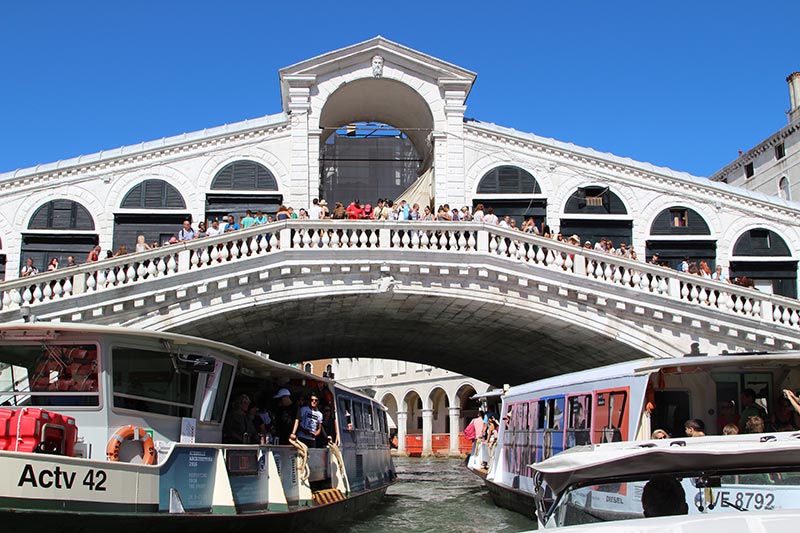
They number in tens of millions each year: tourists saturate Venice and are a real challenge for the municipality. Faced with an influx of visitors which is not decreasing, the new mayor Simone Venturini announced that he wanted to increase the rate imposed on daily visitors by up to €50 (access contribution), exempt from tourist tax levied on overnight stays. The proposal, which must still be examined by the government in Rome, aims to deter daytime return trips and finance the urban costs linked to overtourism.
In 2024, the Serenissima will have more than 75,000 visitors per day in high season. A record attendance which had led the former town hall to subject day-trippers to an entry fee, between €5 and €10 depending on the date of reservation. An unprecedented measure, which the new councilor, in office for less than a month, intends to extend. But after two years of experimenting with the tax, he noticed that the crowds had not decreased and concluded that the current rate was not dissuasive enough.
This increase was one of the key elements of the campaign of Simone Venturini, former tourism deputy to Luigi Brugnaro, his predecessor at town hall. It provides for pricing at the entrance to the city, ranging from €30 for early visits to €50 for last minute reservations, applicable during 60 days identified as busy periods (i.e. 6 days more than in 2025). Only daily tourists residing outside Veneto are concerned. Children under 14 are exempt, as are vacationers planning to stay in Venice. As for the terms, they will remain unchanged: payment is made online, after which visitors receive a QR code, checked on site by agents stationed at the main entrances to the city.
Financially, the results seem positive: 2.4 million revenues in 2024 and 5.4 million in 2025. But the initial objective of regulating tourist flows was not met, highlighting the limits of the system. The opposition points out this failure while putting the economic benefits into perspective: “So far, this ticket has not solved anything: it does not manage flows, does not improve the quality of life and has not even been used to replenish the coffers, because the management costs are equivalent to the revenue” Nicola Pellicani told local daily La Nuova Venezia. The Democratic Party MP also recalls the current legal framework, in which the access contribution is capped at €10, which subjects the application of Simone Venturini’s proposal to the adoption of a new law in Parliament.
For the opposition elected official, tourism management requires more subsidies from the State. The town hall should, according to him, rely on the “Special law for the preservation of Venice” of 1973, voted following the floods of 1966, which gave it a special status of priority national interest. As a short-term solution, Nicola Pellicani suggests “regulate short-term rentals”. In 2019, a study by the academic journal Economia e politica already criticized the measure, still under discussion, arguing that it would contribute to making Venice a “very exclusive”. Its author predicted that the dissuasive effect of the price would act unevenly on tourists, being more effective on low-income groups.
If the proposal arouses controversy, it was able to convince the Venetian Association of Hoteliers, represented by Daniele Minotto. At Nuova Venezia, the latter declared himself “completely agree with Mayor Venturini” believing that it is “normal that those who benefit from the city contribute to its maintenance”.
Overtourism in Venice has been a public policy issue for several years. In 2023, UNESCO once again warned the Italian State on this subject, encouraging it to put in place a strategy aimed at developing sustainable tourism in the City of Bridges, to avoid “irreversible changes to the outstanding universal value of the property”. The access contribution proposed by Luigi Brugnaro’s town hall was presented as one of the responses to this injunction. She managed to convince the World Heritage Committee, which ultimately made the decision not to include Venice in the category. “heritage in danger”.