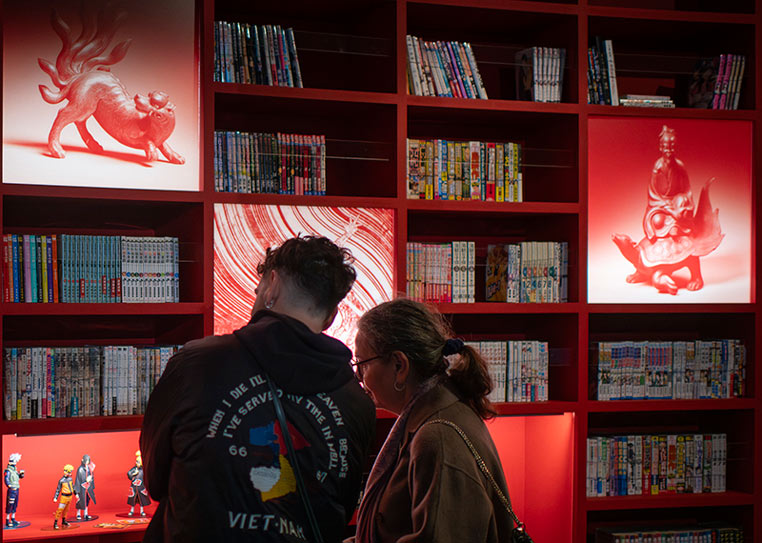
What today embodies the greatest power may be ruin tomorrow, and the art linked to that power will remain under suspicion in that probable future.
For decades, Fernando Sánchez Castillo, a student of the representation of history, especially its episodes of authoritarianism and violence, and what collective memory has made of it, has delved into the relationships between creation, power and its symbols, questioning the past in multiple unanswered questions. This Madrid author has always worked around that same concept, but the theme is never, ever exhausted, because it addresses, at the end of the day, what our present is like and what time can bring us.
A good part of his main projects so far, and the germ of others to come, are part of “The Pilgrim Pearl”, an exhibition that the Reina Sofía Museum dedicates to him in the Velázquez Palace and which has been curated by Ferran Barenblit, already responsible for some of his previous exhibitions at the CA2M in Móstoles. That title is not related to any of the pieces on display, but rather to that jewel whose whereabouts are unknown today, but linked to many chapters of our history, whose journey has allowed the artist to reflect on memory, its transformations over time and the role of creation.
Found in Panama in the 16th century, it arrived from there to the court of Philip II and for several centuries belonged to the Spanish monarchy, until it was stolen during the time of Joseph Bonaparte, it passed through several hands, crossed the ocean and Richard Burton acquired it at auction to give it to Elizabeth Taylor. Upon the actress’ death, it was once again the subject of bidding, but its owner, who bought it for almost twelve million dollars, preferred not to reveal its identity.
This piece was, therefore, a sumptuous object and emblem of power (Margarita of Austria, Isabella of Borbón and Philip III carried it in their Velazquez portraits), but it has ended up becoming a symbol joyfully adopted by mass culture, hence Sánchez Castillo has made it his own to refer to the historical frictions that have illuminated conflicts and unexpected forms of beauty. Like all those to whom this artist directs our gaze in El Retiro: in sculptures, installations, videos and objects that his followers will see, and also in a good number of pieces still in development in the center of the assembly, transformed into a workshop where he himself will work facing the public.
Most of his proposals are linked to the recent history of Spain (dictatorship and transition), although we will also consider works based on traumatic events in Mexico (the Tlatelolco massacre, in 1968) and others that incorporate references to international events. For him, our country constitutes the most obvious and closest example that what is remembered and what is hidden coexist in tension and that power tries to manage both memory and forgetting as one of its strategies of authority. He strives to demonstrate this, to emphasize that there are no univocal narratives of the past nor a monument that cannot be critically interpreted.
For what it offers and for what it does not, and precisely the tour begins by highlighting absences: with figures that he calls expanded memory and in which he represented, in bronze and wood, a Statue of Liberty non-white, a mother from the Plaza de Mayo, the relative of a person who disappeared during the Chilean dictatorship (Cueca Sola), to the activist for democracy in Portugal Celeste dos Cravos, to Tomiko Higa, Navalny or August Landmesser, a soldier modeled with his arms crossed for having refused to salute Hitler. It accompanies them, on a scale close to that of the David by Michelangelo, The tank manthat Chinese protester with the incredible guts to stop in front of the tanks in Tiananmen in 1989, carrying only plastic bags. Sánchez Castillo seems to emphasize that there are heroes without effigy and effigies without heroes.
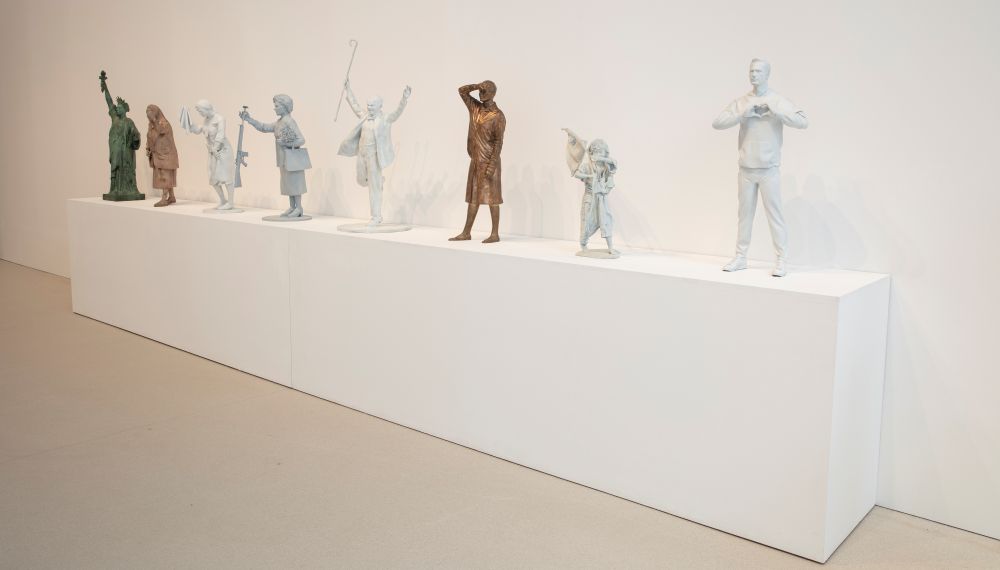
Fernando Sánchez Castillo. Expanded memory figures2017-2026. Photography: Fatima Sanz
Some of them had to wear masks, to protect their fragility or to hide their identity in contexts of violence. A compilation of them, also recreated in his workshop, have arrived at the Velázquez Palace, from those of Pussy Riot to those of Chilean gas. Ultimately, they protect and summon at the same time: they make those who hide behind them anonymous, but they multiply their political projection by potentially turning them into any of us. By making this ephemeral instrument durable, Sánchez Castillo accentuates the strength of those who protest against that of those who repress them.
Not to be missed in this exhibition were his admixtures from the Azor, the boat on which Franco sailed and which Felipe González later used very briefly until, in the face of criticism, it was auctioned and acquired by an individual who wanted to convert it (unsuccessfully) into a motel. An emblem of power in the collective imagination for decades, the artist bought it in 2011 to turn it into scrap metal, reducing the symbol to raw material. Almost to this base material, there are also fragments of famous Madrid monuments that now make up a barricade in Nature of the social; A shift is proposed from reverence to shared experience and nothing remains above our height.
Sánchez Castillo has also brought to the Velázquez Palace reproductions of the bunker that protected the National Artistic Treasure in the Civil War and the sophisticated constructions designed to save various fountains and churches in Madrid, as symbols of the culture to be preserved even when protecting lives was not easy; also a reproduction of Carrero Blanco’s dilapidated car after the ETA attack, that of the hole made to carry it out and that of the enormous resulting crack in the ground, the latter in acrylic on cotton. Other nearby holes are those reproduced in marble that copy La Rambla tiles located in front of a brothel; They correspond to the orifices resulting from the clicking of prostituted women’s heels.
That stone, a noble material, has become an involuntary record of what was not intended to be remembered or could not be further from monumental memory. The same logic responds The man from Melillathe iron and bronze sculpture of an emigrant perched on his fence, a reproduction of a real displaced person who resisted there for hours.
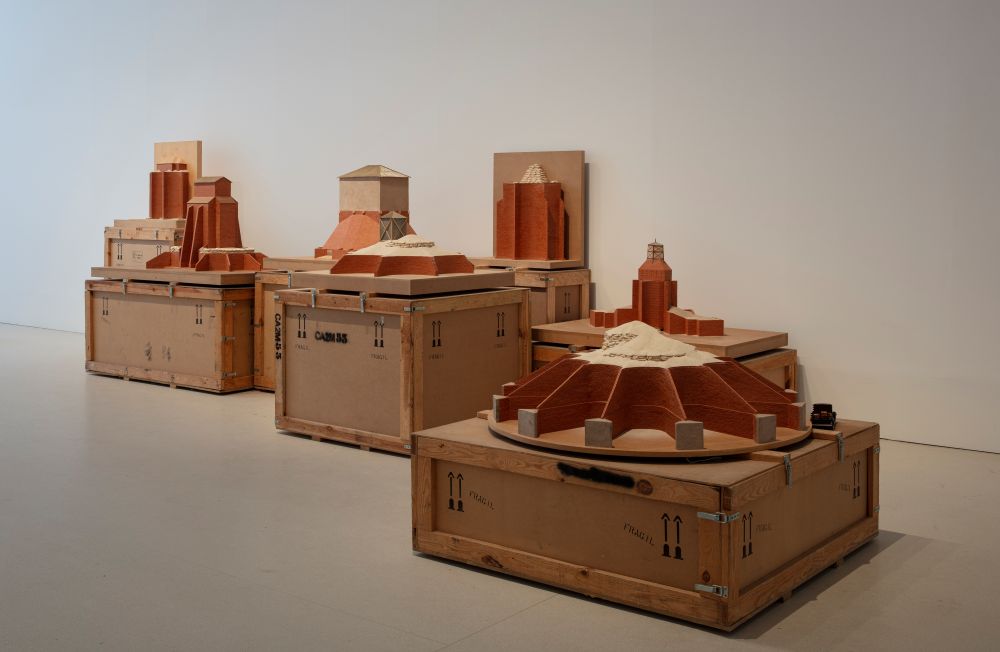
Fernando Sánchez Castillo. Expanded memory figuresa, 2017-2026. Photography: Fatima Sanz
Incomplete or vandalized equestrian sculptures by Franco suggest that we shift our attention not so much to the figures, but to the many possible ways of contemplating them; Other horses were filmed inside a faculty of the Autonomous University, alluding to the control exercised over the students and to the design of these constructions so that the animals could move there. To avoid surveillance, the students used to throw marbles, which we will also see in the video. To the artist’s surprise, the horse in the recording performed a dance in front of the camera to relax, almost disruptive movements in that context.
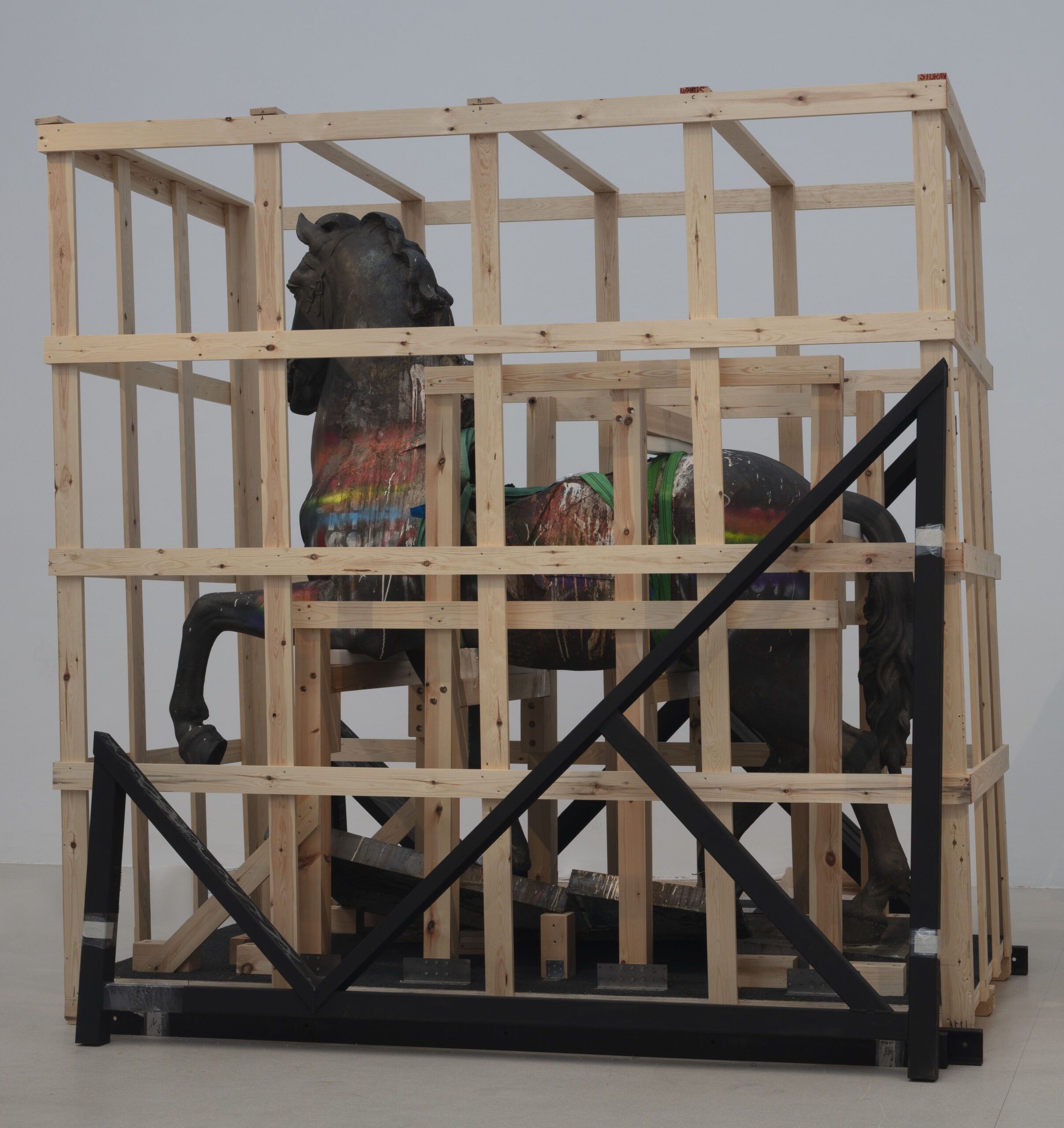
Josep Viladomat Massanass. Horse sculpture, part of the set To General Franco. 1963. Photography: Fátima Sanz
Another set of works also refers to the student context of that time, but to the Mexican one, and to the aforementioned Tlatelolco massacre. In 1968 a revolt against spending on organizing the Olympics left hundreds dead; We will see a video with shots fired in the dark, a carpet with a map of the location of those who shot and the wood carving of one of the humiliated protesters. Sánchez Castillo has also modeled in bronze the corpses of dogs that the Shining Path hung in Lima warning of their sinister intentions; For the artist, they appropriated “communicative” strategies characteristic of the power they claimed to be fighting against.
There’s more: the light bulb Guernica emits in Morse the message “The Prado Museum is more important than the monarchy and the republic together”, a gigantic white flag hangs in front of the base of Torrejón or beautiful abstract canvases were made with wet towels, like those used for torture without leaving marks.
Today Sánchez Castillo has adopted a Duchampian (and not utilitarian) definition of art: creation would be a dialogue between the people of the past and those of the future, and the artist, its intermediary.
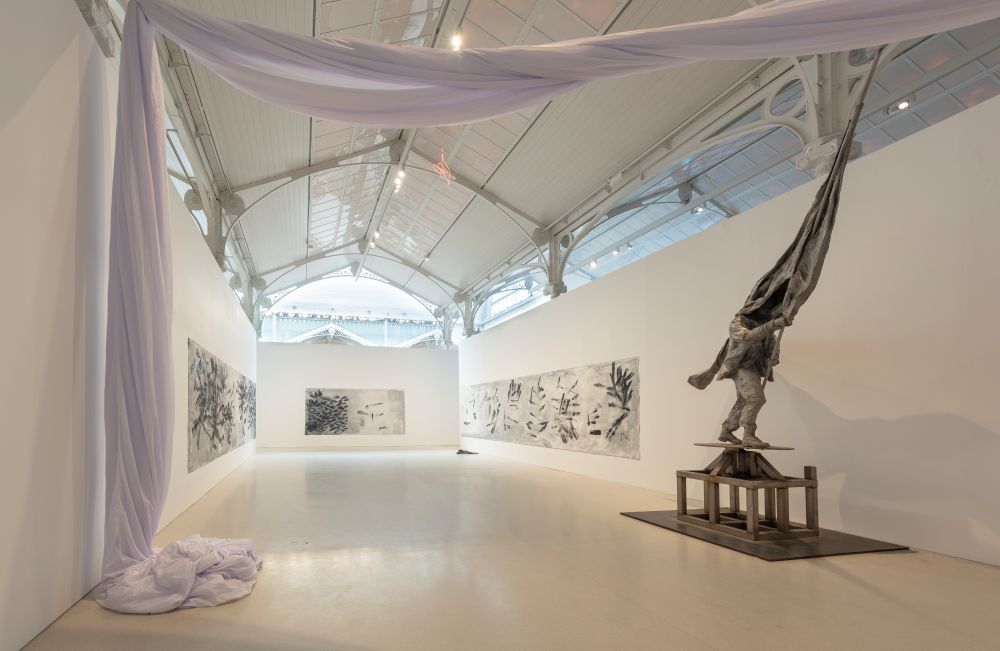
View of the exhibition room «Fernando Sánchez Castillo. The Pilgrim Pearl. Velázquez Palace, Reina Sofía Museum, 2026. Photography: Fátima Sanz
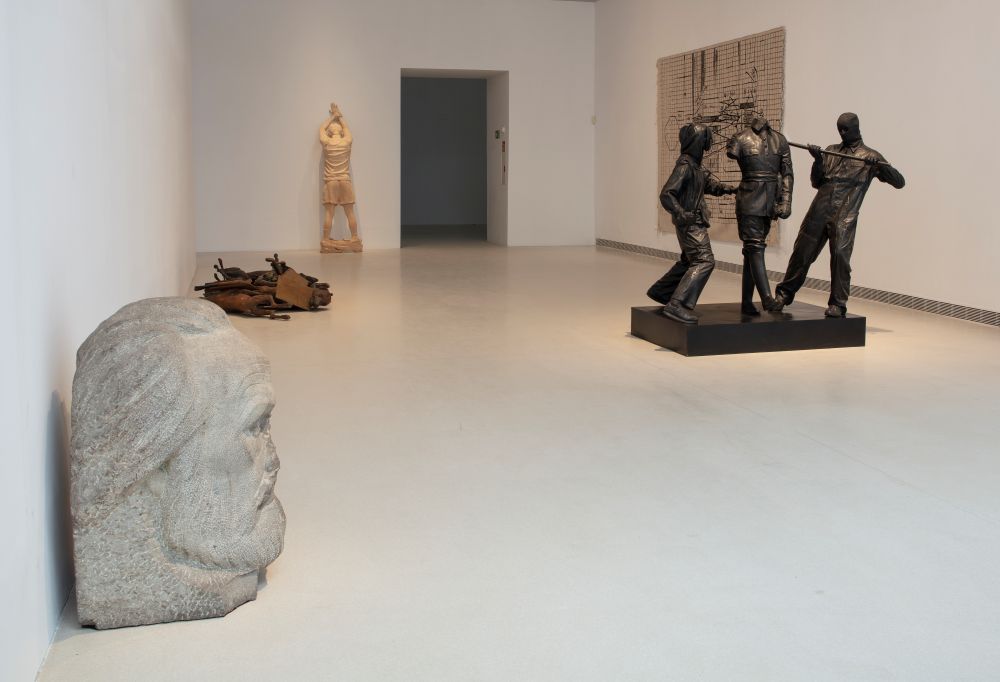
View of the exhibition room «Fernando Sánchez Castillo. The Pilgrim Pearl. Velázquez Palace, Reina Sofía Museum, 2026. Photography: Fátima Sanz
«Fernando Sánchez Castillo. The Pilgrim Pearl
PALACE OF VELÁZQUEZ
El Retiro Park
Madrid
From June 25, 2026 to March 8, 2027