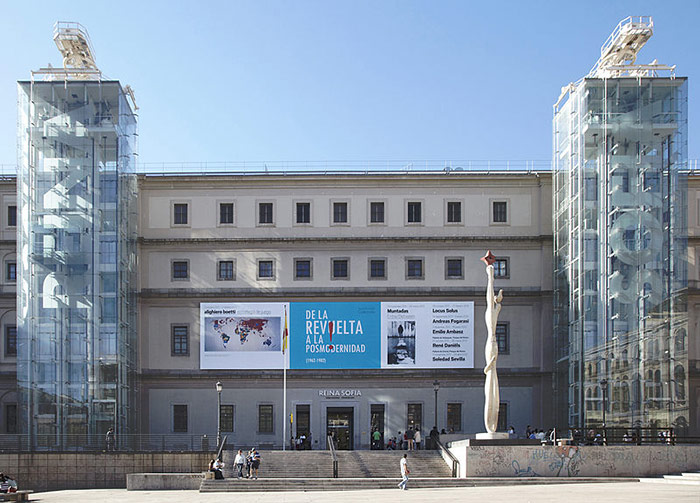
Madrid. In the Spanish capital, the question of the inventory of the Reina Sofia National Art Center Museum (MNCARS) took an unexpected turn. What until now was a matter of internal, technical management, with little media attention, has become a political issue in its own right, closely monitored by Parliament. The joint Congress-Senate commission, responsible for relations with the Court of Auditors, has just adopted a resolution carried by the right, with the support of the extreme right, approved by 20 votes to 13. The Socialist Party, in power, stayed away. The text sets a deadline: December 31, 2026. By then, the museum must have a complete inventory, updated and valued according to the rules of public accounting.
But it’s what happens next that catches the attention. If nothing is done within the deadline, the deputies ask the Ministry of Culture to dismiss the director of the museum, Manuel Segade. The threat is explicit, written in black and white. “The works of art kept at the museum, as well as those which belong to it and are not duly located, cannot continue to be in danger”warned elected officials from the Spanish Popular Party during the debates. We are far from the subdued language usually practiced in parliamentary committees. The representatives of the people also demand that a control be carried out “total and absolute” collections, those kept on site, but also works placed on deposit, those loaned, as well as the location of pieces whose situation is considered abnormal. Monthly reports are requested to monitor progress.
Proofing and economic valorization of works
The National Museum of Modern and Contemporary Art manages more than 25,000 works, including Picasso, Dalí, Miró; and it is no longer just a question of knowing where they are. The verification must now be linked to their economic valuation and their inclusion in the State accounts, in accordance with the general public accounting plan. Bibliographic funds are also concerned: they must be integrated into the same management system as the works.
These requirements continue the long-standing criticisms made by the Court of Auditors, which had pointed out inadequacies in the museum’s internal control systems and traceability difficulties. The question is therefore not new. What is, is the political pressure that now accompanies it. The parliamentarians thus report a donation of works from 2021 of which we no longer have a trace.
Faced with this offensive, Reina-Sofía does not deny the problems. Contacted by Arts Journalits press service indicates that “the museum is engaged in an internal regularization process concerning the inventory, the valorization of heritage, the control of works and the security of the collection”. The museum has also deployed a new computerized management system, called “Artis”, intended to centralize the monitoring of all works – loans, deposits and permanent collection – within a single database.
The problem goes back to the old museum
According to the museum, the problems identified do not fall under current management. The transition of 1988 is highlighted here: “The main anomalies detected correspond to periods prior to the creation of the current museum”, when the collections of the former Spanish Museum of Contemporary Art (MEAC) were integrated into the emerging institution.
This absorption would have generated discrepancies between successive inventories, gaps in the monitoring of certain works, documentary inconsistencies that no one has really had the courage to unravel since. Decades of administrative layers to reconstruct, which is not an excuse, only an attempt at an explanation.