Madrid,
One of the emblems of the photographic collection of the Mapfre Foundation is the Nicholas Nixon series The Brown Sisterswhich in turn is the fundamental project of this author of Detroit that, in its beginnings, followed the path of Henri Cartier-Bresson working with a Leica, but after attending a photography workshop in Aspen-where he would meet what his wife would be, Beverly Brown-he decided to cultivate the great format.
In 1974, the year he settled in Boston, began using an 8 x 10 -inch camera, the same one that he continues to use today and with which he made that series of images dedicated to the Brown, which he would later print in silver jelly. This camera facilitated sharpness in the details and a subtle luminosity that allowed to enhance the feeling of reality that its works transmit. He participated in an exhibition today considered mythical, “New Topraphics”, in the George Eastman House de Rochester and his first individual would host the MoMA; Urban landscapes presented there.
The portrait would become the center of his career since 1977 and his first models were people on the porches of their homes and in friends meetings; Later, he would be fixed in the elderly in residences (since he volunteered in hospitals and senior centers) and in AIDS patients, at the end of the eighties, in the crudest stage of that disease in the United States. The latter starred in one of his books, which collected the lives of fifteen people affected, along with letters and interviews in charge of his wife. These images are among the most exciting of their production; According to Carlos Gollonet, Chief of Photography of the Foundation, their simplicity and roundness makes them shocking; What moves us in them does not depend on their beauty, or the pain they contain, but on those thoughts that become palpable, of the paradoxical and disturbing finding that life and death are presented hand in hand.
One of its most recent series, started in 2000, is dedicated to Couples: Before photographing them, he established with them a climate of trust and some returned to portray them in the passing of the years, according to the procedure of that central project in his career, The Brown Sisters.
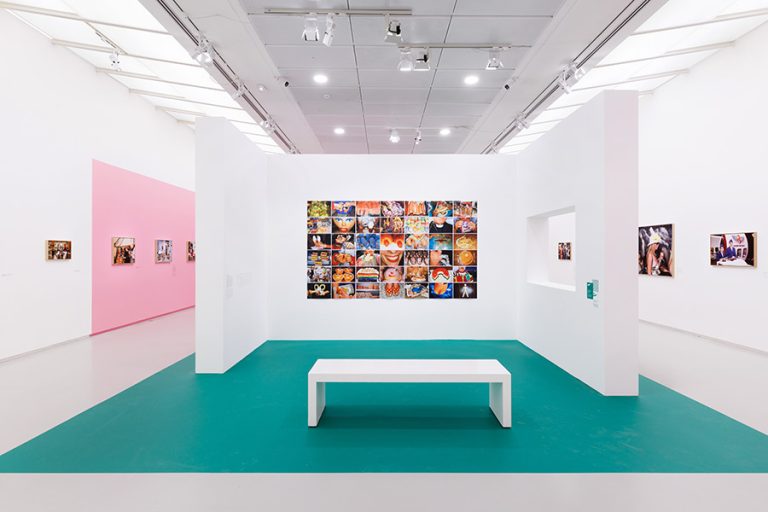
Nixon stars in one of the three new exhibitions of the Mapfre Foundation in Madrid: if he photographed Beverly Brown on numerous occasions, creating from those images a daily meaning of his life in common, he did the same, year by year, with his sisters -in -law. The origin of this practice was in a family tradition: the Brown parents took, also every year, an image of their daughters who used as Christmas greeting and Nixon gave continuity, artistic, to that habit from 1974. The ages of Beverly, Heather, Laurie and Mimi then ranged, that first time, between fifteen and twenty -five.
All his photos took them with a large format camera and maintaining certain common notes: the sisters always appear in the same order (which, by chance, maintained in the first photograph), keep natural poses while looking at the camera and are normally found outdoors, taking advantage of natural light. Today we consider these images a masterpiece of the photograph of the second half of the XX for its clarity and its formal precision, which can be linked to the tradition of the formalism of this discipline in their country.

Occasionally, Nixon is subtly interfering with the images, such as shadow or introducing their fingers in a corner; In this subtle way, he joined the whole as a family member. But the most outstanding note of these photos is the look of his wife, always frontal, because he evidently denotes his complicity.
This series, of a nostalgic air that usually boosts a twilight light, tells us about the irremediable passage of time (in the form of gray hair, wrinkles, closer or more hidden looks -the latter, the very early -), of family ties and an intimacy ceded to the public gaze. The success of the whole, and its historical character, does not depend only on Nixon, also on the sisters themselves, who pose with obvious freedom (beyond that constant disposition) and, in addition, they participate in the choice of the shots that will be rescued.
The exhibition that the MAPFRE Foundation dedicates to the team in Madrid is the first to compile, internationally, all the portraits of this proposal. The last one was taken in 2022, when the series concluded by collegiate decision, although Nixon did not plan to finish it until he missed.
In the background, these images also inform us of our ways to contemplate the progress of the years. They capture the surprise or disappointment that can cause us that almost nothing remains unscathed, that everything is subjected to ruin and also that becoming, not known, do not stop hurting and, in most cases, we do not cease to oppose resistance to decrepitude. In their compositions we see how faces look gradual, but inexorably, determined by ages and sorrows, but we can also appreciate how, in turn, much in these faces it remains identical to itself: the presence of each individual resists on those faces and protects others.


Nicholas Nixon. “The Brown Sisters”
Mapfre Foundation
Recoletos Paseo, 23
Madrid
From June 5 to August 24, 2025