
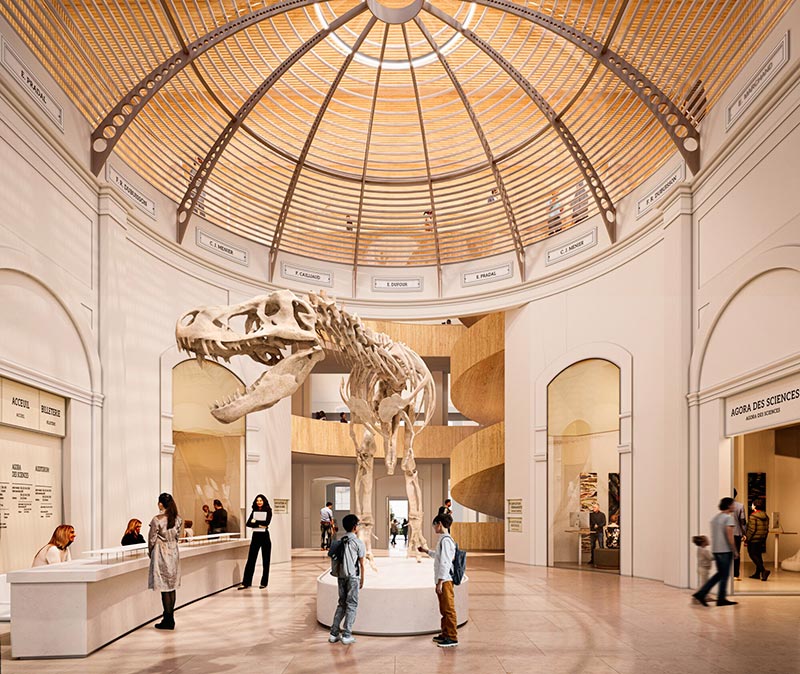
Nantes (Loire-Atlantique). An enlarged route, completely redesigned, faithful to the 19th century aesthetic of the place… The ambitious architectural project of the Museum of Nantes is now entering concrete form. Since the beginning of November, the establishment has kept its doors closed and has been busy preparing its site. Scheduled to last three years, costing 46 million euros (90% financed by the Metropolis), the work will begin next year in parallel with the moving of the collections. A long and meticulous step, especially with regard to the dismantling of the imposing whale which, like the other parts, will lie dormant in external reserves during the operations.
Energy renovation, accessibility: the project – led by the Moatti & Rivière agency – includes a complete restoration component for the building which has become dilapidated. But the biggest axis concerns the complete reconfiguration of spaces. Frequented by more than 150,000 visitors on average each year, the Museum suffers from the cramped conditions of its rooms. On the program therefore, no extension but a redevelopment of the existing: the building has vacant premises and a large unused space, where two additional levels could be built without affecting the height of the ridge. The partitions will be removed, and the frames redone to take advantage of the attic and create a brighter space. The areas open to the public will almost double, going from 2,200 m² to almost 3,900 m².
Architect’s view of the facade of the future Museum of Nantes.
© Moatti & Rivière
Overhung by a large glass roof, the future reception dome will house the flagship piece: a sauropod skeleton, which the museum team is currently unearthing in Wyoming in the United States. “We really insist on the real object and not on its representation, even if there will also be some casts, specifies Philippe Guillet, the director of the Museum. It is a real change in discourse that will take place, with a new path related to environmental issues, which will prioritize storytelling. » From the origins of the Earth to the Anthropocene, integrating the essential issues of biodiversity and climate. “We will also call on artists to address some of these themes, which are sometimes complex to understand,” he adds. New specimens (botanical, minerals, fossils, naturalizations, etc.) will be deployed in this new circulation, which takes the counterpoint to the current one where “there was no overall coherence, (Or) everything was confused.”
Adjoining the seven historic galleries, six contemporary alcoves will be fitted out with modular equipment, to allow them to be updated frequently. It is also planned to create a “agora of science” (a media library), a new shop, a café with terrace… Because Philippe Guillet insists: “Our desire is really to open the museum as much as possible. To make it a pleasant place, which the visitor can enter easily, without apprehension. »


