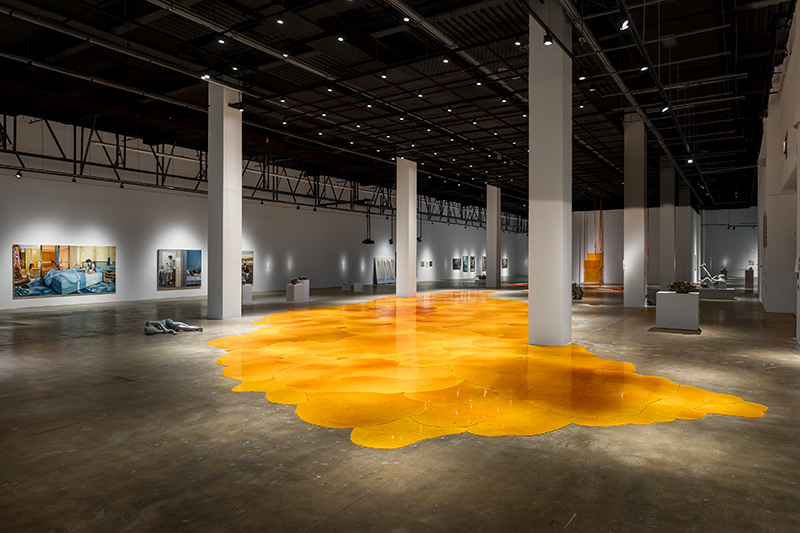
Gwangju (South Korea). Inaugurated on September 5 the 16th edition of the Gwangju Biennale is distinguished by its tight format, bringing together 43 artists, compared to 72 during the previous one, designed by Nicolas Bourriaud. For its artistic director, Ho Tzu Nyen, this reduction aims to intensify the visitor experience, while reinforcing curatorial coherence, facilitated by the grouping of works in a single location, the Biennale exhibition hall. Known for his video work, where scenography takes center stage, Ho says he considered this mission“like an artist”
surrounded by a curatorial team composed of Che Kyongfa, GaHee Park and Brian Kuan Wood. Ho Tzu Nyen is interested in the transformative force of art. Inspired by Rilke’s poem, the injunction of the title is expressed in a Korean and contemporary context, to offer a reflection on the human condition and our relationship to time. You must change your life (Du musst dein Leben ändern) concludes the sonnet Archaic torso of Apollo (Archaïscher Torso Apollos),
written by Rainer Maria Rilke in 1908.
A route designed in five spaces
Ho structured the exhibition around the idea of change, methodically presented in five successive spaces. While the choice of a German poem contrasts with the prevalence of Asian culture in his work, it nevertheless underlines the ambivalence of this injunction in the Korean context and, more broadly, in the Far East.
Amanda Heng’s photographic series thus takes on its full meaning. Produced over three decades, it consists of portraits of the artist and his mother, until her death. Unvarnished, through everyday scenes, Heng depicts a matriarchal lineage whose rarity she highlights within her own Sino-Singaporean culture. The Korean context is explored in particular through the memory of the Gwangju democratic movement, crushed bloodily in 1980. But the memorial approach here strives to go beyond the trauma thanks to a series of paintings produced by members of the May Mothers House, a local collective of victims who uses art for therapeutic purposes. This political dimension continues with Jùlius Koller and his installation of ping-pong tables, designed in response to the repression of the Prague Spring in 1968. The sport and its rules, common to the adversaries, become here the symbol of peaceful resistance against authoritarian power. The video by James T. Hong (see ill.), which compiles public apologies from political figures from the 1970s to the present day (from Nixon to Pope Francis, via Clinton, Chirac and Macron), extends this reflection on great history. For Ho Tzu Nyen, “we sometimes associate change with a rupture, a violent form of change, when we do not perceive the changes which are part of the long term”. Tehching Hsieh’s pioneering performance,Time Clock Piece constitutes a radical illustration of this. Between 1980 and 1981, the artist clocked a clock every hour, day and night, for 365 days. This expansion extends to geological time, approached through volcanic stones from the island of Jeju which, thus exposed, acquire the status of rocks of scholars, even of
James T. Hong, Apologies, 2012-2026, video projected on the facade of the building hosting the Gwangju Biennale. © Jeon Byung Cheol James T. Hong,Apologies
2012-2026, video projected on the facade of the building hosting the Gwangju Biennale.
© Jeon Byung CheolVideo works occupy a preponderant place. That of Saodat Ismailova, evoking the memory of the rebel leader Al-Muqanna in the 8th century, seduces with its visual and sound mastery. Rafik Greiss’s installation, designed like an altarpiece with its three vertical screens, depicts the artist’s experience with Egyptians engaging in Sufi rites of circumambulation. This evocation of transcendence, between earthly life and spiritual aspirations, offers poetic mediation on our relationship to the cosmos and the immaterial. Three videos by Lu Yang, with almost frenetic editing, borrow from the aesthetics of video games and animation, while deploying a particularly inventive graphic universe. With Wang Tuo, they maintain a Chinese presence at the Biennale, despite China’s official withdrawal following the controversy surrounding the “Taiwan pavilion” ( LeJournaldesArts.fr
of September 4, 2026).
Erratum – Thursday October 8, 2026 Contrary to what was published in the
JdANo. 684, the 16th Gwangju Biennale was inaugurated on September 5 and not November 5.