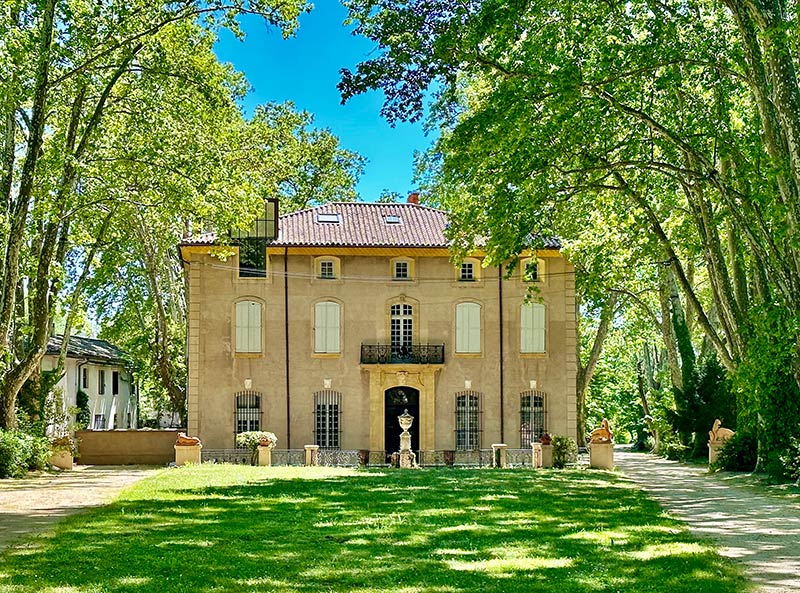
Aix-en-Provence (Bouches-du-Rhône). What kind of painter Cézanne wanted to become at 20? The answer to this question was hidden behind the coatings of a large building at the exit of downtown Aix-en-Provence, and could never have been revealed if Louis-Auguste Cézanne had prohibited his son from drawing on the walls. Over several surveys and restoration campaigns ordered by the city, the remains of large murals appear in the jas of Bouffan, this agricultural property in which young Paul grew up.
These are the testing of the one who is called to revolutionize his art: in the JAS fair, the public discovers the fragments of a fairly ambitious program around the four seasons. Over the surveys, this cycle is reconstituted by fragments, that of a port entrance, or a painted medallion discovered in the spring. Fragments that allow the city to expand its Cézanne heritage, celebrated this summer by the event year and an exhibition at the Granet museum.
But beyond this 2025 programming, the city wishes to make Jas de Bouffan an essential heritage site in the region, by investing more than 10 million euros, and by considering an objective of 120,000 visitors per year. “” We are at the dawn of the creation of a major heritage site, one of the most beautiful houses of artists in the country ”promises Pierre Laforest, recruited last summer to administer the Cézannian sites of the city. The year “Cézanne 2025” offers visitors a taste of what this experience will be, by opening the ground floor to guided tours. A success, with gauges fulfilled at 100 % and a target of 44,000 visitors which will be widely exceeded.
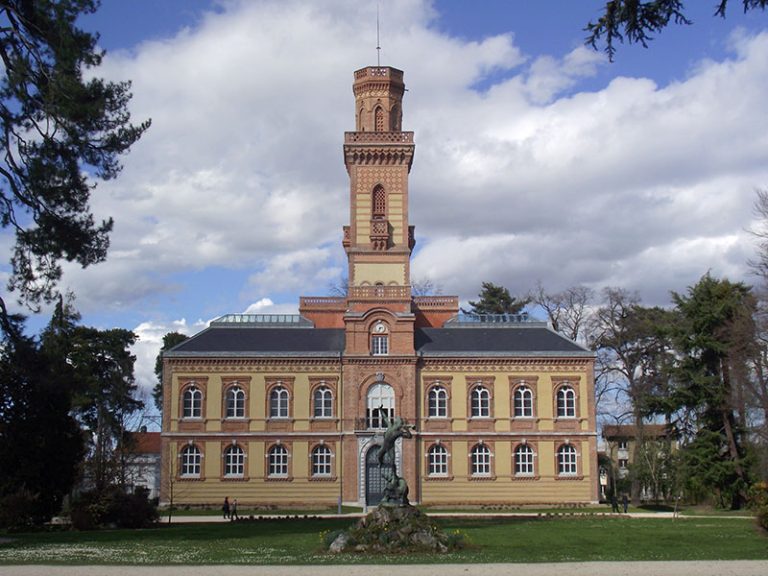
Paul Cezanne (1839-1906), Bouffan jas house and farm1885-1887, oil on canvas, 60 x 73 cm, Prague, National Gallery.
© National Gallery Prague 2025
However, this minimum opening does not correspond to what the city had first considered: going from surprise to surprise during the catering site, Aix-en-Provence made the choice of prudence. “We preferred to open fewer things, rather than opening badly and causing irreversible damage”explains the location manager. The vestiges of the pictorial program that adorned the large living room led the city to consider each bastide wall as a potential heritage element: each of the pieces has been the subject of preliminary studies, through stratigraphic cuts to go back in time, and find the “Cézanne” states of the inner decor. A long and tedious work, as was the release and restoration of the painted elements, produced by the Sinopia workshop.
A first phase ended shortly before the opening of the 2025 season, with the structural recovery of fragile floors, the treatment of the clos and the cover and the adaptation to the standards of this aging building to accommodate the public. This can already discover the large and small living room, as well as the kitchen, in which a projected mediation device makes it possible to understand the adventures of the large found decor, of which whole sections have been torn off and kept in private collections.
During phases two and three of the site (which will take place during the winter of 2025-2026, and 2026-2027), complex catering choices will have to be settled, as in this room upstairs where the wallpapers of the 19th century were found. Assisted by the DRAC, the Aix heritage service will have to determine whether this decor should be returned with new wallpapers, or restore those that are still in place. “A real ethical, and financial choice, underlines Pierre Laforest. A restitution is a significant cost, but a restoration is a huge cost! »»
Future sites
In the fall, the city will already be able to open two new equipment in the vast Bastide park (see ill.), An amphitheater as well as a farmhouse welcoming the educational space, the premises of the Cézannien de Research Center and the Archives of the artist’s reasoned catalog. It will then be necessary to wait until 2027 that the site has its final entrance pavilion, replacing the temporary installations used this summer.
Giving the visitor to climb the elevation which exists between the avenue de l’Europe and the estate, this pavilion, designed by the agency eight and a half, will be a little more than a shelter for bad weather, by framing the views on the garden painted by Cézanne. The museum development finalized in 2027 in JAS will be available in three themes: the history of the Bastide, the forty years that Cézanne will have spent there, and its current restoration. One way, for the city, to enhance this vast heritage project that she wishes to be exemplary.