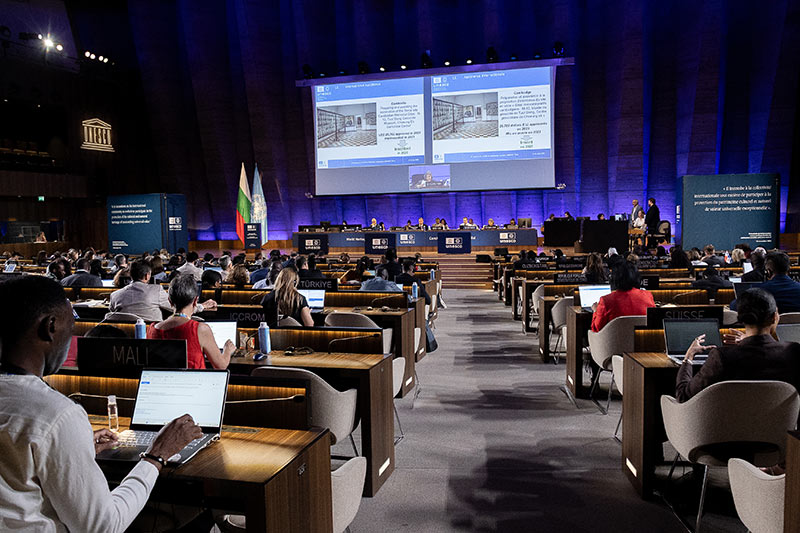
World. Cornemuse, Binious and Bombardes … On Saturday July 12, the bagad of Carnac disturbed the calm of police, but also disputed exchanges, of the 47th session of the World Heritage Committee, held at the UNESCO headquarters (Paris), from July 6 to 16 (see ill.). Celebrating the inscription of the megaliths of the Breton seaside resort on the World Heritage List, the noisy orchestra then interrupted the discussions on the inscription of the Château de Neuschwanstein in Germany: two candidacies which access the coveted list without difficulties or debates.
For these two European files, ICOMO’s favorable opinion – Committee’s advisory body, assessing applications for the assembly of diplomats – has not posed any problems. But other cultural goods promised to a candidacy referred or deferred by ICOMOS have been the subject of long discussions, leading to an inscription … despite the recommendations of heritage experts. A case now banal during the committee sessions, but which culminated during this last meeting.
With the registration of the Emirati site of the Faya Paleo-Paysage (see ill.), It is a file whose ICOMOS recommended the pure and simple non-registration (its most severe appreciation, prohibiting the whole new candidacy) which accesses the list of World Heritage. Despite this uncompromising assessment, completely rejecting the demonstration of exceptional universal value submitted by the United Arab Emirates, it is the delegates of the member countries of the committee: Zambia, Lebanon, Senegal, Ukraine, Kenya, Rwanda, Argentina, India, Bulgaria, Greece, Kazakhstan, and Turkey Only voice the evaluation of UNESCO experts to register the site.
Faya Paleo-Paysage with the United Arab Emirates.
© Institute for Heritage Management / Stephanie Veith
The case is rare (even unprecedented), since such an assessment normally invites the state carrying the candidacy to withdraw the file. When he still tries to submit his candidacy before the Committee, it is a failure, as was the case for France with the chain of Puys Auvergne, in 2014. Diplomatic negotiations took precedence over the heritage expertise of ICOMOS (Cultural Heritage) and IUCN (natural heritage) for a few years, authorizing hope for files condemned by the two advisory bodies.
The referral assessments (request to supplement the file within three years) or of postponement (request to submit a new file) are thus generally no longer followed by the member countries during the sessions of the 2020s’ Committee. This year, two proposals for which ICOMOS demanded a new file were thus registered: the Mérathes military landscapes (India) and the Buddhist monuments and landscapes of Yên Tu (Vietnam). During the registration of the latter good, the proposal to conduct an impact study of tourism on heritage, carried by Lebanon, was even firmly fought by India, which saw it as a lack of confidence in the state of Vietnam.
Because the decisions of the Committee are indeed anchored in a rise in power of the countries of the “global South” within UNESCO-deserted again by the United States this year-which opens the way to a challenge to the opinions of ICOMOS. Recognized as a central problem of the World Heritage List since 1994, the problem of the over -representativeness of European countries in the list – just like the alleged Eurocentrism of heritage expertise – was put forward by Zambia, Qatar and Turkey to defend the registration of the United Arab Emirates site. But the weakening of the authority of scientific experts also benefits European files, submitted by countries already well represented, such as this year Greece and Italy.
Relaxing this project to rebalance the list when it arrived at the post of the Director of the World Heritage Center at the end of 2021, the Cameroonian architect Lazare Eloundou notably made the African continent his priority. The least well represented region, Africa benefited from two inscriptions during the 47th session, with the cultural landscape of Mount Mulawi in Malawi, and that of the Mandara Monts in Cameroon. A first result of training and support efforts to local professionals started by UNESCO, and an event of Nairobi orientations adopted last May: a complement to the concept of authenticity adapted to the African context, connecting cultural sites to practices and communities. During the last five sessions, African inscriptions were extremely rare, and responded to a European heritage conception: ruins and archaeological sites of Ethiopia or Kenya.
But rebalancing will also go through a lower number of registrations for countries already well equipped … and France must prepare for it. While UNESCO invites European countries to slow down the pace of inscriptions, France continues to obtain the registration of one to two sites per year. A sustained cadence which will be made impossible by UNESCO from 2027, with the introduction of preliminary assessments: a single candidacy per state will be authorized to follow this three -year process, during which ICOMOS and the Committee will evaluate the proposal continuously. Other countries have already prepared for this slowdown, such as the United Kingdom, which presents only one file every three years, and has largely housed in its indicative list, the anteroom of official applications, holding only five goods. France has 32 potential candidates on this list, which is now like a purgatory.