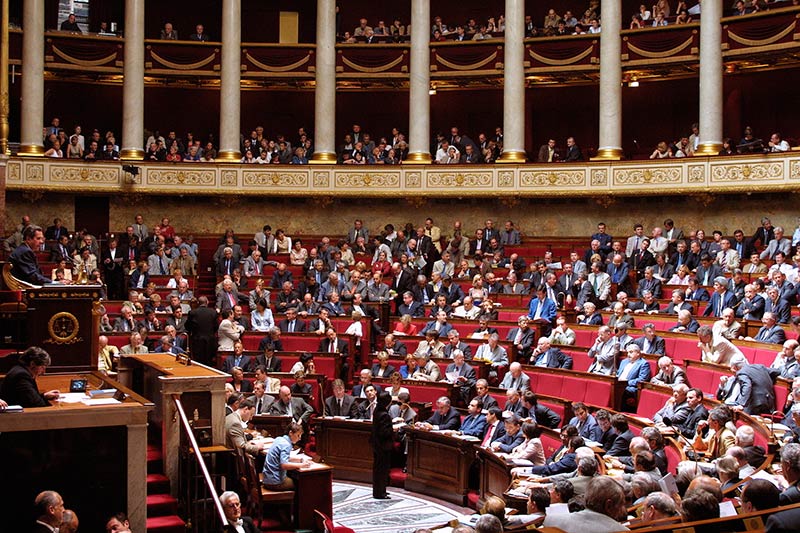
The Senate unanimously adopted, on May 7, the conclusions of the joint committee (CMP) on the bill relating to the restitution of cultural property that has been the subject of illicit appropriation. The deputies had approved the text the day before, on May 6, after the agreement reached in the CMP on April 30. This final adoption completes a project initiated by the Ministry of Culture from 2023 and paves the way for the promulgation of the law by the President of the Republic, unless referred to the Constitutional Council.
The text, tabled in July 2025, was adopted at first reading by the Senate on January 28, 2026, then by the National Assembly on April 13. It establishes a general framework allowing the restitution, without recourse to a specific law each time, of goods preserved in French public collections when it is established that they were acquired following looting, theft, forced transfer or any other illicit appropriation.
Until now, the restitution of property belonging to the public domain required the adoption of a specific law, as was the case for the twenty-six works returned to Benin in 2021 or for the Djidji Ayôkwé talking drum returned to Côte d’Ivoire.
The new law introduces into the Heritage Code a general exemption from the principle of inalienability. It concerns goods entered into public collections before the most recent international instruments, in particular the UNESCO Convention of 1970 and its implementation in French law. France thus equips itself with a permanent mechanism, comparable to those already put in place in several European countries.
The compromise adopted is based on a strongly regulated procedure. The request must be presented by a foreign state. A bilateral scientific committee will bring together French and foreign experts to establish the circumstances of the acquisition and examine the historical and heritage significance of the file. Its report will then be submitted to a national commission for the restitution of cultural property, a new permanent body made up of parliamentarians and qualified personalities. On the basis of this opinion, the Government may pronounce the removal from the public domain and the restitution by decree subject to prior legal control by the Council of State.
The rapporteurs, senator Catherine Morin-Desailly and deputy Frantz Gumbs, agreed on a text which retains the architecture of the Senate, keen to reconcile political openness and scientific guarantees, while incorporating several additions from the National Assembly.
Debate on the origin of the request
The National Assembly wanted to clarify that a State could act on behalf of a “human group” present on its territory and whose culture remains active. Such wording would have led to the implicit recognition of non-state actors as direct interlocutors of France. The CMP retained the Assembly’s formulation while maintaining the fundamental principle of exclusively interstate restitution. This solution aims to take into account indigenous peoples or traditional communities, without calling into question the sovereignty of the requesting States.
Conservation conditions finally ruled out
Parliamentary debates also focused on the advisability of making restitution subject to commitments by the beneficiary country concerning conservation, security or presentation to the public. The deputies had introduced such guarantees; the CMP ultimately removed them. The rapporteurs considered that these requirements were contrary to the spirit of the framework law, based on the recognition of illicit appropriation and not on a negotiation of conditions.
Parliament without the right of veto
The question of parliamentary control was one of the sensitive points of the CMP. The National Assembly had introduced a mechanism allowing the culture committees of the two chambers to decide by a binding vote on each restitution request. In the event of negative votes representing at least three-fifths of the votes cast, the request would have been deemed rejected. The CMP removed this parliamentary veto, deemed contradictory with the very purpose of a framework law and fragile with regard to the separation of powers.
Parliament will nevertheless remain involved in two ways: through regular information to the Government on the requests received and through the presence of two deputies and two senators within the national commission. However, in the event of a politically sensitive issue, nothing will prevent the use of a specific law.
A more flexible composition of scientific bodies
The National Assembly had provided for a “parity” composition of the bilateral scientific committee. The CMP preferred the term “balanced”, considered more operational. This nuance will make it possible to adapt the composition of the committee to the skills actually available, particularly when certain disciplines are poorly represented.
The search for provenance enshrined in law
The text explicitly establishes the search for provenance among the missions of the Museums of France. This provision, largely consensual, reinforces a practice which has developed in recent years, whether it concerns colonial spoliations, war acquisitions or works passed through the art market under obscure conditions. On the other hand, the CMP removed the obligation envisaged by the Assembly to publish each year the list of works likely to be subject to restitution, considering that such publicity could create legal uncertainty.
The Ministry of Culture welcomed a “historic step”, believing that this law provides France with a coherent architecture for processing restitution requests sent by foreign states.