Santander,
Nuno gives Luz, a Portuguese artist born in 1984, has focused his work on sound creation, linked to ecology and study of noise, and has compatible with his work as an editor and as a researcher. In 2015 he received one of the art scholarships from the Botín Foundation, which allowed him to participate in Paris in a program of the Institute of Studies Po, dedicated to art and politics: there he launched Shanghai radioa radio broadcast project that installed in the Théâtre des négociations; He simulated, together with international students, negotiations on the climate, symbolically appropriating a small space of the electromagnetic spectrum to refer to our possibility of recovering our lives more sustainably and also our ways to communicate. The time of the work was timed attending at the solar noon, the tides and the local sunsets.
This summer, a decade later, da Luz has returned to Santander to join the program Tanglesthat the Botín Center offers its scholars, in order to support its trajectories. This artist has sought to convert the building that Renzo Piano designed for this museum into an acoustic body capable of reverberating and expanding the sound frequencies of the waves, winds and currents of the bay where it sits. His pieces are also proposed to enrich the resonances of a selection of works from the Botín collection, corresponding to Javier Arce, Katinka Bock, June Crespo & Madi Barber, Tacita Dean, Eva Fàbregas, Asier Mendizabal, Damián Ortega and Jorge Sato Sato.
It was expected that Nuno’s proposal linked the building with its surroundings: after all, its creations have always approached both the developments of environmental art and the intensities, patterns and rhythms of the tides, the wind or the evolution of the climate and, in fact, to all the bodies involved in the sounds that surround us: humans and those that are not, natural and artificial.
In the Botín Center we can pay attention, not only visual, to two new sound facilities that it has produced together with the Botín Foundation: it continues to study in them the possibilities of sound when revealing architecture as an entity that resonates and is transformed by perceptible and imperceptible paths. In these creations, the sound acquires the role of a force that allows the atmospheric conditions of the Santander Bay to the interior of the rooms to be transferred.
On the one hand, Bay of Santander Sonic Province Service Translate the environmental data of the Bay of the Cantabrian capital, in sound and vibrations, through the walls of the exhibition rooms. These data are provided by the Oceanographic Center of Santander and include the activity of the waves, currents, wind and temperature of water and air in oceanic waters in front of the city; In addition, they amplify the building’s own vibrations, evidencing its intrinsic energies.
On the other, COLLECTED AIRS (AIRES COLLECTED) In different improvisations of artists and musicians of the Portuguese context. This work, produced with the support of the Portuguese Embassy in our country, consists of a set of reverberation units (extensive suspended steel plates, equipped with a transducer that converts audio signals into physical vibrations). This instrument has been commonly used in recording studios to add spatial depth, but Da Luz has preferred to use said reverberation unit as a sculptural presence that interacts with its environment and can work more or less as a stopwatch. He has invited, in fact, those musical performers of his country to improvise and play with each reverge unit: the performance of each has been recorded and reproduced through the plate that has been assigned in the Botín Center.
The plates, in addition to transmitting these actions, resonate with a live transmission of environmental sounds from abroad; Each serves, in this way, as a musical registration and as a time mark, preserving the traces of a specific moment.

As for the links between their works and those of the booty funds, it gives light speaks of Resonances by sympathyin reference to the phenomenon by which an inert object vibrates in response to a close harmonic source with similar harmonic. The first are seven sculptural masks of Damián Ortega made with everyday objects and materials that refer, for the Portuguese, to the potential of the metamorphosis and the reciprocal connection with other beings.
Thanks to a scholarship of the Asier Mendizábal loot he could perform Signals, Calls and Marches: He offered a drummer, instead of a score, a written essay on the history of different musical movements (jazz, punk music), next to a description of the Aristrain town, a Basque neighborhood built in the sixties for the families of the employees of the factories. According to Nuno, the conductive thread that Mendizabal proposed between jazz, punk and military aesthetics is important to understand an underground history that connects the resistances to power in the United States and Europe.
We will see too Feuilles of earlyby Katinka Bock: copper leaves suspended from the ceiling that were originally the dome of the dome of the Anzeiger Hochhaus building, built in the twenties in Hannover. Bock recovered them after being discarded during renewal works and Nuno has valued his past and noises.

Oozing 3by Eva Fábregas, it is a sculpture elaborated with inflatables entangled whose skin resists the pressure produced by the air that contains inside. He has in common with the creations of Da Luz his claim to materialize the physical effect of certain sound wavelengths, in our body and our intestines, and refer to how they could interact only with the billions of bacteria that make up our intestinal flora.

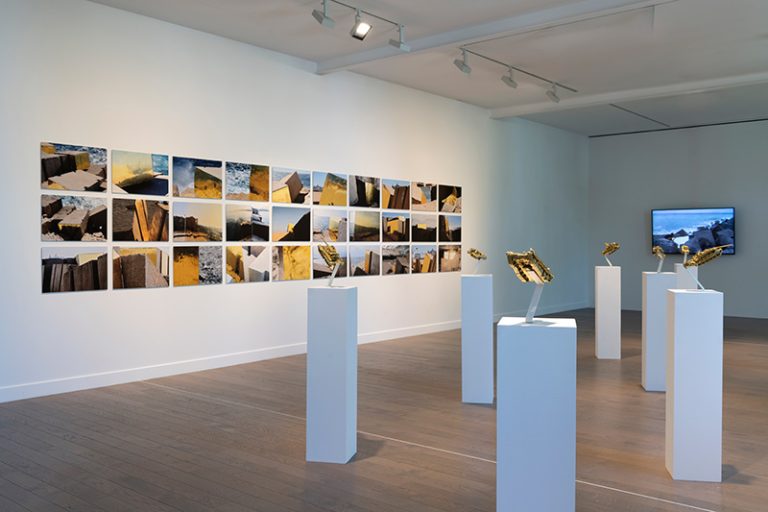
The exhibition also hosts a serious paintings by Javier Arce: About the near. They are inspired by a hut of shepherds in the mountains of Cantabria, where the author lives, and in them nature is one more character, sometimes near and sometimes elusive, as in Nuno’s pieces. Very close, the sculptural installation of Jorge Sato Formal encounter in the garden Explore the archive of the cartoonist Miguel Covarrubias, deposited in the house of the architect Luis Barragán. That artist was fixed above all in the sketches of hands and feet and vases and vessels to carry out a hundred objects in cooked mud, turning them into volumes. If he sought to make sense of fragments and remains through speculation and hypothesis, it gives light uses sound as a record that can also be archaeological, although more fleeing. While, Coreby June Crespo and Maddi Barber, it is a video that documents the different states through which the material passes: stone, dust, liquid and solid; In it, hands that run and manipulate cement sculptures coexist with the process of extraction and transformation of stones into a quarry.
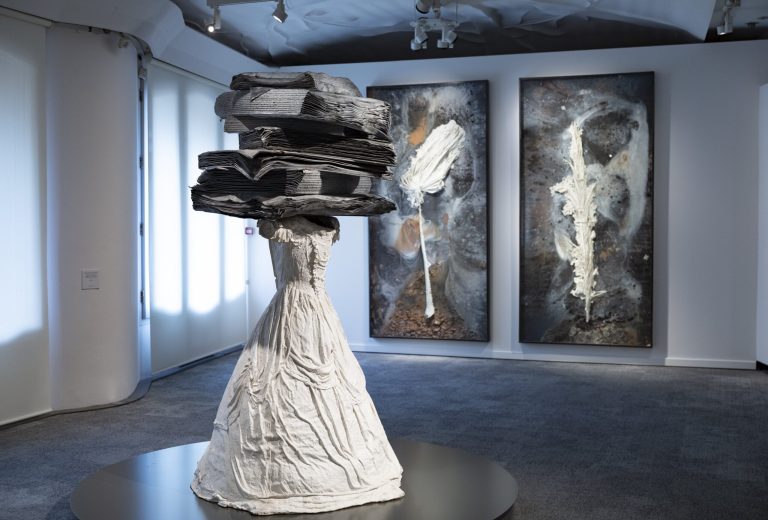
Finally, since their student time they were interested in Nuno the drawings on Tacita Dean. The two panels that integrate The Wet Prayer They were created in 2013, in Santander, when Tacita exhibited at the Botín Foundation, and when accompanied by the sounds of the Cantabrian Sea emitted by Nuno membranes they charge strength. According to the Portuguese, more than most of the representations of ocean waves that I know. And I have been obsessively recording the sound of ocean waves for several years. I can only expect everything ears and listen carefully to your restless and incessant roar.

“Tangles II: Nuno gives light”
Botín Center
Emilio Botín Square, s/n
Pereda gardens
Santander
From May 31 to October 19, 2025