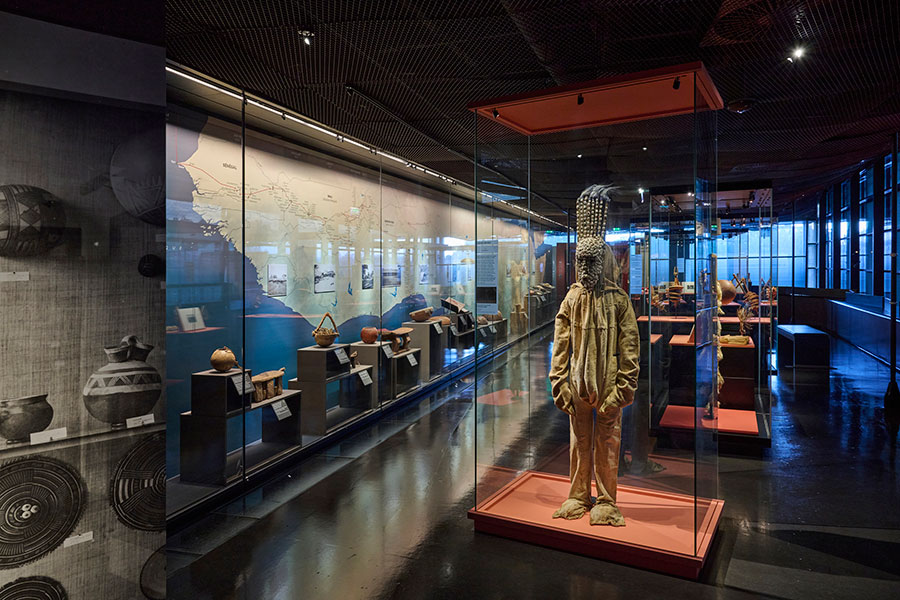
Paris. As Emmanuel Kasarhérou, president of the Quai Branly museum specifies, the exhibition chooses to “Show everything” From this mission, including the darkest aspects. Because of the 3,600 objects reported from Africa in 1933, how many were stolen or looted? From the colonial context to contacts with the communities of Mali or Ethiopia, the commissioners of the exhibition “Mission Dakar-Djibouti” and the scientific committee opt for transparency, based on archive documents and notes in the researchers. The title of the exhibition gives a judicial varnish to the approach, and it is no coincidence: the general commissioner, Gaëlle Beaujean, says she was inspired by the novel by Kamel Daoud Meursault, counter-investigation (2014, Actes Sud). There is therefore a question of clues, evidence, interrogation, the terms used on the cartels and in room texts. The fairly classic scenography (windows, ocher walls) offers a neutral framework for this survey, which is embodied in detailed cartels and video extracts shot in Africa by certain members of the committee. One of the contributions of this exhibition is indeed in counter-investigations carried out in several countries crossed by the mission, in search of testimonies or information on the objects collected.
The exhibition therefore confronts objects and documents of the mission with a look influenced by postcolonial studies. This is how the identity of African interpreters and guides was systematically sought, especially since some are present in several photographs of the mission and cited by Michel Leiris, secretary of the mission. Objects were also renamed when their function could be specified by the interlocutors of the counter-investigations. According to Mame Magatte Sène Thiaw (Museum of Black Civilizations, Dakar), counter-investigations in Senegal “Have been prepared upstream, because the context was quite sensitive”and went well even if “People did not have a memory of the mission because there was no transmission”. Researchers have sometimes had difficulty obtaining information, and certain cartels remain incomplete, including the very function of objects.
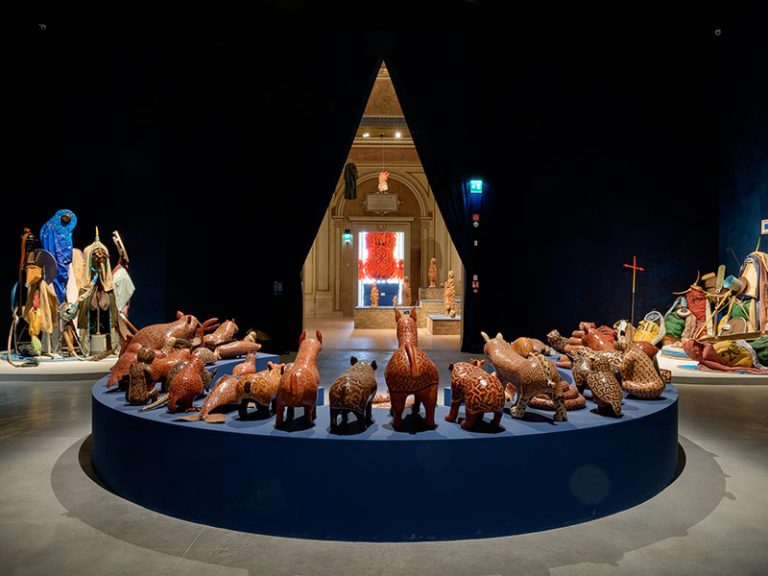
A cult object linked to the male initiation society of Kono, representing a hippopotamus (or a horse?), Bamana population, Mali, earth mixed with beeswax, coagulated blood, wood, 44 x 59 x 24 cm.
© Musée du Quai Branly – Jacques Chirac / Patrick Gries
Only 30 objects benefit from a counter-investigation, indicated by a lozenge on the cartels, and the others are exposed with the maximum details on their acquisition method. We note the use of the term ” stolen ” On several cartels, especially for ritual objects. THE Boli Malian is studied here in detail because “Requisition” By the mission despite the refusal of the head of worship, while it is a highly symbolic object. In the current context of restitutions and the debate on colonization, the exhibition therefore materializes the good will of the museum which highlights African researchers. On this sensitive subject, Hugues Heumen, director of the National Museum of Cameroon, declares that “Talking about decolonial or postcolonial does not mean revenge on the former colonist”. The museum is at the center of several requests for restitution, but the commissioners do not all agree on this issue. If Hugues Heumen believes that “All ritual objects should be returned”, Mame Magatte Sène Thiaw judges that “The exhibition is not necessarily to be placed in this debate”. For its part, the museum claims to want to continue research from origin in its collections.