Paris. The subtitle of the exhibition reflects a very broad definition of heritage: “Heritage in resistance”in the plural, indicates that the commissioners Mathilde Leloup and Élisabeth Essaïan approach heritage as common goods and not as “an object kept under a bell jar”as they specify. Along the way, visitors will discover the destruction of archaeological sites, vernacular habitats and attacks on the environment or popular culture. The scenography highlights this “polysemy” of heritage, alternating, for each part, works of art, videos of destroyed sites (produced by Iconem) and quantified data accompanied by maps or graphs. There are therefore several possible entries into the exhibition, and “all media are used to access knowledge”according to Julien Bargeton, president of the City of Architecture and Heritage.
Beyond heritage clichés
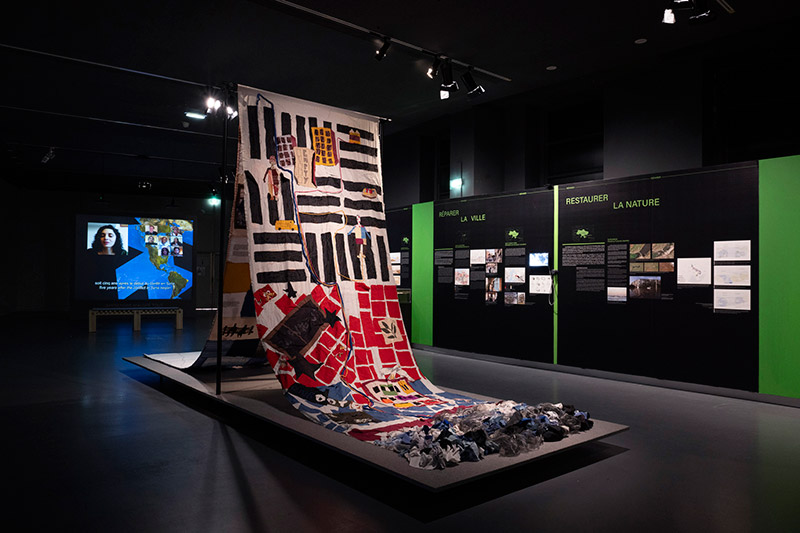
From Bâmiyân to Sudan via Gaza, Iraq and Syria, the exhibition covers the main conflicts of the last thirty years with this double perspective, without always convincing. The commissioners specify that they wanted to avoid “a more expected and more agreed vision of heritage” where the major sites are highlighted, but these remain very present thanks to the 3D reconstruction videos projected in each section. Furthermore, from the entrance to the exhibition, the panoramic photography of Bâmiyân by Pascal Convert seems to announce a sensitive approach to heritage. The fairly strong soundtrack, composed for the videos, also immerses visitors in a space where emotion dominates, and this emotion is found in the face of the contemporary works and heritage objects that dot the rooms (parchment from the library of Timbuktu, fragment of Syrian Hellenistic sculpture). This key to reading through art and emotion, even through aesthetics, works quite well, even if certain contemporary works have already been seen a lot in recent years (Emeric Lhuisset). Opposite these works, on the right walls, long panels with numerical data broaden the meaning of “heritage”: “cultural cleansing, urbicide, ecocide, pillaging of resources” constitute, according to the commissioners, attacks on heritage in the same way as the destruction of buildings or monuments. Numerous documentary photographs illustrate these other types of degradation, in a scientific or even cold manner: how many visitors will read these panels full of information to the end, where the photographs are also in small format?
View of the “Heritage in Resistance” exhibition at the Cité de l’Architecture.
© Didier Plowy, Capa 2026
This double bias does not work in all sections, even if the one devoted to international law and the safeguarding of cultural property remains very interesting: we note that the definition of heritage is more classic here. It is likely that the exhibition location and the university training of the curators influenced their approach, favoring buildings, attacks on populations and reconstruction initiatives (third part of the exhibition).
The emphasis on NGOs and collectives is assumed: the commissioners insist on “ the conditions for remaking society” after a conflict, preferring the term ” repair “to that of “reconstruction”. This emphasis on the human element is also revealed in several filmed interviews, broadcast in the small side rooms: architects, historians, members of UNESCO and Aliph discuss their role in the protection of heritage and its reconstruction.
There remains the question of a political angle or not of the subject, since Julien Bargeton declares that on this theme widely present in the media “ the City is aware of the measured risk it is taking, and it must remain in its scientific and cultural role.” Showing the extent of the destruction in Gaza, Ukraine or Beirut in the 1980s as the exhibition does would therefore be scientific and not political? The curators’ response is more measured, Mathilde Leloup specifying that her research work which informs the exhibition deals “the question of politics, of what binds us, of what creates the conditions for living together”themes present in the course. It is undoubtedly important to understand that the exhibition does not explicitly take sides in current conflicts, which in fact no one can demand.
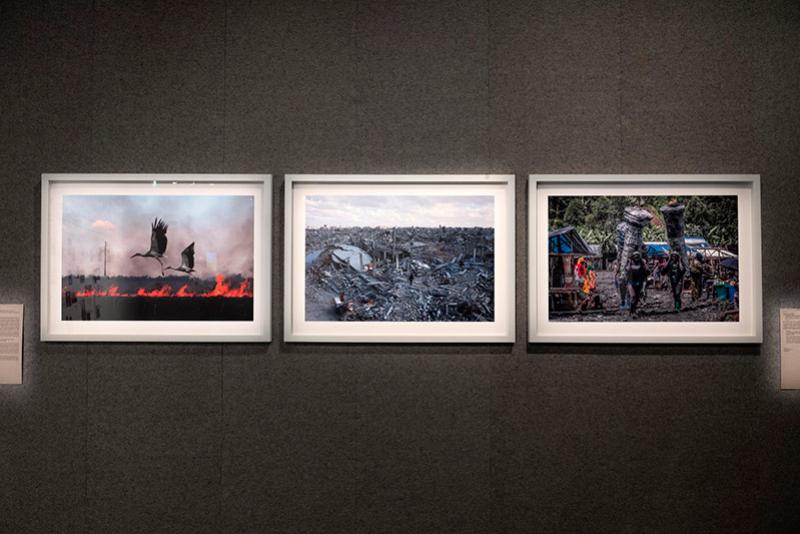
View of the “Heritage in Resistance” exhibition at the Cité de l’Architecture.
© Didier Plowy, Capa 2026