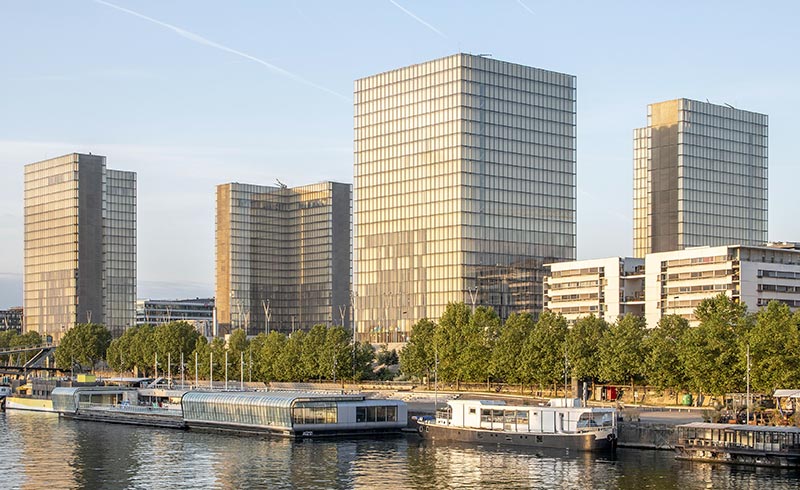
Paris. Thirty years after the François-Mitterrand site opened to the public, the Bibliothèque nationale de France (BNF) is entering a critical real estate phase. In an information report presented on May 27 on behalf of the Senate Finance Committee, Jean-Raymond Hugonet points out a growing gap between the scale of the BNF’s built heritage (worth 1.49 billion euros), its conservation constraints and the resources available for the maintenance of its sites.
After several decades of rationalization, this real estate portfolio is today based on seven main locations: François-Mitterrand, Richelieu, Arsenal and Opéra in Paris, the Maison Jean-Vilar in Avignon, as well as the technical centers of Bussy-Saint-Georges (Seine-et-Marne) and Sablé-sur-Sarthe (Sarthe), set to be replaced by the future center of Amiens (Somme).
High risk by 2029
The most sensitive point concerns the François-Mitterrand site. The building, whose gross useful surface area reaches 200,455 m2, is similar to an industrial site. The report lists around 80,000 light points, nearly 80 elevators and goods lifts, around a hundred air handling units and an automated document transport system. However, this equipment is reaching the end of its life cycle: 25% of the site’s components were already classified in “very critical” condition in 2025 and 30% in “critical” condition. By 2029, more than 70% could present a high or very high risk, with the threat of partial or total closure in the event of a major failure.
The overall renovation needs for the François-Mitterrand site are estimated at 527.6 million euros. In the short term, the draft multi-year real estate strategy plan 2026-2030 shows a maintenance debt of 88 million euros from 2025, to which would be added 112 million euros between 2027 and 2029. That is to say around 200 million euros over five years, an amount well beyond the establishment’s ordinary budgetary margins. The initial 2026 budget only provides for 12.8 million euros in payment credits for the site’s real estate assets, while the working capital no longer leaves much room for maneuver. The Senate therefore recommends establishing a multi-year budgetary trajectory without delay.
The second issue concerns the saturation of stores. The BNF’s collections are still growing by around 6 linear km per year, as a result of legal deposit. Between 2018 and 2022, stores were already close to saturation, around 90% on average. The development of self-publishing, which now represents around a quarter of printed books arriving by legal deposit, accentuates this pressure. The report calls for developing, where possible, the deposit of a digital file instead of physical deposit, particularly for self-publishing and the regional press.
The future conservation center in Amiens must provide a long-term response. Its commissioning, planned for 2029, would allow a net gain of 106 linear km after the closure of the Bussy-Saint-Georges and Sablé-sur-Sarthe centers. Its cost is 116 million euros all expenses combined; its financing, believes the Senate, is fragile. Final points of attention: the Arsenal library, whose purpose must be redefined, and the Richelieu site, which still requires 8 million unfunded works.