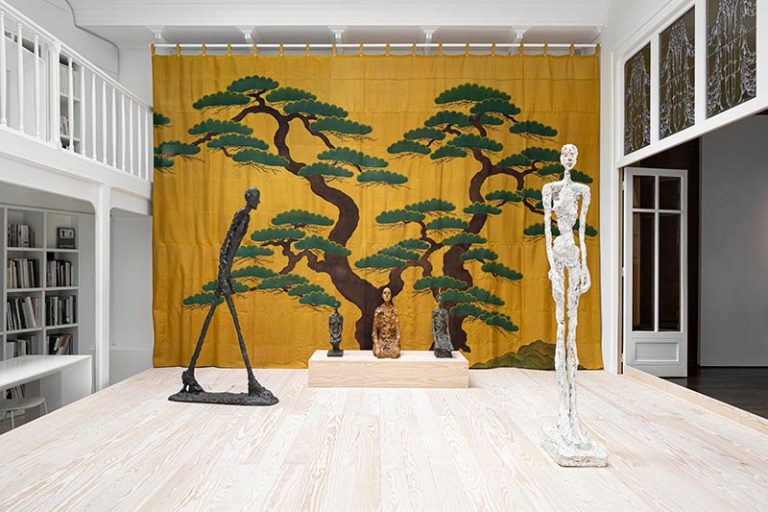
Metz (Moselle). Is the Center Pompidou-Metz on the way to becoming a museum of ancient, modern and contemporary art? Maurizio Cattelan presents, under the title of “endless Sunday” [lire le JdA no 657, 6 juin 2025]a personal selection of works from the collection of Parisian “big brother”, while the Louvre collections are the subject of another exhibition.
Finally not really: these are copies. Chiara Parisi, director of the premises, and Donatien Grau, advisor for contemporary programs at the Louvre, sent the following request to a hundred artists: “From the work of your choice, kept among the collections of the Louvre Museum, imagine its copy. »» The injunction of the notion of “imagination” in this context opened a breach in which the artists rushed with enthusiasm. Because the creators borrow, but without being reduced to simple copiers.
In fact, if the commissioners distinguish between imitation copies and copies of interpretation, it is undoubtedly this second category which predominates. One might even wonder if the term “variations” would not be better to qualify the works gathered, because they operate on a principle similar to the rest made by Picasso from the Algiers women Delacroix, for example.
Francesco Vezzoli, Gli Schermi del Potere2025, Humberto Campana, Samochaos2025, Fabienne Verdier, Annunciation (detail), 2025, George Rouy, The Witness2025.
© Center Pompidou-Metz / Marc Damage
© Adagp Paris 2025
Note that in Metz we cultivate a certain continuity of ideas. Any guarded proportions, a link can be established between the principle of copying and that of rehearsal – theme of the previous exhibition (from 2023 to 2025), which was advancing that “For many artists from the XXe and xxie centuries, creation was born from repetition, by multiplication, accumulation, repetition or restart ”.
Be that as it may, we can regret that the spectator is confronted with the only titles of the original works-the painting constituting the main source of inspiration of the artists-without seeing the reproductions presented in vis-à-vis. Certainly, masterpieces such as The Mona Lisa Or The Raft of the Medusa belong to the collective imagination, but in the majority of cases these are paintings less known to the general public. It is only by consulting the catalog that we really take the measure of the gap, often considerable, between the source work and its reinterpretation. Can we then still speak of copies, when it comes to evocations, suggestions, “updates”, a thousand leagues from any servile imitation?
A form of betrayal
The work Revolution D’oriol Vilanova accurately illustrates the fact that even copies obtained by mechanical processes – reproductions -, supposed to guarantee perfect fidelity to the original, can mislead. In reality, the eighty postcards, these false twins, representing Mrs. Vigée Le Brun and her daughter Élisabeth Louise Vigée Le Brun, are not identical. A more or less sustained shade, a more or less close shooting, the presence or absence of a framework: as many details that reveal that a copy, as a translation, is always a form of betrayal.
The main merit of the Messina exhibition lies precisely in the inventiveness of these “betrayals”. Thus, Agnès disturbed, called “Agnès b. “, Revisit The man with a glove (1520/1523) of Titian: barely modified, the character now seems to belong to our time. Elsewhere, Dhewadi Hadjab, from the Murdered marat (1793) by David, replaces the body of the revolutionary martyr with that of a transgender friend, responsible for thrilling eroticism.
Further on, two artists attack the still lifes of Chardin, each according to a particular approach. Laura Owens says he wants “Capture respectfully” This painting, with all the nuances of light. Objective undoubtedly achieved, as the copy is confused with the original. The approach of Michaël Borremans, it is radically opposed: objects disappear, remains only a void saturated with a dull light which, according to the artist, “Highlights the disturbing underlying currents of the original paintings” (in the catalog).
Throughout the route, many female figures meet, whether creators or characters represented. The one who undoubtedly ignites the imagination is the heroine of Freedom guiding the people : Marianne. It gives rise to a feminist proofreading by Agnès Thurnauer, which covers the central part of a reproduction of Delacroix’s painting of an extract from the test of Monique Wittig, The Guérillères (1969, Editions de Minuit).
Even more surprising is the transformation of this masterpiece by Bertrand Lavier: it only retains the weapons dispersed in the composition, thus a saber, a pistol, a bayonet rifle, which it replaces with real objects, found in antiques. In this assembly, the inevitable violence of the revolution of the three glorious rises in the foreground.
Impossible to catalog all the artistic proposals presented in Metz. Their diversity attests with brilliant that a striking work is always inscribed in its time – while escaping it.