Outside France, the archaeological year was punctuated by numerous discoveries of ancient objects or constructions. Many of them, combined with the use of modern tools such as artificial intelligence, allow us to better understand the social organization of our ancestors.
1. Karahantepe (Türkiye): a testimony of a Neolithic human group
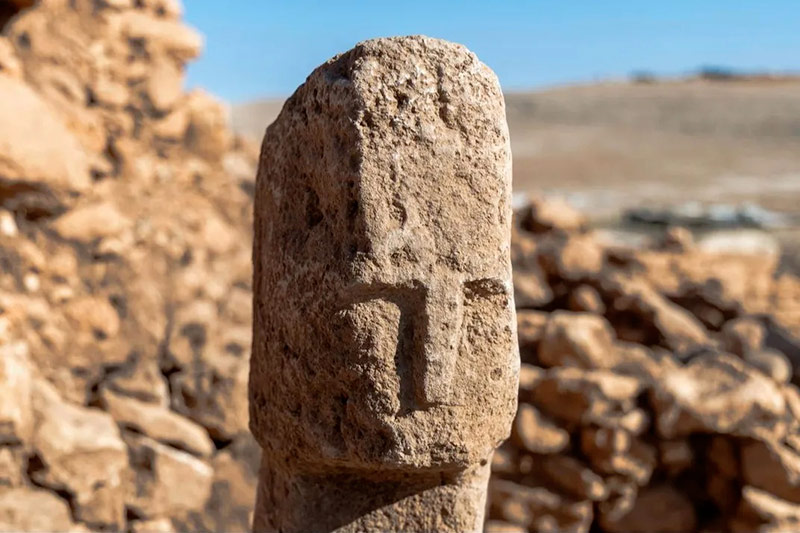
At Karahantepe, a major Neolithic site in Southeast Anatolia, two recent discoveries shed light on the symbolic thinking of the first agricultural societies (12,000–10,200 BC). Archaeologists have unearthed a T-shaped pillar carved with a human face – a first – confirming its anthropomorphic interpretation. They also discovered, in a deliberately abandoned building, a ritual set of animal figurines arranged in a symbolic order, which archaeologist Necmi Karul describes as the oldest “three-dimensional story” known.
2. Caracol (Belize): the tomb of a Mayan chief
At the Mayan site of Caracol, a team led by Arlen and Diane Chase (University of Houston) identified the tomb of Te’ Kab Chaak, founder of the ruling dynasty, after more than forty years of research. Dated from the 4th century AD. BC, it is the only royal burial ever unearthed at Caracol and one of the rare cases where human remains can be associated with a sovereign known through hieroglyphic inscriptions. The funerary chamber, with walls coated with red cinnabar, contained prestigious offerings – ceramics, jade jewelry and a mosaic funerary mask – confirming the rank of the deceased and shedding light on the beginnings of the city’s dynastic power.
Tomb of Te’ Kab Chaak discovered at the Mayan site of Caracol.
© Caracol Archeological Project / University of Houston
3. Origin of Indo-European languages (Eastern Europe and Southern Russia)
A study of ancient DNA sheds decisive light on the origin of Proto-Indo-European, the ancestral language of nearly half of the languages spoken today. The analysis of more than 400 prehistoric individuals from eastern Ukraine and southern Russia shows that the Yamnaya and the ancestors of the Hittite speakers descend from the same population of the Copper Age (4,500–3,300 BC). Installed between the Volga and Don rivers, this community resulting from the mixture of steppe nomads and Caucasian farmers would have been the first to speak the oldest form of Proto-Indo-European, before its diffusion across Eurasia.
4. Papoura (Crete): the oldest construction on the island
In central Crete, at the summit of Mount Papoura, archaeologists are studying the oldest known Minoan monumental complex. Dated around 3000 BC. BC, this vast circular structure of more than 50 meters in diameter is made up of eight concentric walls and a central vaulted building. Visible from the surrounding plain, the monument would have served as a community rallying point, hosting gatherings, feasts and rituals. Used until around 1800 BC. BC, it testifies to a collective social organization well before the rise of the Minoan palaces.
5. The oldest mummies in Southeast Asia
A study led by archaeologist Hsiao-chun Hung reveals the existence of a very ancient practice of mummification by smoking among hunter-gatherers in Southeast Asia. The analysis of 57 individuals from eleven sites in China, Vietnam and Indonesia, dated from 10,000 to 2000 BC. BC, shows that the bodies had been heated to low temperatures before their burial. Light and tied up, these deceased could be transported over long distances. Some burials, 10,000 years old, constitute the oldest known intentional mummies.
6. Pompeii (Italy): The House of Thiasos
In Pompeii, in the Regio IX district, archaeologists have rediscovered a luxuriously decorated dining room, now called the House of Thiasos. Dated 40–30 BC. BC, its frescoes constitute a rare example of megalography, representing almost life-size the procession of Dionysus. Satyr musicians, scenes of libations and maenads in a state of ecstasy compose a Dionysian iconography, marked by a free and transgressive representation of female figures, uncommon in Roman domestic art.
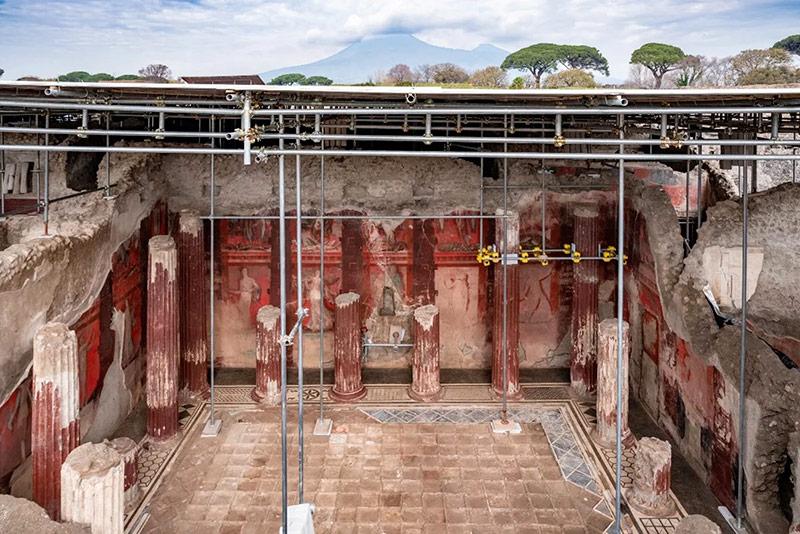
Overview of the fresco discovered in the domus Thiasos.
© Pompeii Archaeological Park
7. Thebes (Egypt): The Tomb of Thutmose II
In Egypt, archaeologists have identified the long-vanished tomb of Pharaoh Thutmose II, ruler of the 18th dynasty (15th century BC). Initially thought to be a female burial, the burial chamber revealed decorations reserved for kings – starry ceiling and scenes from the Amduat. The definitive identification was made possible by fragments of alabaster vases bearing a dedication from Hatshepsut to her husband. This discovery puts an end to the quest for the last unknown royal tomb of this dynasty.
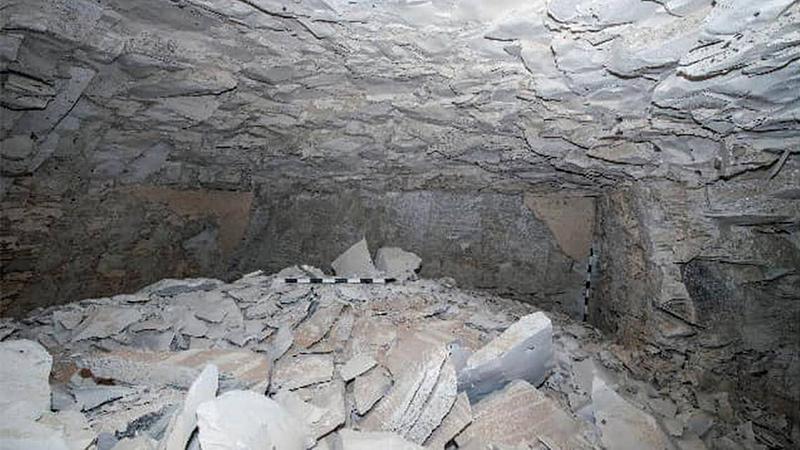
Tomb of Pharaoh Thutmose II in Luxor, Egypt.
© Egypt’s Ministry of Tourism and Antiquities
8. Sippar (Iraq): Understanding a singular Babylonian text
Using artificial intelligence, researchers have reconstructed a previously unpublished Babylonian text celebrating Babylon as the first city in the world. Studied from fragments of cuneiform tablets from the ancient library of Sippar, the text, dated to the second half of the 2nd millennium BC. BC, exalts the city, its inhabitants and the god Marduk. Unlike most Mesopotamian writings, it does not place the king at the center of the story: it highlights a collective Babylonian identity, affirmed as eternal.
9. Huanchaco (Peru): a tomb between two eras
In Peru, the discovery of a burial dated from 850 to 1000 AD. AD at the site of Pampa la Cruz sheds light on a period of major transition on the north coast. The tomb, containing two men buried according to highland rites, combines objects and styles from Wari and Moche cultures. This intersection of influences reveals a phase of cultural hybridization, marked by the decline of local traditions and the emergence of new socio-political balances.
10. Çatalhöyük (Türkiye): the beginnings of a matriarchal Neolithic society
At Çatalhöyük, a large Neolithic community in southern Anatolia (7150–5950 BC), a genetic study provides strong evidence of a female-centered social organization. Analysis of the DNA of 131 individuals reveals that little girls received funeral offerings much more often than boys and that family ties within the houses mainly followed the maternal line. These results suggest a matriarchal society, whose practices may have favored more egalitarian social relations.