Seven years ago, the Chilean Cecilia Vicuña received the Velázquez Prize for his production as a poet, visual artist and activist, who has displayed multidimensional art in which she interacts with the land, written language and fabrics, and for being the owner of a special poetics in which ecological awareness, the city and the artistic institution intersect.
That award, and the exhibition that the Dos de Mayo Art Center in Móstoles dedicated to her in 2021, helped us get to know this Chilean author better, who has lived in the United States since the eighties and who works by interweaving languages, media and techniques in projects that have to do with eroticism, colonial legacies and indigenism, the notion of collective happiness and environmental devastation. His most common formats are installations and paintings that refer to languages of indigenous culture, although it was the 1973 coup d’état in Chile that had a profound impact on him during his formative years.
Vicuña believes in the healing and ritual aspect of art and that its function is neither to colonize nor to dominate, but to promote change in social and emotional structures, as well as our behavior towards nature. His first assemblages, made in the sixties, were carried by the waves and the sea breeze, but, compared to the authors linked to land art, his early production did not aim to respond to debates about the challenges of modernity, institutionality or the market; his compositions were neither early minimalist exercises nor expanded sculptures. From simpler parameters, he took elements from the beach – wood, rocks, feathers – and arranged them on the seashore in a humble act of communication with it, as if they were sacred offerings. In his precariousness, he considered them to be spatial metaphors or multidimensional poems and they allowed him, from his point of view, to unearth the meanings and forces of what was designated as disposable by our consumer-oriented society. Delicacy, like that of those pieces, is an integral aspect of his work, although it implies the ephemerality of some of his proposals.
This quality is part of the textiles and knotted cords typical of Andean fabrics. The quipu, in fact, is a writing system with knots and colored threads that was created in the Andes, more than 5,000 years ago, and that Vicuña knew when he was a teenager, living in Chile. It was in use until the Spanish conquest in the 15th century and she has been interested in resuming it, using unspun wool that symbolizes the state. not yet from which almost everything springs. When people cross it, they themselves become “knots,” bearers of memory and members of a poem in space.
Vicuña manages a cyclical understanding of the creative act that is manifested through the return of ideas that do not exist as final objects, but as essays, such as his quipus since the sixties: fabrics and assemblages that seem to activate the memory of ancient civilizations, sanctuaries, idols, temples and tombs.
At that same time, he began to paint under the influence of the Andean and mestizo painting that was produced in the Cuzco School in the 16th and 17th centuries, in which the iconographic types of European art sometimes alluded to original beliefs. His meeting with the painter Leonora Carrington in Mexico in 1969 was also significant: after meeting her, he incorporated naked women protesting in the streets, references to animism, Andean philosophy, folklore and popular myths into his work. Although some of these images were exhibited in museums and were recognized, others also sparked controversy, such as Menstruation angel (1973).
After settling in London in 1972 thanks to a scholarship to study painting, and shocked by Pinochet’s coup d’état on September 11, 1973, the artist distanced herself from her paintings of harmony between animals and humans to adopt a course of agitation and mourning, more open to other disciplines. He began to place the viewer at the center of his work with the aim of reorienting his vision; in some cases, to see through Allende’s eyes. Along with other international artists and intellectuals, he donated and created pieces in support of the Chilean struggle to restore democracy; also actions: from a massive demonstration in Trafalgar Square to collages and canvases that called for reversing the colonial order, also in Vietnam. One of his most important paintings is, in this sense, Chile Greetings Vietnam! (1975), which presents a Mapuche indigenous woman and a Vietnamese militiawoman in a profuse landscape of plants and flowers, exchanging a rifle and a red book titled The August Revolution – the name of the Vietnamese revolutionary uprising against the French colonial government in 1945.
Furthermore, since 1973 he has created collages, drawings and actions for the series Wordarms. Produced largely between London and Bogotá, it suggests unresolved paradoxes between art and revolutionary politics. Through the representation of words as weapons, the artist advocates for the transformative dimension of language in the fight against dictatorships; the wordwords They are words that have been opened to explore their meanings, revealing a space for the development of imagination and transformation. This notion of openness is emphasized through the image of the shovel that removes the language as if it were soil to be tilled, in the double sense of working and cultivating it.
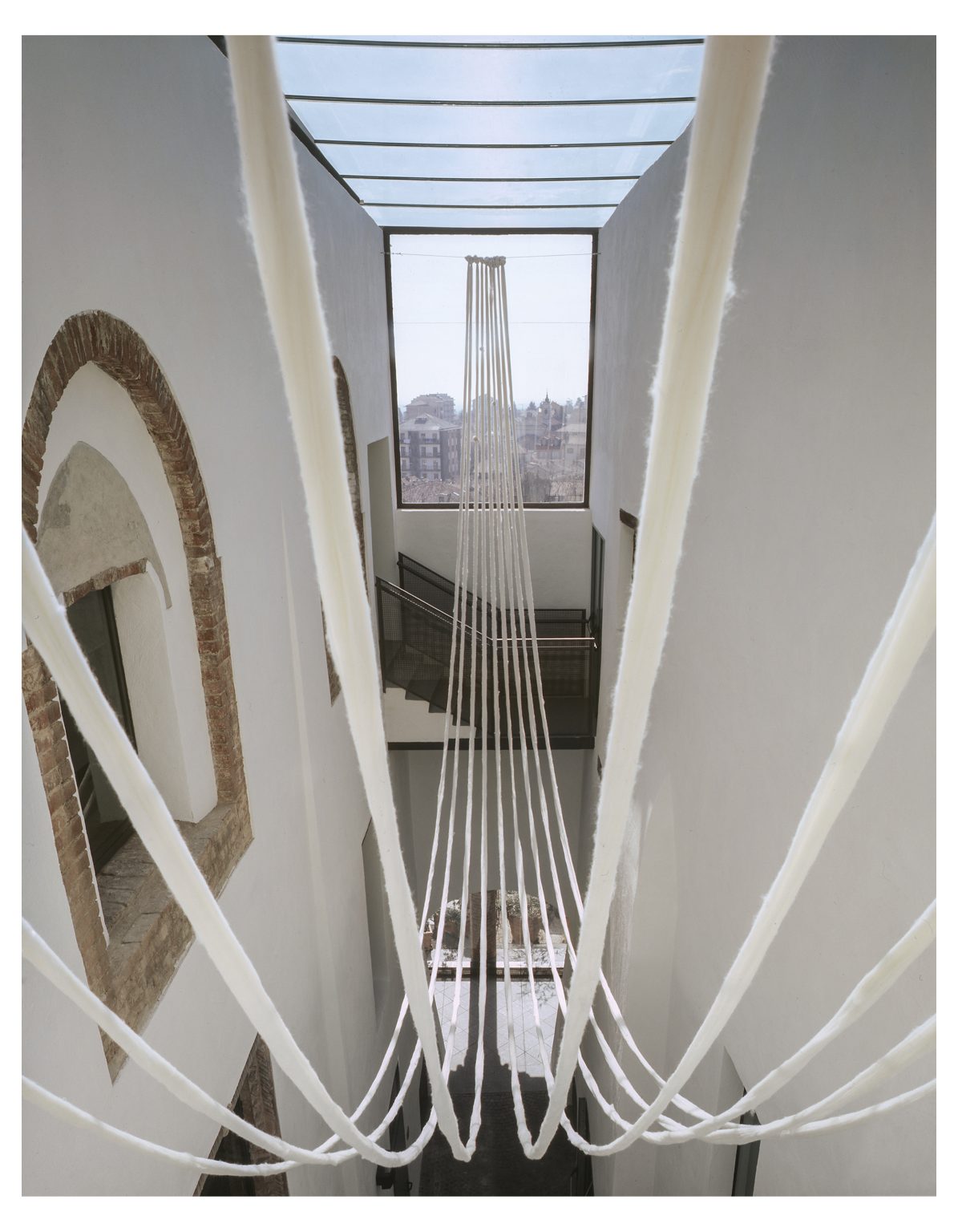
Cecilia Vicuña. Canoe of light (Canoa di luz)2000. Casa del Conte Verde, Rivoli-Torino
His first Italian exhibition, curated by Marcella Beccaria, can be visited this summer at the Castello di Rivoli in Piedmont. It is called “The Gone Glacier” and contains a project precisely carved and worked for that space and its longitudinal rooms. It is a lying quipu, a horizontal installation suspended at different heights that refers to those knotted ropes that were used as a system to record information, including administrative, astronomical and historical-narrative data. Like Vicuña’s other contemporary quipus, it becomes environmental and immersive and transcends time and place from its raw, unprocessed wool, which is unrolled and assembled, generating striking aerial architectures.
This glacier evokes transience, the movement of natural elements such as ice, water and wind and the impact of human presence on the environment; From its very title, Vicuña seeks its relationship with said water as a reminder of the ancient tongues of ice, now extinct, that once dominated the landscape of the Valle di Susa, where the Castello is located, near Turin. And we will not see knots in its fabric, because its absence tells us about the gradual loss of memory and care in today’s society, as well as of the disappeared, whether they are victims of the Chilean dictatorship or any other repressive system.
The exhibition includes video works, in order to incorporate into the project images, sounds and songs that have been an integral part of the Chilean practice since its beginnings, and also poems written specifically by the artist and presented as wall poems.
Despite being his first Italian individual, it marks an important return for Vicuña to the Castello, the institution that hosted his work for the first time in that country in 2000, within the collective “Quotidiana”. The process of preparing this sample involved the participation of local communities who collected small fragments of waste on the banks of nearby canals and ponds, including lakes Dora Riparia and Avigliana. Through a workshop organized in collaboration with the Accademia Albertina di Belle Arti in Turin, these materials were transformed into an ephemeral outdoor installation, which the author entrusted to the creativity of a group of students.
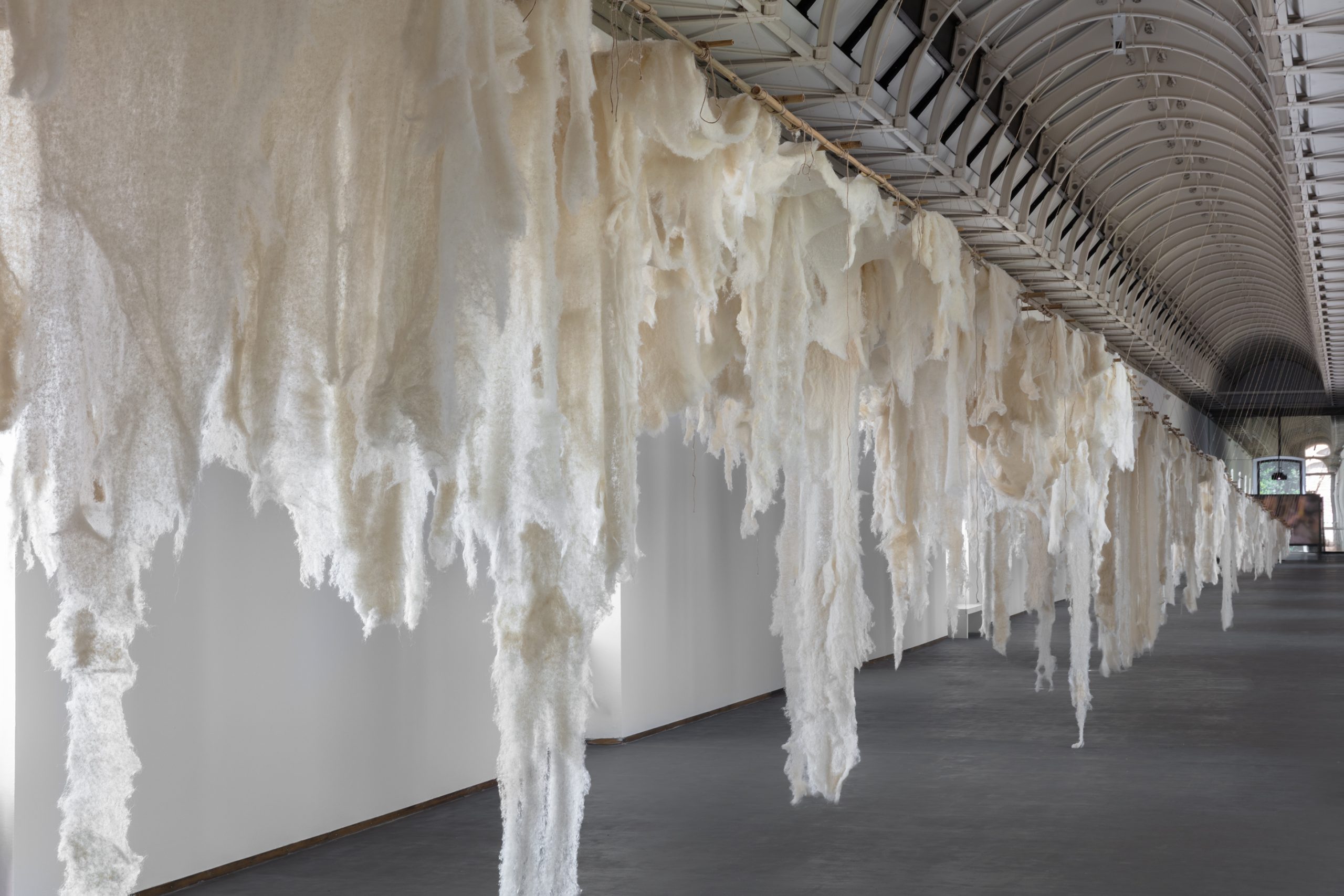
Cecilia Vicuña. The glacier gone. Castello di Rivoli
Cecilia Vicuña. “The Gone Glacier”
RIVOLI CASTLE
Piazza Mafalda di Savoia
Rivoli, Turin
From April 29 to September 20, 2026