Next year it will be four decades since Ouka Leele managed to paralyze traffic in Cybele to recreate there the mythological portrait of Hippomenes and Atalanta, which he represented in his work Rapelle toi, Barbara!also giving shape to a visual encounter between the performance (carried out by the actors in the composition), the photography (which was taken from the moment) and the painting (with which that image intervened). The three mediums, in communion, would be vital for the creators of their generation, as was also, although it may be unexpected, the classical world, the axis of the exhibition “Modern Mythologies: Ouka Leele & Co”, which can be visited today at Alcalá 31 and curated by Julio Pérez Manzanares.
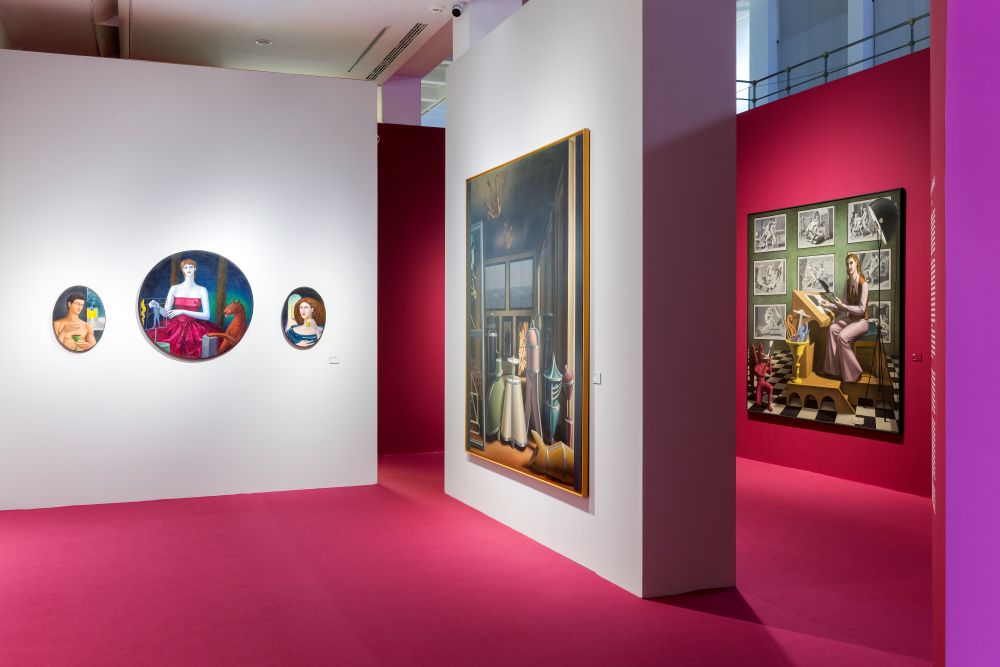
That artist and that work are the axis of an exhibition that, however, is above all choral and that brings together some of our most significant painters of the eighties around a bubblegum pink temple, a tholos circular occupied in its center by the recordings of the interviews of the protagonists with Paloma Chamorro in the program The golden age; The youngest will thus be able to become familiar with their faces and voices. Bárbara Allende occupies what would be the head of that temple; He took his stage name from the El Hortelano comic Europe Requiemalso in this exhibition, and here we can see a brief overview of his career, a compendium of his techniques and interests that emphasizes the more intellectual and less spontaneous aspect of his creations, let’s talk about photographs, paintings or altered black and white photos.
There are several of his self-portraits, which we can relate to two myths very present in the tour: that of Narcissus, in love with him, and that of the daughter of the potter Butades of Sición, who would have given rise to the art of painting itself by tracing the silhouette of her lover, about to leave. We will see his first drawings from the late seventies, a period in which he met Ceesepe and El Hortelano and began to pay attention to comics, cinema, album covers and multiple street references, cultural and not, along with the weight of his visits to museums and galleries; One of his most famous series also dates from then, Hair salonwith a surrealist air and linked to new appropriationist techniques. His was a domestic mystiquein his own expression, in which he sought to prove that certain elements of daily life could achieve classical transcendence and even be allied with baroque keys.
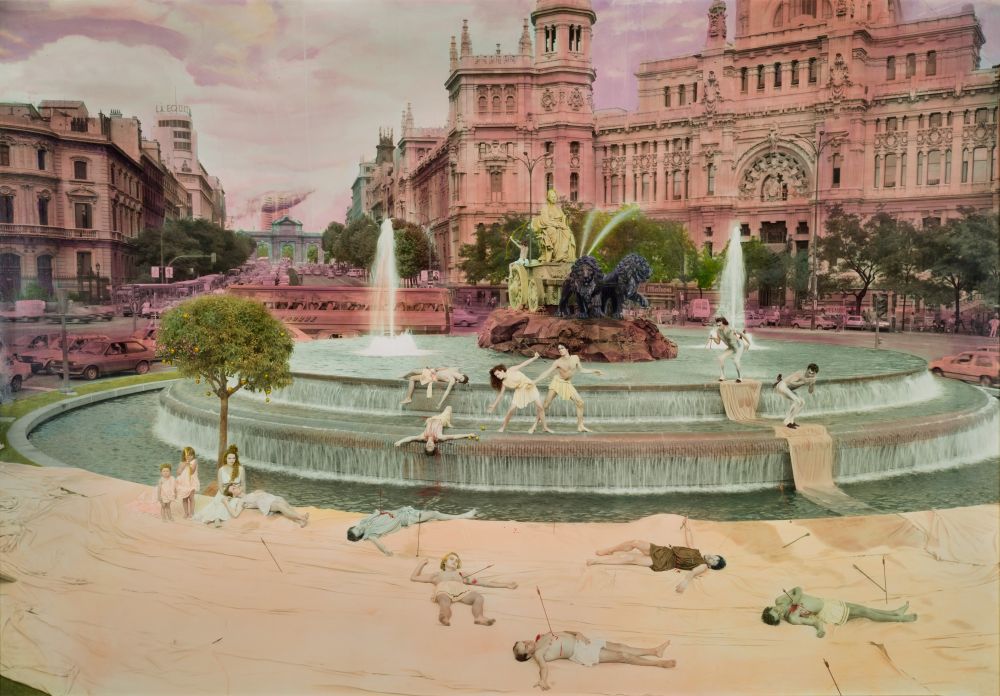
Ouka Leele. Rapelle-toi, Barbara1987
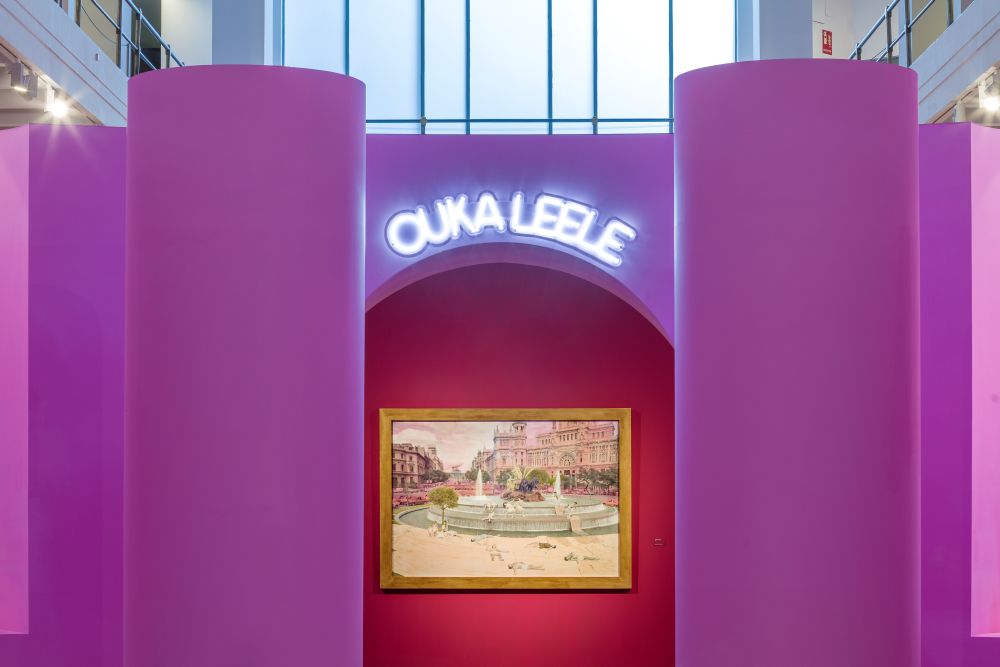
Modern mythologies: Ouka Leele & Co. Sala Alcalá 31, 2026. Photography: Jonás Bel
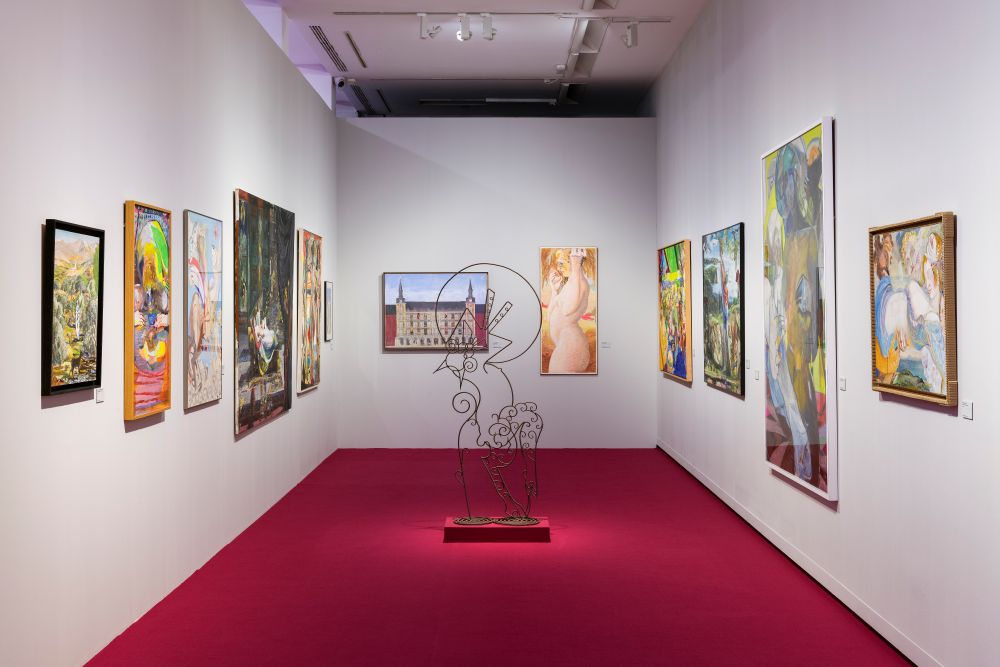
It is possible that, if we have to think of an artist from that time linked to mythology, we will soon do so in Carlos Franco, who won the competition called to decorate the façade of the Casa de la Panadería, in the Plaza Mayor of Madrid, in view of the cultural capital of this city in 1992, with a proposal on that theme. Literature and the aspect of classical myths most deeply linked to desire and sensuality had a decisive influence on his overall production: with his compositions he intended to arouse multiple sensations, hence he came to incorporate cow teeth if he wanted to allude to jaw grinding derived from jealousy.
Associated with the new Madrid figuration, his work opens up to symbols and dreams and stands out for its classicist refinement and its narrative complexity compared to the continuous look at the media and the street air of his colleagues in the exhibition. So much so that, if we do not pay close attention to the details of his figures for the Casa de la Panadería -some of his designs have reached Alcalá 31-, perhaps we will not notice from a distance that its creator is our contemporary.
Many of his works have not yet had an end: he continues to modify them decades later.
Modern mythologies: Ouka Leele & Co. Sala Alcalá 31, 2026. Photography: Jonás Bel
Perhaps his counterpoint in the exhibition is Ceesepe (Carlos Sánchez Pérez), who drew from dirty comics, fanzines and the most sordid, even violent, side of Madrid during the transition – the drugs in the exhibition do not appear with any explicitness, but they are here and there. This author became familiar to readers of publications such as The Viper, Star, Madriz either The moon of Madridand he also knew how to privilege pop over the underground if he had to put posters for films like The law of desireby Almodóvar.
His jump to the then called high culture It arrived right in the eighties, after an exhibition of his in 1979 at the Buades gallery; in fact, he was one of the most popular authors in the first editions of ARCO. He never completely abandoned the style pulp and crude, but he also applied it to the reinterpretation of myths and classic works, in an exercise of hybridization with many fronts: when he went to New York, a creative mecca at the time, he proposed his own port version of the Breakfast on the grass by Manet.
It is rare to hear Ceesepe’s name without linking it to that of El Hortelano (Alfonso Morera Ortiz), whose beginnings were equally deeply linked to the underground, fanzines and comics and who, like him, was a very close friend of Ouka Leele and García Alix and contacted the Barcelona counterculture circles. In his case, that rebellion was combined with his love for celestial bodies, nature and the language of neo-expressionism or the so-called Bad Painting; He came to pay tribute to romantic artists and New York was also part of his mythical constellations.
Modern mythologies: Ouka Leele & Co. Sala Alcalá 31, 2026. Photography: Jonás Bel
Sigfrido Martín Begué completes the roster of artists who inhabit the pink temple on the ground floor of Alcalá 31, and it may be a surprise for many. He was one of the most relevant (and refined) authors of the moment, despite having fallen into certain oblivion after his death in 2010.
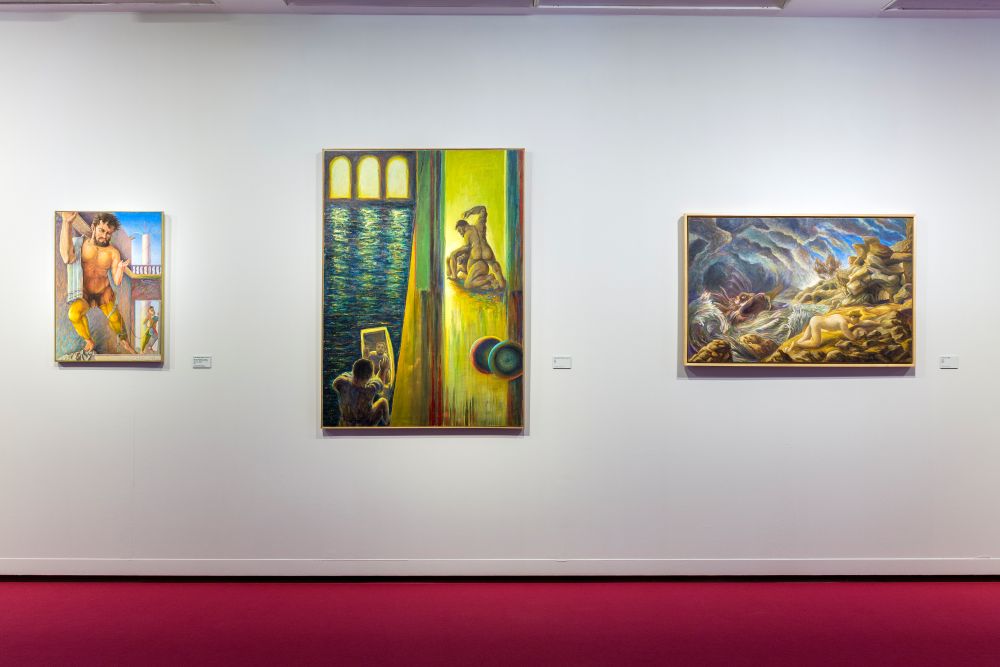
In fact, to interpret his works we would do well to read Vasari and Alberti and soak up what has happened in the pictorial field since Duchamp, because he painted Pandora, Narcissus, Las Meninas converted into objects extracted from the Big GlassSaint Lucia in front of a wheel of vision or the daughter of Butades immersed in scenes that refer to a conception of painting as passion and the Eros of Giulio Romano. He even brought together, in one of his paintings, the classicism of the nudes of Ingres and The source Duchampiana, figuration and the emblem of conceptual art. Furthermore, he also represented the story of Hippomenes and Atalanta.
Modern mythologies: Ouka Leele & Co. Sala Alcalá 31, 2026. Photography: Jonás Bel
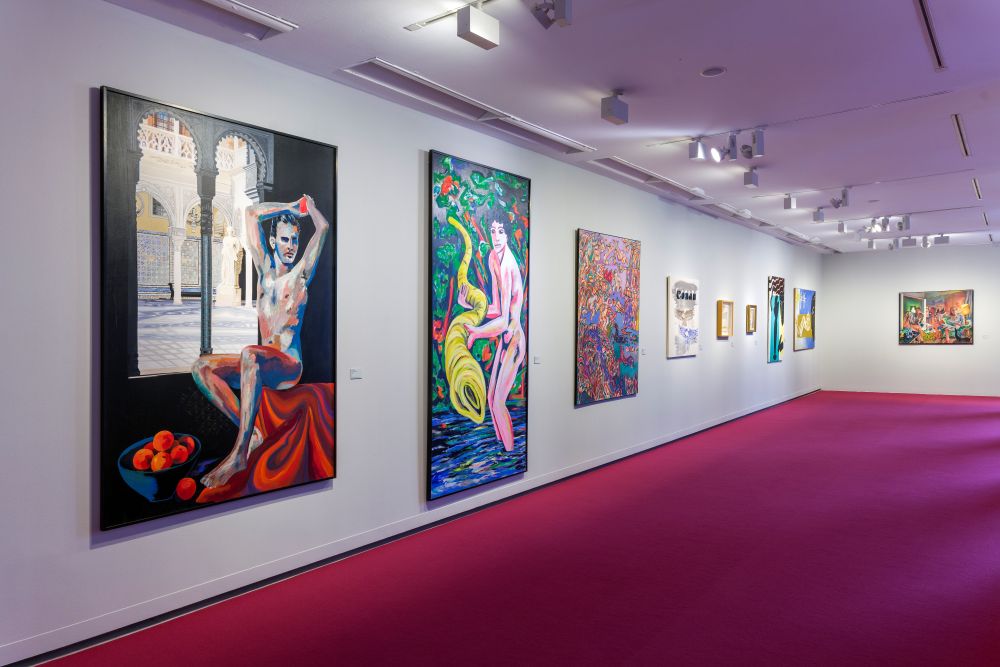
On the upper floor of Alcalá 31 we usually contemplate pieces in discreet formats, but Pérez Manzanares has chosen, practically, to do the opposite exercise on this occasion. Each of the two galleries is dedicated to mythologies addressed from underrepresented sensibilities to the eighties (those of homoeroticism, women artists) and to the city seen as a symbol or entertainment. Thus, we will encounter classical and interior themes by Pérez Villalta, one of the authors of this time who looked most at Greece and Rome (at Narcissus, Ganymede and also at Velázquez, in his treatment of space in depth); the very lively Costus, popular but until now little analyzed; Ana García Pan and her city, both archaeological and modern; Julio Yuste and his phallic New York; looks at consumption between pop and Greco-Latin by Miluca Sanz; the very peculiar visions of Carlos Alcolea of The drunks and the painter and the model, sifted by Hockney; Narcissus trapped in the aquatic whirlpool, with a Greek temple in the background, by Alfonso Albacete; post-pop stridencies of Pablo Sicet; the tribute to the starry night by Patricia Gadea or the reflections on the artist’s task from Dis Berlin taken to canvas.
The Soriano culminates, precisely, this montage with a small-format multiplex that reminds us that the visual culture displayed in the exhibition was part of an environment known to all: it was not alien or distant to the ordinary public, but rather emanated in part from it.
Modern mythologies: Ouka Leele & Co. Sala Alcalá 31, 2026. Photography: Jonás Bel
«Modern mythologies: Ouka Leele & Co»
ALCALÁ ROOM 31
C/ Alcalá, 31
Madrid
From July 2 to October 18, 2026