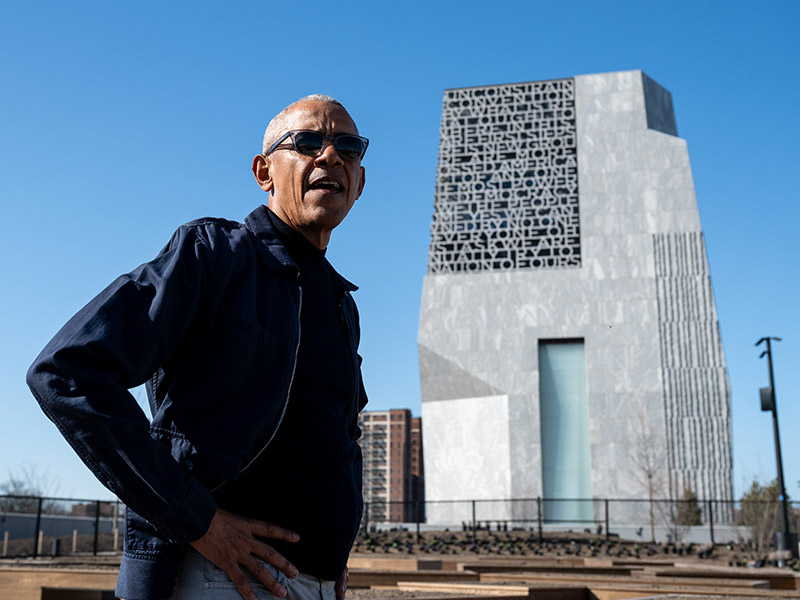
Chicago, Illinois. Vertical bunker, beveled silo, decor from the saga Star Warssanctuary… and even “foolishness” for Lee Bey, an influential architecture critic from Chicago (not an architectural madness, but an absurdity, in the pejorative sense): the tower of the Obama Presidential Center initially attracted mockery and reservations.
Hawaii, New York, Columbia? It was finally to the south of Chicago, birthplace of Michelle Obama and the beginnings of former President Barack Obama, that the Presidential Library was established. A geographical choice which has caused dissatisfaction in the southern districts, where there are fears of gentrification of the place. A choice which was also contested because it was considered the requisition by a private foundation of an already valued public space.
A severe granite quadrilateral, with facades barely broken by windows, the building occupies a historic site of 7.8 hectares, Jackson Park. Its opacity and stocky silhouette, despite its 68 meters in height, disconcert fans of verticality and transparency, who are legion in the “windy city” whose skyline is a farandole of glass icons.
New York architects Tod Williams and Billie Tsien, to whom we owe the Barnes Foundation, defend formal sobriety. They refuse the term “iconic”, foreign according to them to Obama’s vocabulary.
The Obama Presidential Center in Chicago.
© The Obama Foundation
A reference to Brancusi
The project, which took ten years to see the light of day, is full of ambition. That, above all, of a president invested: “He was one of those clients who came in and said, ‘If I wasn’t president, I would have been an architect,’” says Billie Tsien. He wanted the tower to take the shape of “four hands coming together”, a “lantern” giant. He would not have hesitated to ask the designers to “raise their game”. References? Only Brancusi’s name was mentioned by Obama, observes the pair. The Brancusian reference is gaining depth. The muted sculptural form may have a connection with the silent, simplified works of the Romanian sculptor naturalized French. Is the monolithic tower of the Obama Presidential Center a base as Brancusi conceptualized it?
The monolith changes color depending on the weather, the New Hampshire granite taking on dramatic accents under the cover of a cloud. In its high corner, giant letters hollow out the shell, a modernist and gigantic version of the Rosetta Stone. What do we decipher there? Sentences from the speech given by Obama in 2015, for the 50th anniversary of the Selma to Montgomery marches. Text chosen by himself, which commemorates civil rights and magnifies the figure of the first black president of the United States.
With 850 million dollars (735 M€), an absolute record which could be surpassed by the Trump library project in Miami, Obama breaks with tradition. Franklin D. Roosevelt invented the model: private funds built the place, the National Archives and Records Administration (Nara) managed it. Presidents thus erected what historian Robert Caro calls “pyramids of America”. But with Obama, the first digital presidency, no physical archive: the center, managed by the foundation, escapes Nara.
Because it’s not a library. The much-discussed tower hides a forest of buildings: museum, forum, library, gardens, gym, restaurant – Jackson Park becomes a campus. This bias allowed the architects to win the competition. With the promise of transforming the Presidential Library into a living space open to the communities.
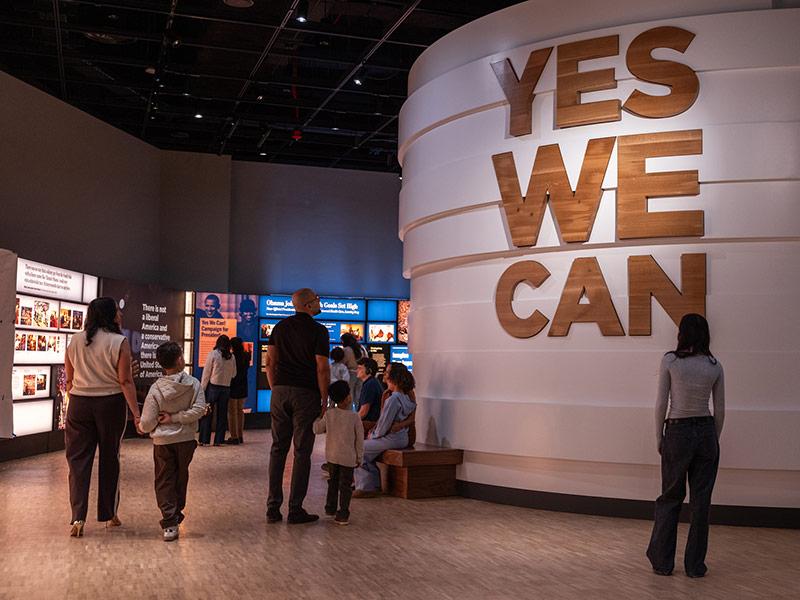
Obama Presidential Center Exhibit Hall.
© The Obama Foundation
Families from the neighborhood will therefore visit this ultra-modern campus. Everything is free, except the museum, located in the tower. American-style multimedia scenography: blue atmosphere, archive windows, videos and giant panels. The spaces, which decipher the mandate with hagiographic accents, are spectacular. Highlight: the Oval Office, recreated identically, where the visitor dreams of being president. This is the materialization of the house credo: “Ordinary people can accomplish extraordinary things”. Also moving when the exhibition embraces the history of civil rights, or explains democracy. Still moving when the Frenchman of the stage, the designer Jules Julien, signs All Togethera digital fresco of hundreds of thousands of points placed and colored by hand, one by one: “An invitation to understand that the power is in our hands if we come together. »
The Obama method is deciphered during an interactive visit, from “Yes, we can” At “Permanent Home for Hope”. Through its success, it is the American model that is examined, a pedagogy of winning. We regret that the difficult moments of the mandates are discreet, even erased: in wanting a legacy without shadow, the story deprives itself of a strength that it could have kept.
28 works of art
The center is finally decorated with commissioned works: 28, created by 30 artists, in the museum and on campus. Curator Virginia Shore’s selection alternates big names (Mark Bradford, Julie Mehretu, Martin Puryear) and emerging talents. “For each space, we submitted a selection to President and Mrs. Obama; it was he who made the final choice,” explains the museum’s director, Louise Bernard. To the north, Mehretu, who “worked with glass for the first time”, sign Uprising of the Sun : 35 painted panels embedded in the facade, which accompany the rise to the floors. And, upstairs, in the Sky Room overlooking the south of Chicago, Idris Khan affixed the letters of the Selma speech to the ceiling. “Sky of Hope”: the poetics of the British for the highlight of the visit.