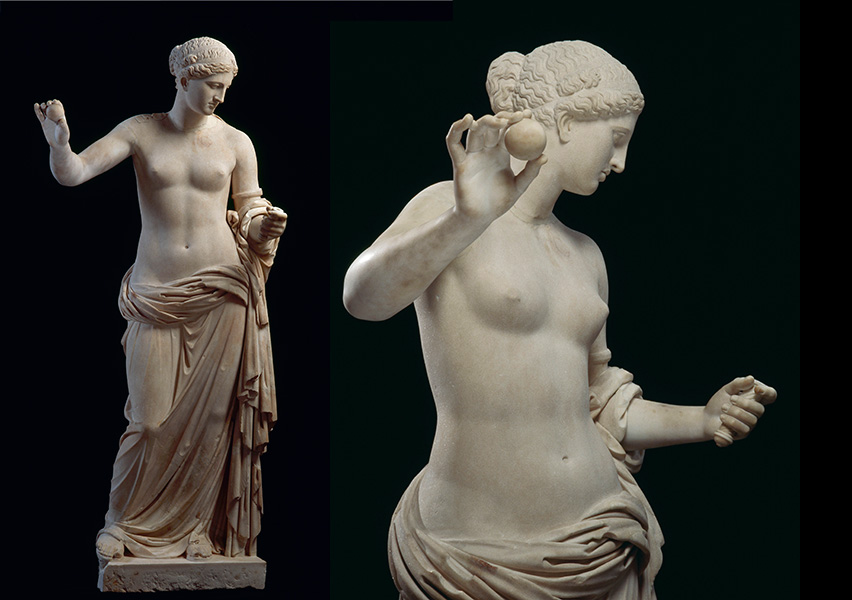
Arles (Bouches-du-Rhône). 1651: a majestic Roman statue of Venus was unearthed from the remains of the ancient theater of Arles. Nearly four centuries later, the one who has since taken the name “Venus of Arles” [voir il.] is making a comeback in the city, for the duration of an exhibition. This is not the first time that the Venus has stopped at the Arles Antique Departmental Museum. In 2013, the Arlésienne had already left the galleries of the Louvre to take part in an exhibition on the influence of Antiquity in the work of Rodin. But here the point is completely different and Venus takes center stage. “We could have told the story of the Greek Aphrodite, that of the Roman Venus, that of Louis XIV, or even the Provençal Venus. But we really wanted to think about what we mean by today’s Venus. explains Romy Wyche, co-curator and director of the museum.
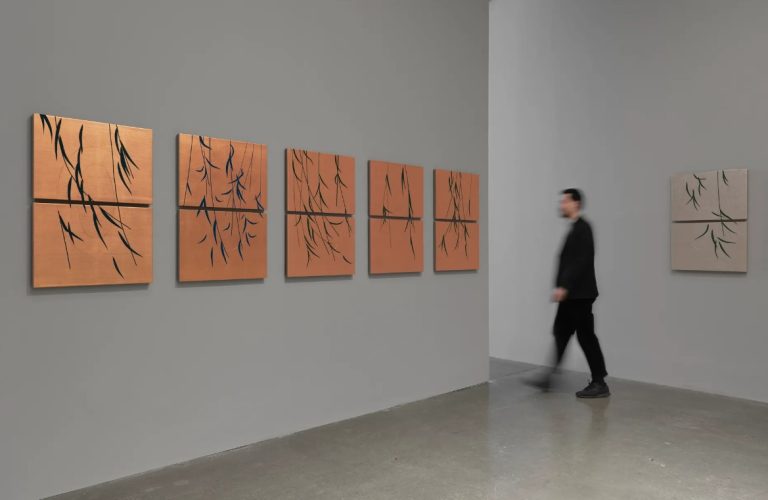
View of the exhibition “The Passage of Venus” at the Arles Antique Departmental Museum.
© Rémi Bénali
Power of the gaze, vitality of the body
The archetype is understood in all its diversity, questioning its posterity in art. But if the figure of Venus remains a cliché well anchored in the history of art, the exhibition avoids the classic presentation repeated many times. The journey opens with the birth of Venus but quickly moves away from the scholarly presentation to explore the multiple facets of her powers. First a focus on her look, both captivating and terrifying, where a statuette of modest Aphrodite with silver-encrusted eyes (3rd-2nd century BC) meets the painting What I see by Serena Carone (2010), creating a striking echo around the power of the gaze. Then we see the vitality of the body of Venus, the power of her adornments, her power which goes far beyond beauty and seduction to touch on fecundity, fertility…, and this through a rich selection of ancient pieces punctuated with a few contemporary counterpoints, i.e. nearly 80 works. “We wanted the Venus of Arles to be accompanied by first-rate works, and not by a few small Venuses and other nymphets serving a peripheral discourse. Above all, it was a question of questioning the very notion of “vanous”.” insists Ludovic Laugier, co-curator and curator in charge of Greek sculptures at the Louvre.
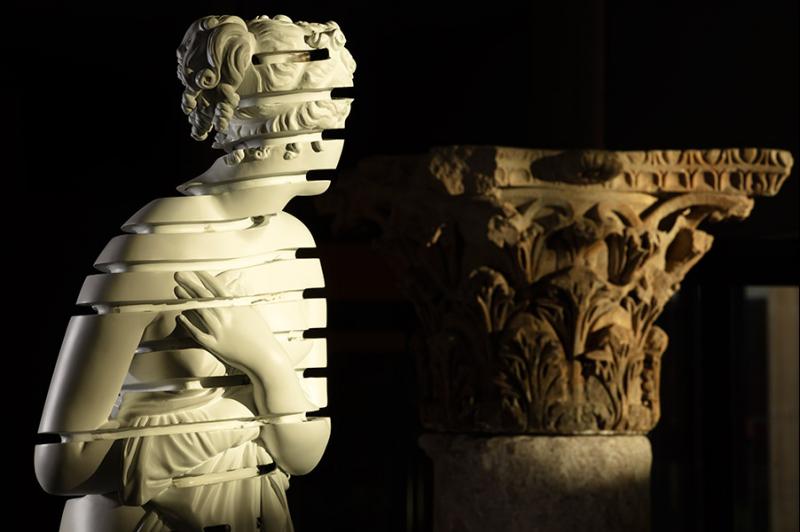
View of the exhibition “The Passage of Venus” at the Arles Antique Departmental Museum.
© Rémi Bénali
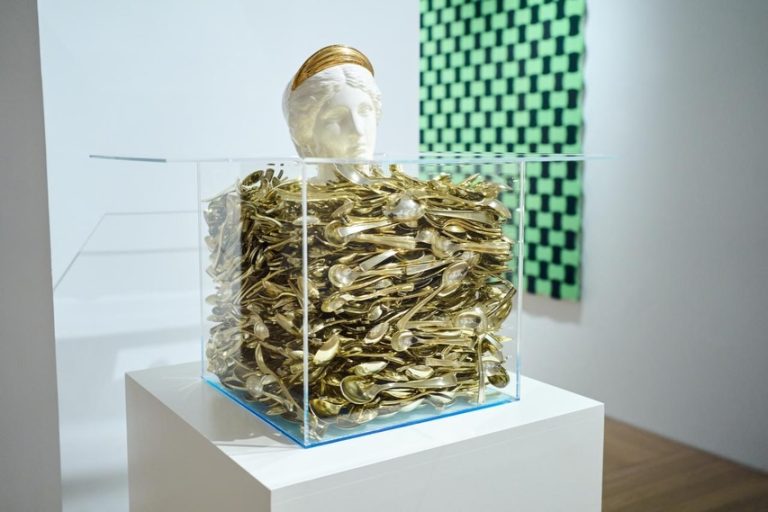
The presence of modern and contemporary works, finely chosen by the art historian Jean de Loisy, then takes on its full significance. This dialogue between ancient and contemporary operates visually, without being an artificial rapprochement. It engages, in fact, a real reflection on the injunction to beauty. What does it mean to look at a woman’s body? What is the status of women? In the video installation In the Mirror by filmmaker Chantal Akerman (1950-2015), the mirror becomes a symbol of a weakening relationship with the body. At Michelangelo Pistoletto (born in 1933), the statue of Venus surrounded by rags demonstrates that beauty can be born from anything. Finally, it is by going around a wall covered with uteruses drawn by Annette Messager (born in 1943), in a beautiful scenographic gesture by Nathalie Crinière, that the Venus of Arles is revealed. A Venus that we perceive with a new eye, in the light of the journey traveled.
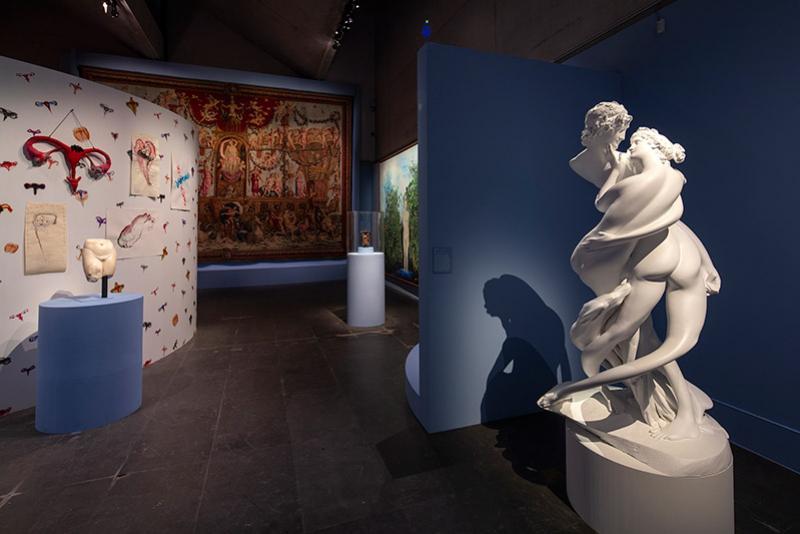
View of the exhibition “The Passage of Venus” at the Arles Antique Departmental Museum.
© Rémi Bénali