Besançon (Doubs). It is the story of a partnership that has lasted for a decade. It all started with the screening of several films by Nina Laisné (born in 1985), a graduate of the École supérieure des beaux-arts de Bordeaux, during a cycle of “special sessions” at the Frac Franche-Comté, in 2016. The young artist, whose practice oscillates between visual arts, music and performing arts, was invited a few months later to carry out a creative residency within the Bisontine institution. The Frac then dedicated a first solo show“L’air des infortunés”, in 2019, which ends with the acquisition of a multidisciplinary installation – this same work is part of the corpus of the first hanging of the Frac branch opened in June 2025, in Arc-lès-Gray, in Haute-Saône. It is therefore quite natural that the establishment today dedicates its first major monographic exhibition to her, and it is clear that the director of the Frac, Sylvie Zavatta, has flair: she was able to detect the potential of an unclassifiable artist whose talent brooks no disciplinary boundaries.
Musical syncretism
A reflection is necessary from the start of the visit. Nina Laisné is an erudite artist and her in-depth knowledge of the baroque repertoire and the oral traditions of South America allows her to skillfully play with the conventions of the musical languages she invokes.
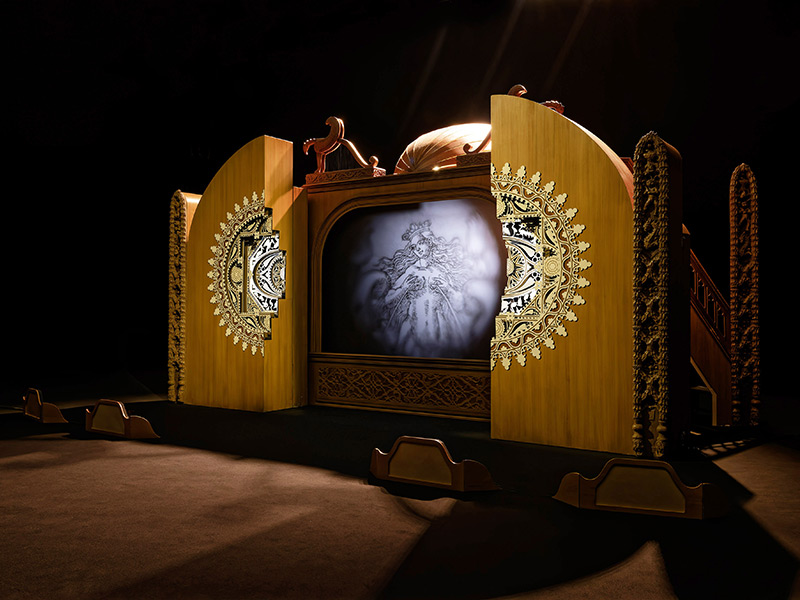
In Arca ostinata (2026) (see ill.), a sound and visual installation adapted from an eponymous opera created in 2021, the Spanish theorbist Daniel Zapico improvises from a score which brings together a ostinato baroque and a song of Peteneraa very old musical genre, probably born in Latin America and taken up in the flamenco repertoire. By hybridizing registers and subtly altering the timbre of the theorbo, Nina Laisné deploys new and captivating sounds.
Further on, the musician and visual artist presents a completely original immersive installation: the small room which houses Frati uccelli (2023), plunged into darkness, comes alive to the rhythm of a song resulting from a hybridization between a score by the baroque composer Étienne Moulinié and verses by the poet Salomon de Priezac. Performed by singers from the Squadra di Genova, the song which evokes the myth of the “bird brothers” is accompanied by four paintings painted by Nina Laisné and three collaborators in the style of Flemish Renaissance landscapes – impossible not to see a nod to the paintings of Joachim Patinier (1483-1524). This work, as accomplished on a musical level as it is plastic, shows the extent of the artist’s talents, which never ceases to surprise.
Nina Laisné, who almost always surrounds herself with a multitude of craftsmen (cabinetmakers, luthiers, rosette creators), painters and musicians, also demonstrates that a work of art can increase its strength tenfold by taking advantage of the complementarity between know-how.