
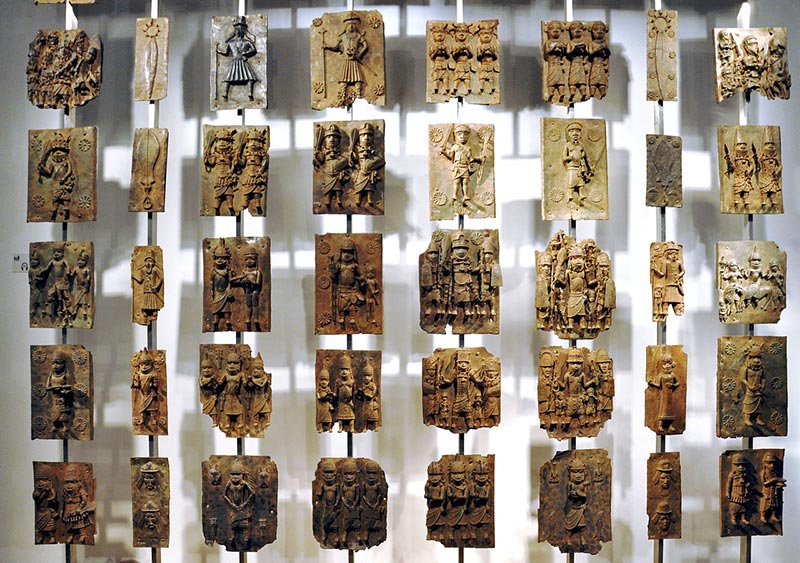
“This proposal is an insult to a nation seeking the return of artifacts looted by British forces in 1897 “, protested the Director General of the National Commission for Museums and Monuments (NCMM) of Nigeria, Olugbile Holloway. Responding to a request from the Nigerian government, which became official in 2021, the British Museum offered to lend the Benin Bronzes kept in its collections, ruling out the possibility of a transfer of ownership. “I’d rather you keep them forever than lend us something that was stolen.”added Olugbile.
While it recognizes that many of these objects come from the looting of Benin City in 1897, the British museum explains that it wants to favor an approach focused on cooperation and the sharing of knowledge. And to invoke the British Museum Act of 1963, asserting a legal constraint preventing the requested transfer of property. Section 5 of the Act strictly regulates the conditions under which a work or object from the collections of the British Museum may be transferred, and looting does not fall into the exceptional categories. The museum has been using this argument for several years to demonstrate its inability to decide unilaterally to make a restitution. Furthermore, he claims to maintain good relations with Beninese institutions, while helping to promote their heritage.
For its part, Nigeria has for several decades expressed its desire to find the Bronzes, looted in 1897 from the royal palace of the former kingdom of Benin by British troops, during the invasion of Benin City. As early as 1991, the Oba of Benin (the traditional sovereign of the kingdom) claimed restitution, but no official procedure was initiated until 2021, when the Nigerian Ministry of Information and Culture sent an official request to the British Museum, then provided the details requested by the British institution in July 2022. A period of negotiations followed, before the new director of the British Museum, Nicholas Cullinan, clarified the position of his institution in a interview published in May 2025, stating that transfer of ownership was not contemplated.
If the legal framework is invoked, there are exceptions to the ban on the transfer of collections, which go beyond the limits of the British Museum Act. Specific legislative provisions have already been adopted for certain cases: the Human Tissue Act of 2004 authorized certain national museums to transfer ownership of human remains dating back less than 1,000 years, and the Holocaust Act of 2009 created a specific mechanism authorizing the return of property stolen by the Nazis. However, no comparable legislative measure has been adopted concerning property acquired illicitly or illegally during the colonial period.
Other British institutions, however, have made restitutions. In February 2026, the University of Cambridge transferred ownership of 116 objects from the ancient kingdom of Benin to Nigeria, 17 of which are to remain on display in the UK on loan. The Horniman Museum in London had already transferred ownership of 72 objects in 2022. Unlike the British Museum, these establishments are not subject to the same legislative restrictions.
In France, 26 works kept at the Musée du Quai Branly-Jacques Chirac from Abomey were returned in 2021 to the Republic of Benin, after the adoption of a specific law in Parliament having authorized the museum to derogate from the principle of inalienability of French public collections.
The Benin Bronzes held at the British Museum constitute one of the most important collections of royal African art preserved in Europe. Made, for the most part, from the 16th century by the craftsmen of the Oba’s royal court, they refer to brass relief plaques representing scenes of war, sovereigns or ceremonies, which decorated the pillars of the royal palace. Also included among the looted works are animal and human sculptures, and objects of worship. In total, 900 objects from the Kingdom of Benin are held at the British Museum, some of which were acquired after the 1897 expedition from private collectors, and whose provenance also raises questions.
With Greece, the British Museum has for several decades maintained a conflict similar to that between Nigeria, refusing to return the Parthenon marbles. However, unlike the Benin Bronzes, the London museum contests the illegitimacy of the conditions of acquisition of the sculptures claimed by Athens.