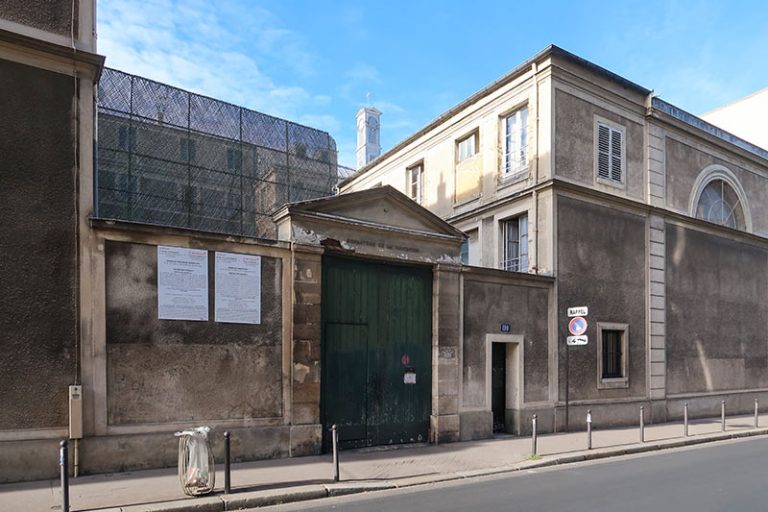
Château-Thierry (Aisne). “Nothing is so sweet as the place where one was born”recalled Jean de La Fontaine, in 1678, in his fable “Death and the Unhappy”. An adage that particularly resonates in Château-Thierry, where the famous writer’s birthplace has just reopened its doors after renovation. More than three years of work have enabled the Jean de La Fontaine Museum to deploy a more fluid route, gaining exhibition space. From now on, the visitor no longer passes through the large entrance gate but through a new reception area, set up under the project management of the Pallot agency in a reclaimed part of the adjoining media library. The first milestone of this project, launched in the fall of 2022, the construction of this new space made it possible to bring together the reception, the boutique as well as a temporary exhibition room much larger than the previous one. It is also thanks to this gain in surface area that an elevator could be installed, ensuring complete accessibility of the place. The building, for its part, has been extensively restored: masonry, electricity, carpentry, painting, floor refinishing, etc. A step prior to the implementation of the last phase of the project: the redesign of the tour route.
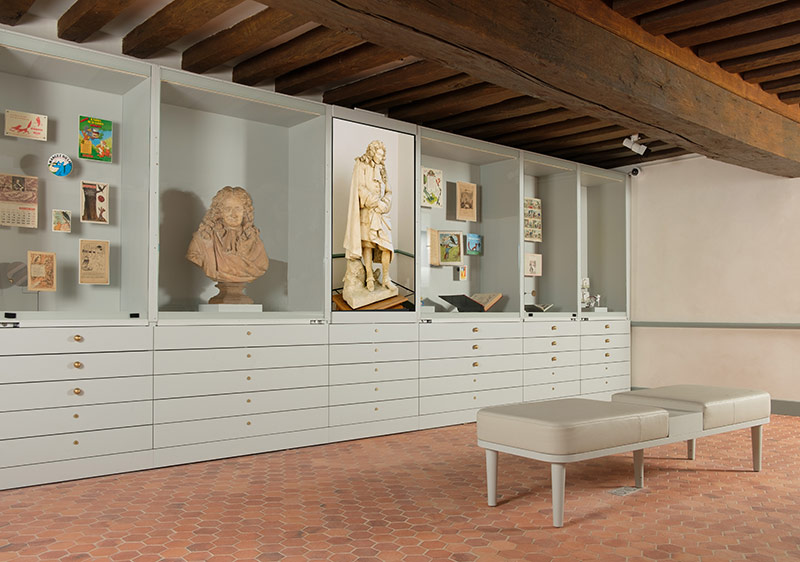
Until now closed to the public, the second floor of the museum serves as the starting point for this new journey. By moving the offices into the old shop, then transferring the reserves to the Hôtel-Dieu in Château-Thierry, the vacant space could be transformed into introduction rooms. Advertising illustrations, school textbooks, maps and vignettes depict the most famous fables of Jean de La Fontaine, while a film narrated by the writer himself retraces the history of his house, in which he lived for fifty-five years. “He is famous for his fables but what he published first were his tales, recalls Claire Tronson, cultural mediator at the museum. What I find most interesting when you come to the museum, beyond learning more about the poet, his life, his times, is precisely to discover all these little-known works. » From an accessible entrance, the route widens to reveal the full diversity of his work: poetry, theater, opera, licentious tales…
“ With these new surfaces, we were also able to further develop the history of the museum, its collections, and highlight all the small luxury objects that illustrated his writings”adds Claire Tronson. Thus, pride of place is given to the remarkable collection of Baron Feuillet de Conches, a fervent admirer of Jean de La Fontaine, whose work he had illustrated by more than fifty artists from around the world between 1828 and 1840. Well-chosen illustrations from this collection sit alongside prints by Marc Chagall and Salvador Dalí. Further on, a beautiful selection of refined objects shows the resounding echo that his literary productions received in the decorative arts. Gradually, the portrait of the man behind the work emerges: the scholar through his reconstituted library, the man of society with the presentation of his protectors, the role of master of water and forests that he held at Château-Thierry.
“This project was an opportunity to completely rethink museography,” rejoices Claire Tronson. New furniture, reworked lighting, integration of touch screens throughout the route: the visit is intended to be more fun and accessible, with particular attention paid to young audiences and schoolchildren, who can now benefit from an educational room set up on the site of the old attic.
With the objective of strengthening the attractiveness of the museum frequented by 15,000 visitors per year on average. To do this, the City has mobilized the necessary resources by financing 23% of this project at 6 million euros, to which were added subsidies from the State, the Region and the Department (72%) as well as sponsorship (5%).
The Jean de La Fontaine Museum, street side.
© City of Château-Thierry