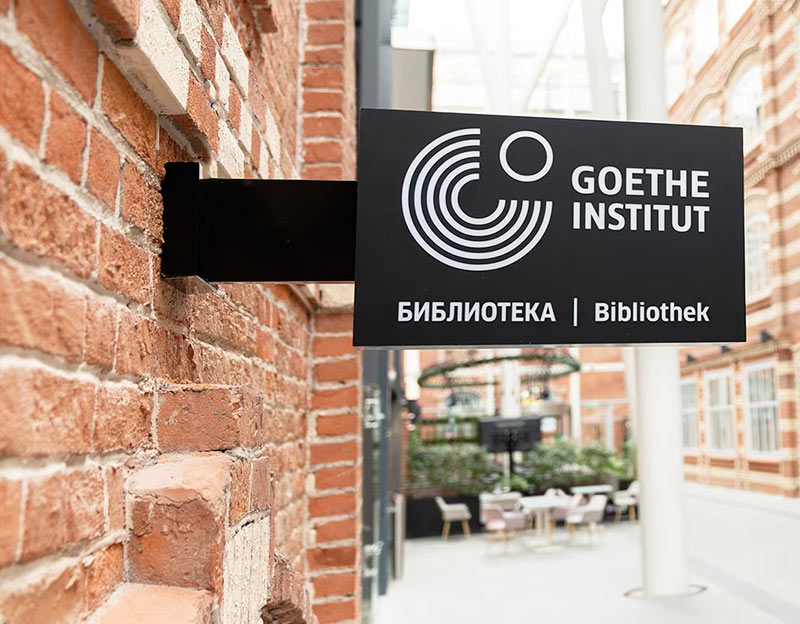
In Berlin, the information did not come as much of a surprise. Since the announcement last Tuesday of new German sanctions imposed on Russia, the government of Friedrich Merz expected retaliation from the Kremlin. It’s done: Thursday, September 3, Foreign Minister Sergei Lavrov announced the closure of the Goethe Institutes on Russian territory during the Eastern Economic Forum in Vladivostok.
This decision is a further blow to German-Russian relations and virtually puts an end to the German institutional cultural presence in the country. Lavrov first indicated the end of the contract with the Goethe Institute in Moscow, before confirming that its secondary branches “will be closed after the expulsion of our cultural center”. The declaration comes after the summons, last Wednesday, of the highest representative of German diplomacy to Moscow, which itself followed the visit of the Russian ambassador to Berlin at the request of the German government.
On September 1, the German interior and foreign ministers announced the closure of the Russian consulate located in Bonn, North Rhine-Westphalia, as well as the termination of the agreement allowing the operation of the Russian House in Berlin. These were sanction measures taken as a result of the presence of a drone loaded with explosives on German territory. Found at the beginning of August near a Ukrainian plane at Leipzig airport, the device was linked to Russian state services after several weeks of investigation. On the Russian side, the Kremlin has formally denied any involvement in the Leipzig drone affair. Lavrov maintains that German authorities have presented no evidence, and Vladimir Putin has called the measure “new big mistake” from Germany.
A non-profit organization aimed at promoting the language and spreading German culture abroad, the Goethe Institute was founded in 1951. In 1992, Russia’s first Goethe Institute opened in Moscow, shortly after the fall of the USSR. A second opened in St. Petersburg the following year, and a partner center was established in Yekaterinburg in 2003. Since 2023, the Moscow and St. Petersburg sites operated at reduced capacity, serving primarily as libraries, while German language courses were provided by approved external partners. The Novosibirsk site, another Goethe Institute which opened in 2009, has been operating as a contact office since 2023. For the moment, the Kremlin has not given details regarding the date on which the three German sites will close.