To celebrate the 75th anniversary of the “Ball of the Century”, which brought together the high society of the 1950s for a memorable evening in Venice, a new museum was inaugurated in the former house of Pierre Cardin (1922-2020) with a costume ball, Thursday September 3. An exhibition of 350 pieces, including 130 items of clothing, accompanies the opening and will be made accessible to the public from September 12.
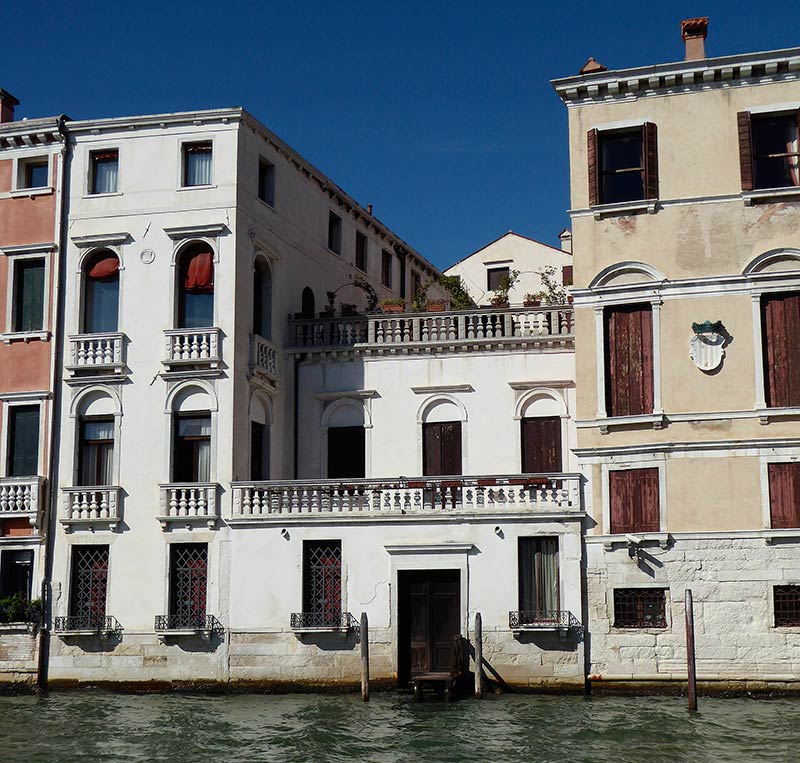
The Bragadin Palace, acquired in 1981 by Pierre Cardin, was his Venetian residence for almost 40 years. More than just a place to live, the home was a true creative nest for the stylist, who found there the necessary inspiration to create pieces at the forefront of fashion. Behind a Venetian Gothic style facade, whose Byzantine influences stand out on the terracotta pink, the Palazzo on the edge of the canal offers 1,000 m2 of exhibition space, which will be arranged according to a thematic display which plans to evolve every September 3.
It was also in this residence that Rodrigo Basilicati-Cardin, great-nephew of the designer, met his uncle in 1994. Also president and artistic director of the Pierre Cardin house, he selected for this inaugural exhibition pieces representative of the architectural treatment of clothing, one of the most striking characteristics of the designer’s approach. The opening of the museum is also a way for Rodrigo Basilicati-Cardin to highlight the artistic dimension and authenticity which characterize, according to him, the essence of the Cardin house, whose name is today affixed to hundreds of derivative products.
Beyond the prestige granted to his work, Pierre Cardin is also known for being one of the first haute couture figures to have developed his ready-to-wear line. He is also one of the creators who have pushed the licensing system the furthest, and in a pioneering way. Developed in more than 800 product categories, from leather goods to household appliances, its brand adorns frying pans as much as handbags and today has 130 licenses. Today, Rodrigo Basilicati-Cardin wishes to regain control of this disparate group and resume a qualitative link with the licensed companies, even if it means having to terminate the contracts of some. The creation of this new museum in a historic house of the designer helps to support this strategy, by highlighting the creative process and the inspirations that accompanied his beginnings.
Pierre Cardin took his first steps in the fashion world at the age of 14, during an apprenticeship with a tailor in Saint-Étienne. He arrived in 1945 in a liberated Paris, where he worked for Paquin, then for Elsa Schiaparelli. From his meeting with Jean Cocteau, the costumes for the film Beauty and the Beast (1946) were soon born, which he produced alongside Christian Bérard, and whose experience may have contributed to developing his taste for the theater and the stage, evident in later creations. The following year, he joined Christian Dior and participated in the creation of the “New Look” silhouette, one of the most significant in fashion history. Building on this experience, the young 28-year-old couturier opened his own house in 1950, and it did not take him long to begin developing innovative silhouettes; he then detaches the garment from the body, imposing an almost sculptural treatment on it. In 1951, he created around thirty costumes for the star guests of the “Ball of the Century”, organized by Charles Beistegui, including the one worn by Salvador Dalí.
In 1954, he created the famous Bubble Dress, which appears in the itinerary of the next exhibition at the Palais Bragadin. Other emblematic pieces from the Cardin collections were taken out of the archives for the occasion, including silver lamé dresses. Representative of the Space Age aesthetic of the 1960s, they echo the designer’s recognition as a true fashion icon. Fueled by the fascination with the conquest of space, Space Age clothing transforms the body into geometric shape, and uses modern materials gleaned from the world of textiles, such as PVC or Plexiglas. The route thus retraces several decades of creations, from the 1950s to the 2000s. The clothes from the 1970s will be accompanied by certain “utilitarian sculptures”, furniture with sinuous shapes imagined by Cardin, which combine the useful with the decorative.