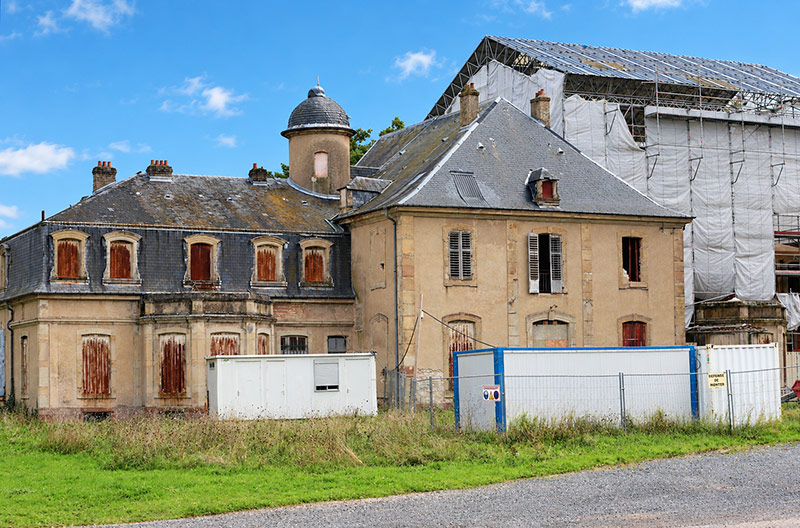
Twenty-three years after the devastating fire at the “Versailles of Lorraine”, another castle in the town of Lunéville (Meurthe-et-Moselle) was affected by the flames. During the night of Monday October 5 to Tuesday October 6, the Château de la Favorite was almost completely reduced to ruins, despite the intervention of the firefighters.
Significant resources were deployed to deal with the fire, which broke out around half past midnight in the building built in 1730 to plans by the architect Germain Boffrand at the request of Duke Leopold I. 25 firefighters were mobilized to try to extinguish flames several meters high, and the fire was finally contained in the morning. Crews are still on site to secure the area, and a security perimeter had to be established due to the risk of collapse. For the moment, the origin of the fire remains unknown.
Partially listed in 1984, then fully listed in 1992, before being fully classified as a Historic Monument in 2011, the castle has been abandoned since its purchase in 1999 by a private owner, “with whom no one has contact” according to the mayor of Lunéville Catherine Paillard, who deplored a great loss for her town and expressed her dismay at the situation in which the building has been stuck for several years. A situation that the Association for the Defense of the Favorite (ADF), which for around fifteen years has been carrying out a project to restore the castle, remains hopeful of reversing.
This is not the first time that the heritage of the town of Lunéville has been affected in this way. In 2003, the Château de Lunéville, official residence of the Dukes of Lorraine from the 18th century, was greatly damaged by a fire caused by a short circuit in its chapel. The building, also built at the request of Duke Leopold I between 1703 and 1720, is still the subject of a major restoration campaign, although it is once again accessible to the public. 50 million euros have already been spent on the work, and the Department of Meurthe-et-Moselle, owner of the castle since 2017, is budgeting an additional 15 million by 2028, the estimated date of reopening. Since 2025, a scientific and cultural project has been developed in parallel with the restoration, aiming to create an exhibition route in the former ducal apartments.