Issoudun (Indre). “ Shortly before Bellmer’s death, I had, through a mutual publisher, been introduced to Leonor Fini. […] I went to her house and she reminded me of a superb feline; receiving me in a sumptuous place (the polar opposite of what I had experienced and was experiencing), she suggested that I, as Bellmer had done, choose a drawing to engrave. […] » This quote from Cécile Reims, published in Cécile Reims by Maxime Préaud and Bernard Gheerbrant (ed. Cercle d’art, 2000), is inscribed, at the Museum of the Hospice Saint-Roch in Issoudun (Indre), on a wall of the space dedicated to the couple she formed with Fred Deux. It is thanks to them that the Berrichon Museum has become the French reference institution on Leonor Fini (1907-1996) and that the exhibition of nearly 70 works commemorating the thirtieth anniversary of his death is organized there. This event also testifies to the enrichment of the museum through donations born from partnership with artists, an exemplary policy which is also demonstrated by the Pignon donation also presented at the moment.
Installed in 1973 in Indre, in Crevant then in La Châtre, Cécile Reims (1927-2020) and Fred Deux (1924-2015) began a relationship with the neighboring Issoudun museum. The exhibition “Leonor Fini. Graphic works” was held in 1991 thanks to the mediation of the engraver who was the interpretive engraver of the painter. She, owner since 1972 of a residence in Saint-Dyé-sur-Loire (Loire-et-Cher), was also his neighbor and his friend. At the end of this exhibition, Leonor Fini donated two drawings to the museum, Untitled (Passion fruit) (see ill.), Thirty-two variations on a themeby Leonor Fini (around 1980) (see ill.) and Untitled (The Secret Parties) (1977-1982). Then, during the 1990s, the Reims-Deux couple convinced Leonor Fini to bequeath to the town of La Châtre the decor of her Parisian salon on rue de La Vrillière, the “sumptuous place” that the engraver mentioned. The observation that this municipality could not develop, as had been planned, the reception space for the legacy at the Château d’Ars later led the beneficiary of Leonor Fini, Richard Overstreet, to transfer the living room to the Hospice Saint-Roch for a symbolic euro. This spectacular piece, installed on the former location of the reserves, has been presented to the public since 2007.
An important collection made up of legacies
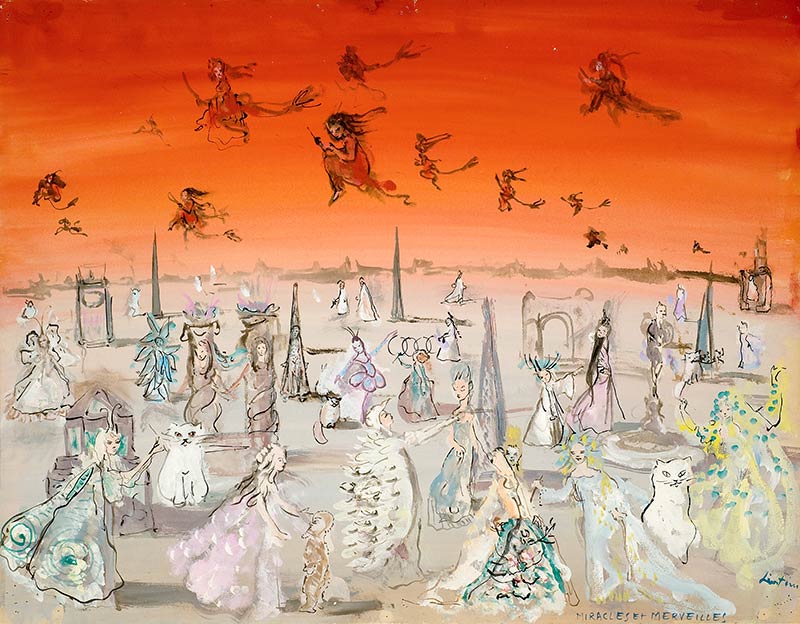
For their part, Cécile Reims and Fred Deux decided in 2001 to donate their entire collection to the Issoudun Museum: their studio funds, the works they had from their friends and their African and Oceanian sculptures. In 2002, the drawings that the engraver had received from Leonor Fini to carry out her work entered the museum. Then it was the turn of the prints, in 2006. This is how the institution gradually built up a large collection of works by the surrealist artist, which has since been increased by a few acquisitions. This year, the drawings are presented for the first time in their entirety and several engravings appear in the “Cécile Reims and Fred Deux” space. Although it is primarily devoted to graphic art, the route nevertheless presents oils: those, on canvas, which are part of the show and Transvestite woman (1931), deposit of the Center Pompidou. Around the latter are hung works from local private collections, because Leonor Fini had established links in this Berry where she now rests. Among the gifts she was able to give are, for example, the two beautiful portraits of her friend Aisha (1993). Oil on panel Landscape VI (1953) and oils on paper hang in this section. Like the portraits of Aïcha, The Fall of the House of Usher (1987), Metzengerstein (1987) and The Mystery of Marie Roget II (1987), illustrations for collections Edgar Allan Poe, Worksas well as The Apparition (1987), are interesting because they belong to Fini’s late production, generally much criticized. However, unlike many of the screen prints from which she then derived her income, we discover her inspiration, her talent and her freedom intact, just as in the drawings of the 1970s and 1980s interpreted by Cécile Reims.