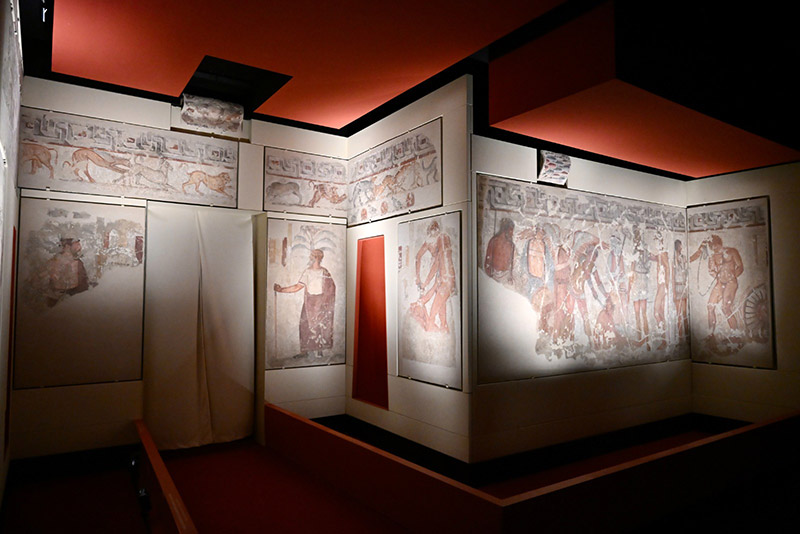
The Italian state had wanted to acquire it for several decades, and the Meloni government did so: after more than a century in private collections, the frescoes of the Francis of Vulci Tomb are now on public display at the Villa Giulia in Rome.
The exhibition begins just over a month after the 15 million euro purchase from the heirs of the aristocratic Roman families Torlonia, Sforza Cesarini and Gaetani, owners of the 4th century (BC) Etruscan tomb panels. With this exceptional acquisition, the Italian State is paving the way for a lasting presentation. If the scenes represented are known in the academic field, thanks to the reproductions of the painter Carlo Ruspi, the frescoes had until then been the subject of only a modest exhibition at the Archaeological Museum of Vulci, following their restoration in 2004. From this point of view, their transfer to the Etruscan Museum in Rome, located in the sumptuous palace of Villa Giulia, is an event. In order to offer a more faithful reconstruction of the original decor of the hypogeum, the exhibition relies on loans from European museums, including the Louvre Museum, which keeps fibulae and other jewelry, and the British Museum, which has several pieces of pottery.
With this purchase, the government of Giorgia Meloni continues its sensational acquisition policy, which the title of this exhibition “The Return of the Heroes” seems to sum up well. Following a stated objective of enriching Italian collections with national masterpieces, the Ministry of Culture recently paid 30 million euros for a Caravaggio (Portrait of Maffeo Barberini1597-1603) and 12.5 million euros for a Ecce Homo (1470-1475) by Antonello of Messina. If the frescoes of Vulci are less captivating for the general public, their acquisition “reminds us that Italian identity is the fruit of a thousand-year-old history”declared Culture Minister Alessandro Giuli. A very rich ancient civilization, whose aristocracy was very powerful and whose artistic production was intense, the Etruscans embody a symbolically strong past.
Frescoes from the Tomb of Francis of Vulci exhibited at the Villa Giulia in Rome.
© Ministero della Cultura
As recalled by Leonardo Casalino, professor of contemporary Italian history and civilization at the University of Grenoble, at JdA, “in Italy, there has always been a debate on the need to be able to bring back works of art. Sometimes it was a bit demagogic”. But the researcher underlines the difference between a policy of repatriation of Italian works on the basis of nationalist criteria and a strategy of patrimonialization of works from the private market: “Regarding the old controversy over The Mona Lisathere was surely an identity explanation on the part of the political world. In the case of this year’s acquisitions, it is about allowing public exploitation: there is a value that goes beyond a nationalist and political explanation.. And to add: “we can imagine that another minister with another political culture pursues a similar policy, without accompanying it with a nationalist discourse”.
During the first mandate of Dario Franceschini, Italian Minister of Culture at the origin of a major reform movement, the acquisition policy was significantly different. Between 2016 and 2017, under the Renzi then Gentiloni governments, 151 works were acquired for around 4 million euros. A budget which, compared to the 57 million spent in mid-2026, seems very meager. However, some important painters were among the purchases: Gustave Courbet, Carlo Carra, Pompeo Batoni and Bernardo Strozzi. A selection without any apparent guideline, which brought together names from the Italian baroque, the futurist avant-garde, as well as foreign painters.
Discovered in the Ponte Rotto necropolis in 1857, the François Tomb takes its name from the Florentine archaeologist Alessandro François. The excavations were subject to the control of Alessandro Torlonia, owner of the land, who had the frescoes detached from the tomb in 1863 to integrate them into his personal collection at Villa Albani. They depicted scenes to the glory of the Saties, a family of the Etruscan military aristocracy who owned the tomb.
Particularly noted by historians, the scene of the massacre of the Trojan prisoners by Achilles during the funeral of Patroclus, on the left wall of the tablinumhas been interpreted as an allegory of the historical war between Rome and the Vulcians, depicted on another wall of the hypogeum. The remainder of the artifacts found in the mortuary chambers were dispersed throughout European collections. With this exhibition, the Italian State is reconstituting a powerful testimony to the Etruscan aristocracy, referring to the pre-Roman artistic wealth of the country.