The House of Representatives has just rejected a museum project that was widely supported at its origin. It ultimately did not obtain the votes necessary for its adoption. The introduction of the notion of “biological women” and the explicit exclusion of trans women shattered the fragile bipartisan consensus.
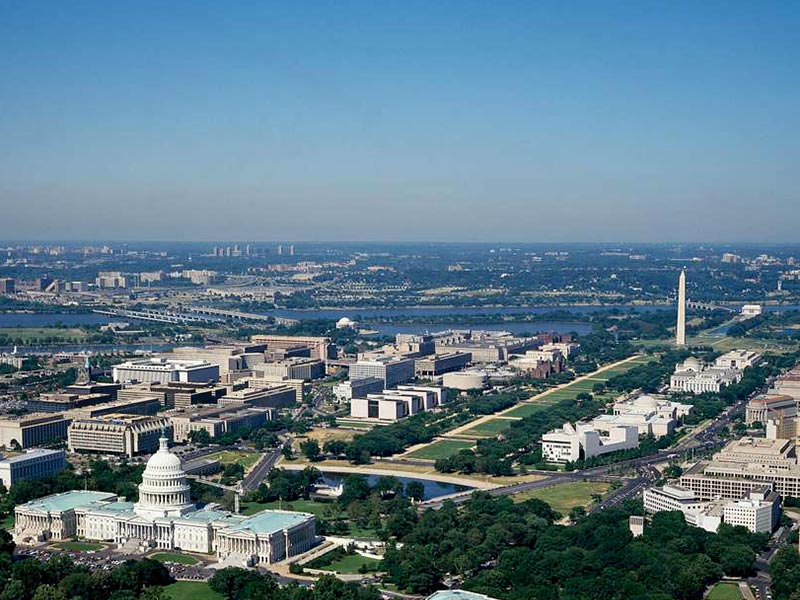
For more than twenty years, the idea of a major national museum dedicated to the history of American women had been in the air. In December 2020, Congress took a historic step by authorizing the creation of the American Women’s History Museum within the Smithsonian, with broad bipartisan support and the signature of Donald Trump at the end of his first term. But a specific text remained necessary to allocate land on the National Mall, the large monumental esplanade in Washington DC which notably hosts the Smithsonian museums.
The movement to make this museum a reality subsequently strengthened. In February 2025, Republican Representative Nicole Malliotakis introduced the bill – the Smithsonian American Women’s History Museum Act – which seeks to allocate a location on the Mall. The text brought together more than 230 co-signatories, including 127 Democrats and 103 Republicans. A specific site was considered: the museum was to be located opposite the National Museum of African American History and Culture. This massive support made this initiative one of the rare parliamentary subjects capable of transcending partisan divisions in Washington.
The situation changed abruptly in March 2025 when Trump signed the executive order “Restoring Truth and Reason to American History”. The decree condemned, among other things, an exhibition planned at the future women’s museum which was to honor transgender athletes, calling their inclusion an “improper ideology”.
In this climate, Nicole Malliotakis’ text, initially conceived as a consensual vehicle for choosing a terrain and a calendar, has become the issue of a semantic battle around the word “woman”. In March, the House Internal Affairs Committee was scheduled to consider the bill. But Republican Representative Mary Miller then filed a substitute amendment that completely replaced the original text.
This amendment redefined the museum’s mission as dedicated to “biological women.” The text stated that “the museum will be dedicated to preserving, researching and presenting the history, achievements and lived experiences of biological women in the United States” and prohibited“identify, present, describe or otherwise represent a biological male as a female”. It gave the President of the United States the power to designate an “alternative site” within 180 days. Furthermore, the amendment removed “diversity” from the composition of the board, substituting a range of political viewpoints and experiences.
The committee adopted the amendment and voted on the amended text on a strictly partisan line, by 7 votes to 4. All four Democrats on the committee opposed it, even though two of them were co-signatories of the initial version.
The breakup was immediate. The Democratic Women’s Caucus, chaired by Teresa Leger Fernández, called the amendment “partisan cluster bomb”. Democrats stressed that this amendment would have the direct consequence of erasing from the history of women key transgender figures like Sylvia Rivera and Marsha P. Johnson, founding figures of the movement for LGBTQ+ rights during the Stonewall riots. More than 146 House Democrats co-signed a letter in April asking Speaker Mike Johnson to reinstate the bipartisan version.
On the Republican side, defenders of the amendment, such as Mike Johnson, accused Democrats of making the construction of the museum conditional on the inclusion of transgender content. Nicole Malliotakis maintained that “America has enough women to honor in this museum without having to debate the inclusion of non-biological individuals”.
In May, the Chamber voted on the amended text: 204 votes for, 216 against. No Democrats supported the amended version. Six conservative Republicans have joined Democrats in the rejection camp, not to defend transgender women, but because they fear, according to the New York Times that the museum becomes “woke” once the Democrats regain power, or oppose its establishment on the National Mall.
The same day that the initiative to create a women’s museum failed, another monument wanted by Donald Trump took a decisive step forward. The Commission of Fine Arts, all seven members of which were appointed by Trump, after he fired previous members in October 2025, formally approved the revised design of the 250-foot-tall triumphal arch planned at Memorial Circle, on the artificial island of Columbia, facing the Lincoln Memorial across the Potomac. It is the same organization, made up of loyalists, which would have had the authority to validate the architectural plans for the future women’s museum according to the amended text.