Clermont-Ferrand. Some view the return of figurative painting with a wary eye. Forcefully, the Frac Auvergne retorted that the French scene was full of talented young painters. With “Inhabiting chaos”, the Clermont-based institution demonstrates that it occupies a place of choice in terms of supporting emergence in the pictorial field. For the first personal exhibition of Johanna Mirabel (born in 1991), the curator and interim co-director of the Frac, Laure Forlay, opted for a chrono-thematic route which allows us to appreciate the evolution of the artist’s practice between her graduation from the Beaux-Arts de Paris in 2019 and today. The scenography, sober and airy, enhances each canvas while providing beautiful visual correspondences between the sections thanks to the perspectives offered by the architecture. As for the room texts, which abound with information on technique, they allow visitors to immerse themselves in the world of an artist oscillating between attachment to pictorial tradition and affirmation of a singular plastic vocabulary.
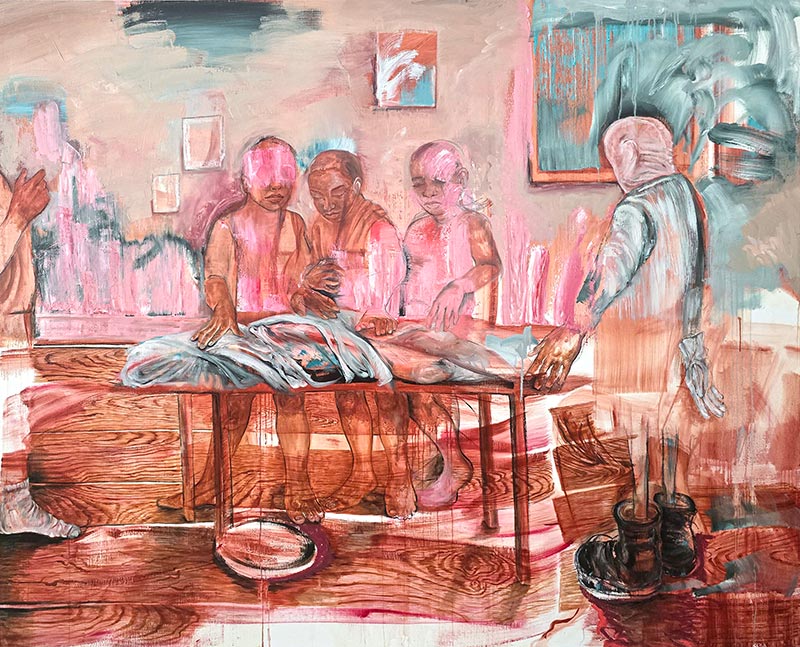
Johanna Mirabel, Masked pare n°22024, oil on canvas, 175 x 215 cm.
© Johanna Mirabel / Galerie Nathalie Obadia
Composition, driving force behind the painting’s narrative
From the teachings of the great masters, the young artist retained the preponderant role of composition for the narrative structuring of a painting. Her way of organizing her domestic interiors, according to a pyramidal hierarchy, reflects this: she does not hesitate to enhance her diagonals through parallel obliques and by contrast with horizontal and vertical lines at the edge of the canvas.. Sleeping Room #9 (2023) (see ill.) is, in this respect, edifying: the arm of the figure represented in the lower right part marks the starting point of an ascending diagonal supported by oblique lines formed by the body of the languid woman at the top of the pyramid. At Mirabel, line structures much more than color, and for good reason: the bodies, walls and floors are all in an overall ocher-sanguine tone. The artist, who traces his figures after painting using expressionist gestures, enhances certain parts with pasty or dry oil to give them their own volume and color while certain bodies remain devoid of fleshy envelope. In Sleeping Room n°10 (2023), the flexible modeling of the face and left hand of the figure – its posture is a direct reference to the engraving The sue of the earth produces monstrosities (1799) by Goya – contrasts with his right arm and the line of his back, barely sketched in charcoal. The extreme dilution of the oil allows it to obtain beings with a ghostly appearance: the lower limbs of one of the figures of Masked Paré (2024), formed from drips, barely stand out from a parquet floor whose wood details are rendered in a striking manner.
Johanna Mirabel exploits all the expressive force of not finished. She never deploys her reserves – sections of canvas covered only by a thin layer of Gesso – at random: in the painting Pared masked, which takes up the composition of Skeletons fighting over a hanged man (1891) by James Ensor, the central reserve serves to mark the opposition between the two men and to draw the eye to the famous hanged man lying on the ground. Mirabel is undoubtedly a great painter, in that she masters the art of both fullness and emptiness.