Verdun (Meuse). Epicenter of the fighting in June 1916, Fort Vaux was besieged and fell into the hands of the Germans on June 7, after fierce resistance from the French. Taken over in November 1916 and became a national symbol in 1917, it quickly became “sanctuary” at the request of veterans, as explained by Nicolas Czubak (head of the History, collections and mediation department at the Verdun Memorial). Official propaganda also took advantage of it, highlighting the carrier pigeon Vaillant, hero of the 1916 siege, honored in 1920 by a commemorative plaque on the facade of the fort.
The site is part of the EPIC “Verdun-Battlefield Memorial” which brings together Fort Vaux, Fort Douaumont and the Memorial (the ossuary and necropolis of Douaumont are managed by another operator). The rearrangements aim to make the exterior route more readable, and the interior route more immersive: the site can in fact be visited in two stages, the exterior stroll allowing you to understand the architecture of the building with its defenses. A few discreet rust-colored mediation panels dot the place while preserving the panorama. The grassy roof keeps traces of German bombings, “because in 1916 the fort was hit by more than 8,000 shells per day”according to Nicolas Czubak: like everywhere around Verdun, shell holes mark the landscape.
Aerial view of Fort de Vaux.
© Verdun Memorial / JLK
The renovation (5 million euros) mainly concerns the interior scenography (signed La Fabrique Créative), previously very basic according to Nicolas Czubak. The circuit was also modified, notably the directions of traffic and the entrances, and a reception pavilion was built on the square. Despite the narrowness of the corridors and the presence of several staircases, “a large part of the route is accessible to wheelchairs”, notes Mélina Zapotiny, communications manager at the Verdun Memorial. The lighting and sound environment were the subject of a long consideration, “because it was necessary to create a scenography in a constrained environment”explains Nicolas Czubak. The stronghold, which dates from the 1880s, is built of bricks and concrete; it suffered damage during the war and suffers from repeated water infiltration. Furthermore, it is home to swallows and bats which nest in its vaults: the scenography must take this into account…
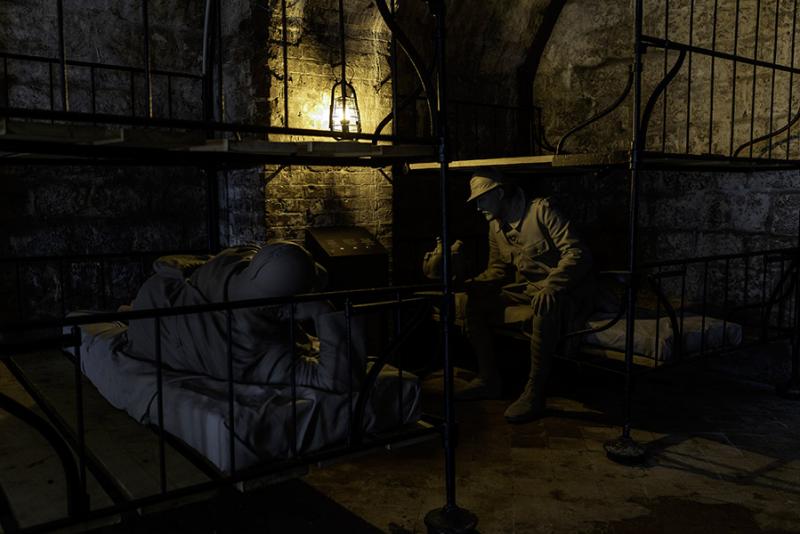
A dormitory at Fort de Vaux.
© Anaïs Cheny
Encourage the public to be active
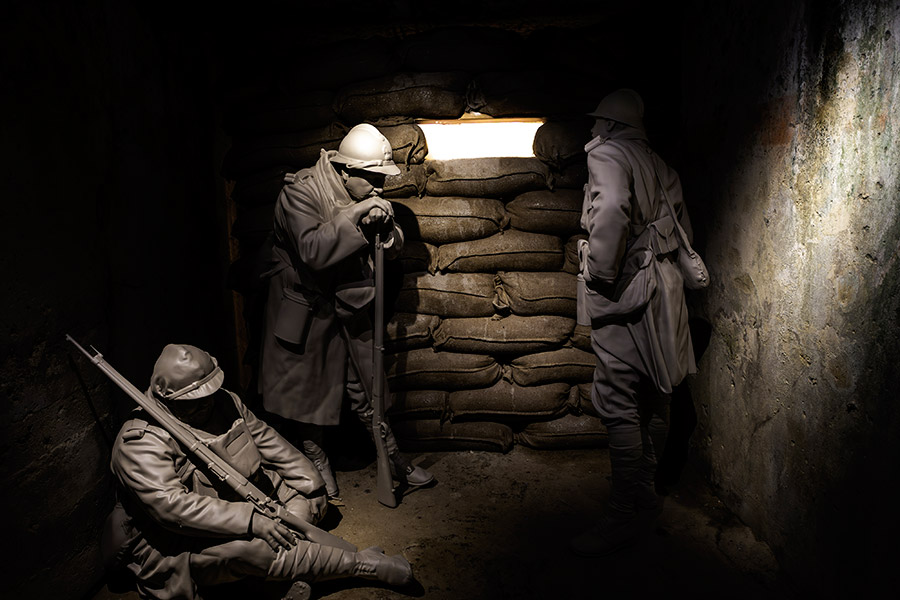
The tour takes place both in the galleries and in the different rooms, with numerous mediation devices and quite clever plays of light: the architecture is well highlighted in the darkness. From communications (walrus, carrier pigeon) to the weapons used during the siege, including the improvised infirmary and Commander Raynal’s office, visitors discover the daily life of the besieged soldiers: several life-size mannequin-silhouettes of Poilus enliven the spaces (see ill.), with some striking scenes (chambers lit by flickering lanterns). Each theme is enriched with digital or manipulatable devices which encourage the public to be active: encoding and decoding messages in Morse code, listening to soldiers’ testimonies, looking at individual files of soldiers killed during the battle of the fort, recognizing the sound of different shells, playing the role of a sentry. An innovative device uses bone conduction to make soldiers’ stories heard: the visitor places his elbows on two microphones and places his hands on his ears, a posture that encourages “to concentrate or recollect”, according to Mélina Zapotiny. The permanent exhibition obviously addresses the history of the fort and the chronological course of the battle, thanks to videos on a large screen and projections on relief plans, supplemented outside by semi-transparent panels in front of the facade which show the evolution of the structure of the fort.
The whole therefore gives a very complete vision of the site and the men who fought there, without neglecting the German point of view when relevant (list of German soldiers killed in June 1916) because “these sites bear witness to a shared history with the Germans”recalls Nicolas Czubak. This successful renovation, which marks the 110th anniversary of the Battle of Verdun, is part of a major project to modernize the three highlights of the Memorial, the latter having been redesigned in 2016 with a more lively scenography and the construction of a floor for temporary exhibitions. The last stage concerns the Douaumont fort which requires a new scenography according to Nicolas Czubak. Work will begin in 2027 for reopening in 2028.