Paris. Once is not usual for an exhibition by Daido Moriyama (born in 1938): it is not large prints of his photographs from the 1970s or later decades which serve as an introduction to the subject, but images from a book, Shashin yo sayonara (Goodbye photography), projected large and thumbed through page by page. Clichés, film scraps and cropped, zoomed, blurred, grainy television screen images follow one another without a narrative thread other than that of the free interpretation of the photographic representation of reality. As an afterword: the conversation between Daido Moriyama and Takuma Nakahira (1938-2015), organized on August 2, 1971, at the Yamanoue Hotel in Tokyo relating to this book that the photographer was preparing to publish the following year.
“Some may find this title sarcastic, but it reflects my disgust and my rejection of complacent photography, of photography that never questions itself, in other words a photography without reality,” points out Moriyama in this conversation. These questions constitute obsessions developed in four sections. Starting with that of the printed form of images through the book, review or magazine, essential and prolific for him.
“Each is a manifesto on its relationship with photography. These are notes of intention, professions of faith, true declarations of love for photography. recalls Clément Chéroux, director of the Henri Cartier-Bresson Foundation, curator of the exhibition with the Daido Moriyama Photo Foundation lending the exhibited prints. Subject of the first section notably via various publications developed on the walls, the second which follows addresses Moriyama’s fascination with Fat’s point of viewheliograph produced between 1826 and 1827 by Nicéphore Niépce, from a window of his house in Saint-Loup-de-Varennes, referenced as the first photograph in the history of the medium.
Moriyama’s obsession
This focus has never been carried out so deeply in the exhibitions devoted to the Japanese photographer until now, with the exception of “Un jour d’été”, presented in 2008 at the Nicéphore Niépce Museum, in Chalon-sur-Saône, a pioneer on this subject. It retraced Moriyama’s two trips: in 2008 to Saint-Loup-de-Varenne, and in 2015 to Austin, Texas, where the heliography is kept. On the eve of the Bicentenary of Photography, which will take place between September 2026 and September 2027, the Henri Cartier-Bresson Foundation is highlighting the importance of this photography for the artist through the photos he took during these two pilgrimages. It also brings together several previously unpublished works, including the framed poster reproducing the Fat’s point of viewformerly hung above the bed in his office in Tokyo, as well as the installation of 36 photographs taken between 2011 and 2017 showing this same reproduction with the reflections of the window changing according to the light of day.
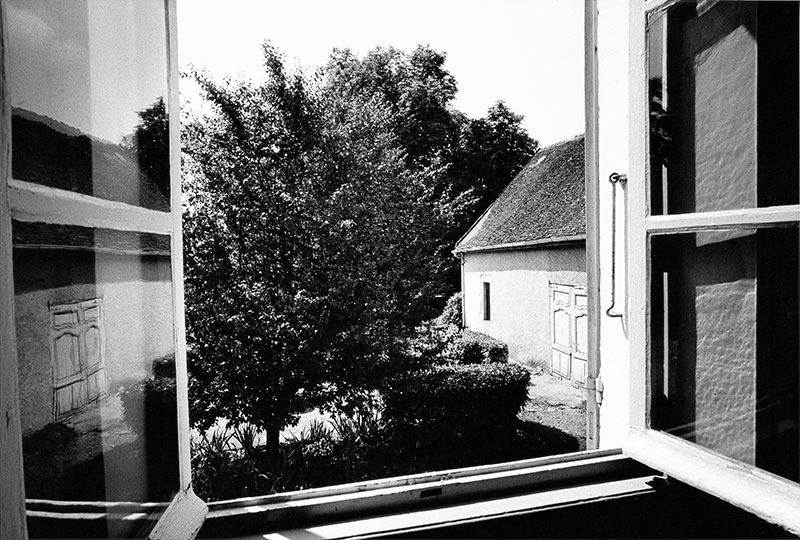
Daido Moriyama, Ikebukuro, Tokyo, Japan2011, photo published in Jikkenshitsu kara no nagame / View from the Laboratory, 2013.
© Daido Moriyama Photo Foundation
Another novelty: the publication of his pilgrimage to Saint-Loup-de-Varenne, published in the Japan Airlines magazine, after the airline gave him, in 2008, carte blanche to take a series of photographs wherever he wanted in the world. “For Moriyama, Niépce’s photography contains both the beginning of photography and the answer to all the questions he asks about his subject”explains Clément Chéroux.
The other two shorter sections that follow, “Metaphors and Scripture,” conclude this fascinating return to Moriyama’s constant visual meditations on the medium. They bring together a selection of self-portraits and photographs taken from his laboratory before addressing the essential place of writing in his work, particularly through his first book of texts, Inu no kioku(Memoirs of a Stray Dog), published in 1984, with the famous photo of the dog dating from 1971 on the cover. “Author of more than two hundred photography books, Daido Moriyama has never claimed to be a writer; However, he has written countless texts, since the 1960s, which shed light on his practice and his projects. The language barrier hindered their diffusion”recalls the gallery owner Jean-Kenta Gauthier in his introductory text to the book Daido Do Moriyama. Love letters to photographypublished by Delpire & Co, which offers a selection of his texts on photography, or fragments, translated for the first time into French.