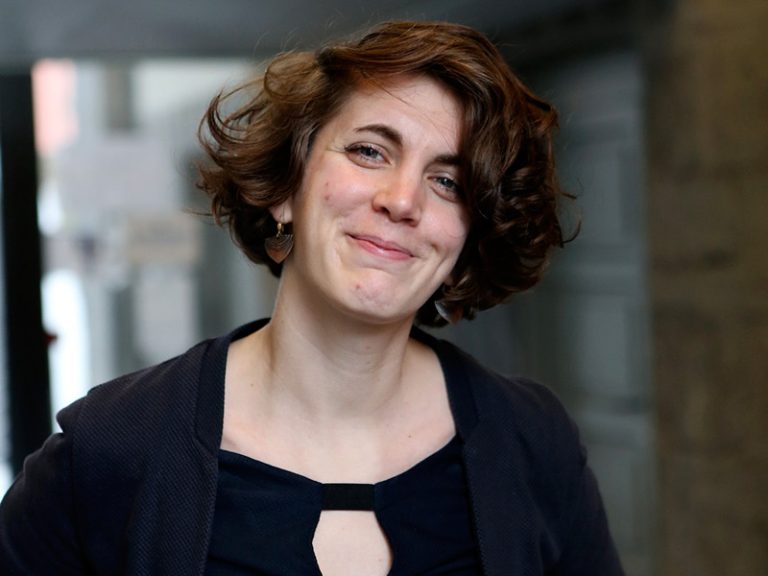
Jean-François Leroy died on August 31 in Paris from cancer, at the age of 69, as the professional week of the 38th edition of Visa pour l’image opens. Very weakened, Jean-François Leroy did not attend the inauguration on August 29, a first since the creation of the event. He nevertheless participated in the preparation of this edition, which continues in Perpignan until September 13.
Born in Paris on October 3, 1956, Jean-François Leroy discovered photography very early in the laboratory of Catholic Lifewhere an aunt works. He also had a passion for conjuring and briefly studied medicine before turning to journalism. He collaborates in Photo-Reporter, The Photographer And Photo-Reviewproduced reports for Sipa Press and became editor-in-chief of Photo Magazine from 1984 to 1987. But he quickly judged his own work as a photographer insufficient and chose publishing and defending the images of others. In 1988, he became the agent of Dominique Issermann and the following year, he participated with Yann Arthus-Bertrand in the “3 Days in France” operation, organized for the 150th anniversary of photography.
In 1989, Jean-François Leroy responded to the call for tenders launched in Perpignan to create an end-of-season event. With the support of Roger Thérond, then director of Paris Match, and Michel Decron, director of Photohe set up Visa pour l’image. The formula was set from the start: free exhibitions in the city, evening screenings and a week of meetings between photographers, agencies, editors and photo managers. The first edition brings together 123 accredited professionals, seven agencies and two countries. Thirty-seven years later, the event welcomes around 220,000 visitors and several thousand professionals from dozens of countries.
Jean-François Leroy made Visa pour l’image both a public event and a professional marketplace at a time when reporting budgets are decreasing in the press and many agencies are disappearing. Gold Visas, scholarships and prizes have gradually taken an increasing place in this system; more than 150,000 euros are now distributed to photographers each year. He has accompanied several generations of reporters, notably Laurent Van der Stockt, Alexandra Boulat, Stanley Greene, Rémi Ochlik and Guillaume Herbaut, while putting historical collections back into circulation, such as Funeral Train by Paul Fusco in 2000 or the photographs of the Korean War by David Douglas Duncan in 2008.
Its editorial line was deliberately not very museum-oriented: priority on the story, sober displays, little taste for scenography and very personal selection of subjects. This position has earned it criticism on the repetition of themes, the place of conflicts or the very embodied nature of the programming. Asked by The Eye in 2018 on his selection criteria, Jean-François Leroy responded: “My bad taste”. He added that he appreciated the definition of Visa as “the itchy skin of the press”. In 2024, regarding the impossibility of organizing a satisfactory exhibition on Gaza, he declared to the Arts Journal : “When we are no longer in information but in communication, I have a problem. »
Jean-François Leroy tried to extend this line outside of Perpignan. In 2017, he created and directed the Arch of Photojournalism, located at the top of the Grande Arche de la Défense. However, he left the project in October 2018, disagreeing with the repeated privatizations of the space and the constraints imposed by its commercial operator. Through Images Evidence, a company associated from 1997 to 2009 with Hachette Filipacchi then taken over by Jean-François Leroy, the director simultaneously maintains operational control of Visa.
In recent years, Jean-François Leroy has focused an increasing part of his positions on disinformation, social networks and images generated by artificial intelligence. In his editorial for the 2026 edition, he uses a fake photograph of Nicolás Maduro to recall the need for verified sources and field work.