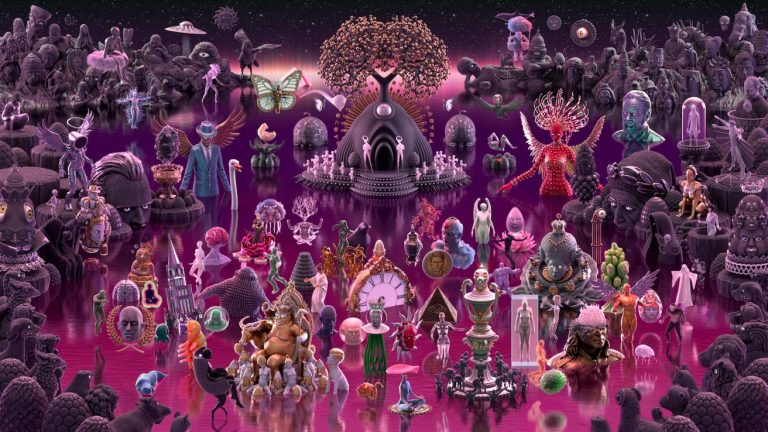
Paris. Sized for the Grand Palais, “Cezanne and us”, this “exhibition of all superlatives”, according to Claire Bernardi, co-curator with Michel Gauthier, Xavier Rey and Jean-Rémi Touzet, has the ambition to show “the continuity of the artists’ view of Cezanne […]a demonstration that we hope is the most visual and the most understandable for the public. » It is spectacular, including nearly 70 works by Paul Cezanne compared to around a hundred works by 80 other artists.
At the opening of the route, the juxtaposition of Bather (1885) by Cezanne, Bather (2019-2023) by Peter Doig and Cezanne Bather Postcard Keithstrasse (2021) by Wolfgang Tillmans fulfills the didactic objectives, these contemporary works transparently referencing the Aix master. The cartel of Bather introduces the rest of the journey: “ […] Its geometrization and sculptural aspect announce both Cubist nudes and a certain form of expressionism. The equal treatment of subject and background, animated by a vibrant touch, prefigures the beginnings of abstraction as much as the paintings of Jasper Johns. For Bather, it is specified that “ […] Doig sees something other than what the modernists saw in Cezanne’s painting: not so much the brushstroke, the permeable relationship between figure and background, as the enigmatic character of his characters. […] “. The explanations are clear. This is also the case when, further on, the relationship of the Neo-Impressionists with Cezanne is shown, for example. Strangely, the cartel of Five Bathers (1877-1878), which belonged to Pablo Picasso, does not specify that, if he only acquired this small work in 1957, he was inspired by the Bathers by Cezanne for The Young Ladies of Avignon (1907) – the information is however given by Arnauld Pierre in the catalog.
A word for insiders
Things become much more difficult for a non-specialist audience when we approach the landscape. If it is possible to see the Cézanian lesson in Alberto Magnelli or Morgan Russell, how can we find it in The Red Wheel (1920) by Fernand Léger (the cartel says it is “manifest in the adaptation of the Cézanian “sensation” to the visual demands of modernity as well as in the geometrization of volumes”) or in a sand-colored canvas with a very textured surface, Kompozycja unistyczna 10 (1931) by Wladyslaw Strzeminski, who “ makes Cezanne the main promoter of “realism of mobile vision” and of painting based on optics » ? It is in the catalog that an essay by Agnieszka Rejniak-Majewska explains the artist’s theories. Upstairs, in the space “A Cézanian renaissance of abstraction” where Pierre Soulages, Maria Helena Vieira da Silva and Serge Poliakoff appear, the demonstration is more obvious, except for Philippe Guston. The cartel accompanying two inks on paper is a masterpiece of uncertainty: “The abstract shapes seem to form a rocky material which is reminiscent of the landscapes painted by Cezanne”. The catalog not being more talkative, the public is asked to believe that Guston, who expressed his admiration for the painter, was subject to his influence (which is not the same thing).
Marsden Hartley (1877-1943), Mont Sainte-Victoire (red mountain)c. 1927, oil on canvas, 50 × 61 cm.
© The Vilcek Foundation Collection
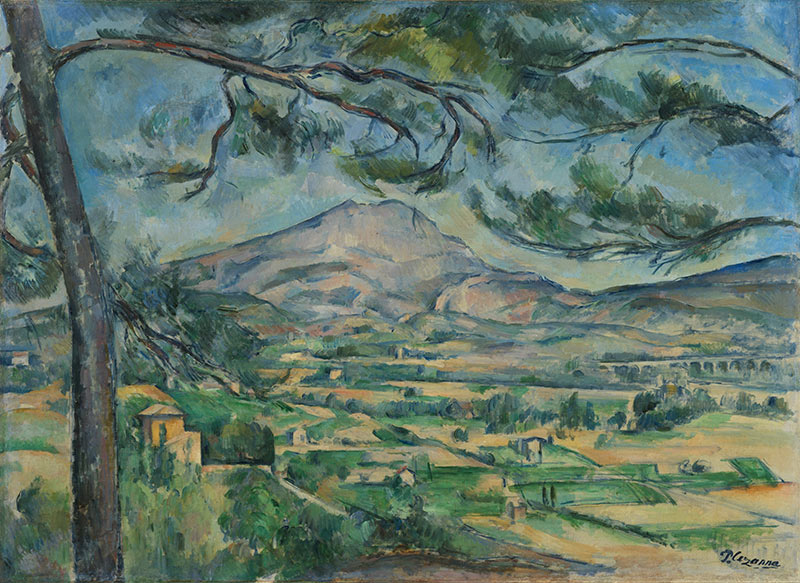
Then presented in covisibility, The Cengle Plateau Or Mount Cengle (1904-1906) by Cezanne and Untitled, “Renate” series (1965) by Hans Hofmann respond to each other masterfully and, for the latter as for Clyfford Still, who is hooked 1965 (PH-578) (1965), their theorization of the master’s influence appears in the cartels, even if, here again, it is Michel Gauthier’s essay in the catalog which allows us to understand it. The room text contrasts their approach with that of Jasper Johns who, too, expresses “a passion for Cezanne” of which he is a great collector. However, the example of Figure 5 (1960), which the cartel says “asks the same questions as Cezanne’s portraits, is not enough to convince. Likewise, Lake II (2002) by Ellsworth Kelly can appear as a game, an unimportant quotation from a work by the Aix painter – it could be that of another painting by another artist. The brevity of the cartel which is not supported by a study in the catalog makes a work which is not anecdotal.
A lineage to be made visible
In the introduction to the catalogue, the curators mention that their approach “is in line with “Cezanne and Beyond”, but wants to further expand his legacy”. This exhibition was presented in Philadelphia in 2009-2010 and visitors flocked to it despite an entry price considered high (but the audio guide, free, was of high quality). It compared around fifty works by Cezanne and those of Max Beckmann, Georges Braque, Charles Demuth, Alberto Giacometti, Arshile Gorky, Marsden Hartley, Fernand Léger, Brice Marden, Piet Mondrian, Giorgio Morandi, Liubov Popova, Jeff Wall, Pablo Picasso, Henri Matisse, Jasper Johns and Ellsworth Kelly. The tour was deeply didactic and, for those who could afford it, the 585-page catalog included, for example, a 28-page essay on Johns and a 30-page essay on Kelly (several works by each were on display). It notably retraced Cezanne’s discovery of Kelly as a teenager, presented a 1947 portrait directly inspired by The Man with the Pipethe apples drawn in 1949, the maturation of his ideas during his studies in Paris in the early 1950s. Thus demonstrated, Kelly’s link to Cezanne is obvious. For Johns, it appears in his creations inspired by Cezanne’s bathers or in his maps of the United States constructed like the views of Sainte-Victoire mountain, before he evolves towards a progressive distance from figuration. It would be a shame if in Paris, a part of the public, deprived of such information and in the presence of works which are not always the best suited to serve the purpose, judges that “Cezanne and us” is an exhibition for art historians in the same way that it has been said that Cezanne was an artist for artists.