
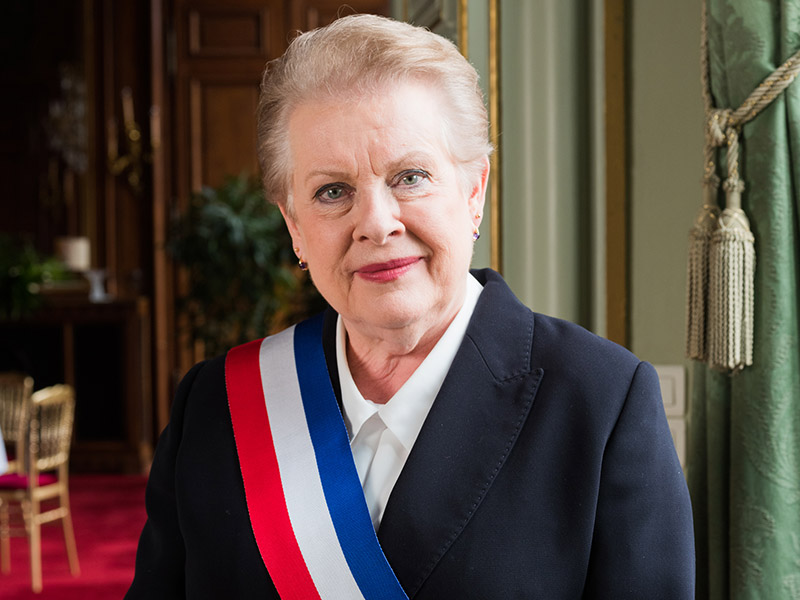
Former Minister of Culture under Lionel Jospin, Catherine Trautmann is the first woman to have led a city of more than 100,000 inhabitants in France and has just been elected for her third term as mayor of Strasbourg. She was also a national and European deputy.
Two months after taking office, what surprised you the most in the cultural reality of Strasbourg?
The fact that the cultural policy carried out under the previous mandate was more a matter of management than a real project. I had already felt this during the “World Book Capital” period when the entire book chain could have been much better mobilized. Then there was the collapse of a structure near the cathedral and this controversy around synthetic trees costing 700,000 euros that the residents did not want. In a context of reduction in state subsidies and weakening of the cultural world, my first objective is to be a stabilizer.
Concretely, what is changing this summer?
We remove the synthetic trees. In their place, a light show is being put back on the cathedral. We are strengthening support for the Street Arts Festival and summer events in the neighborhoods. Part of the 700,000 euros released will be directly reallocated to these actions.
Will this summer also be the start of “cultural seasonality” in Strasbourg?
This will be for the fall, with the idea of organizing cultural life around major thematic seasons so that institutions can pool their resources. I imagined the “Enchanted Days” which will bring together the Musica Festival, the return of the Philharmonic Orchestra, that of the Opéra du Rhin, and the countless choirs and choirs of the city. Amateur practice and professional practice together, in the same musical momentum.
Why change what works? Free and popular support remain. What I want to develop is the cross-border dimension and programming at national and European level. It is for 2027 that we are really preparing for change. Programming is decided well in advance.
Your documentary festival project is also part of this logic of cross-border cooperation…
Yes, but we are still waiting for our selection, and we will have to reformat our partnership with the National Cinema Center. It is a project in which Arte is an essential partner and I wish to relaunch cooperation between Strasbourg and Berlin.
Strasbourg devotes 19% of its municipal budget to culture, double the national average, 305 euros per inhabitant per year. How much does it bring in, concretely?
I don’t have the overall figure.
It’s surprising, isn’t it? You are the leading city in France in cultural spending per capita and you have not measured what that brings you!
You are right, it is lacking. What I can tell you is that the filming of the “César Wagner” series alone generated 10 million euros in direct economic benefits for the hotel industry, artisans and local employment. But we have to build the overall figure.
You have launched an audit. Is it for preparing cuts?
No, to inform our decisions. The situation is serious. We have exceeded our investment capacities, they will have to be reduced by around 100 million euros, especially since the debt repayment period exceeds thirteen years. My objective is to maintain the cultural envelope and optimize its use by sharing places and equipment. I even asked my team to design projects for zero euros.
Precisely, for the renovation of the Opera, you yourself say that 120 million seems insufficient to you. Is this an additional cost that you are recording, even without a definitive figure?
In fact, yes. The people I consulted tend to agree on 180 million, or perhaps 200. But I cannot say this definitively until a precise estimate is available.
And who pays?
No doubt patrons, but not in the form of a hat quest. I want lasting partnerships where the donating company is associated with the life of the institution. A donation is only justified if it is motivating for the person offering it. But the absolute priorities are to maintain excellence, the German public, ambitious programming and above all not to lose the “Opéra national du Rhin” label. Because during the work, the Opera is housed in the municipal theater which is not suitable for all repertoires.
The Museum of Modern and Contemporary Art, you wanted it, designed it, inaugurated it as minister in 1998. It is your museum. What happened between this original ambition and the desert we see today?
A deep crisis! Prolonged closures, the closed store, repeated schedule changes and the absence of temporary exhibitions. An audience is formed and becomes loyal: when we no longer have anything to offer them, we break habits. I say it without trying to avoid it, this museum deserved better. A major European-scale exhibition is included in the three-year contract for 2028-2029. In the meantime, the shop has just reopened and the small amphitheater has been made available again. These are signals…
Signals for all heritage…
A vast renovation program is underway as part of the three-year contract with those of the roofs of the Palais Rohan for 7 million euros, the restoration of the Alsatian Museum for 2 million, La Laiterie is also concerned for 19 million as well as the Star Saint-Exupéry cinema for 6.5 million euros.
However, cultural actors seem worried. What concrete measures can you announce to them?
Maintaining the budget.
This is slim for structures that are struggling to complete their seasons.
I ask them for a little patience, but they have priority and they know it. We are stopping the gadgets, the costly operations which have not highlighted our artists. And we now associate them with the City’s attractiveness and economic strategy. Being a responsible actor in this influence is also the best way to no longer be considered an assisted sector.
Where is Strasbourg on the file of looted works?
Our German partners told us bluntly that we were behind schedule in researching the provenance of works looted by the Nazis, but also for goods collected in other ways such as the human remains of our Zoological Museum. I want Strasbourg to become a place of reference on this subject, by bringing together universities, historians and lawyers. Cooperation between French and German museums is, on this point, essential.
Faced with the rise of authoritarian regimes in Europe, can this cultural cooperation play a role as a firewall?
I am convinced of it. Culture is valuable because it indicates something of the morale and identity of a people and that is why it is dangerous to those who want to control minds. The density of our cooperation will be our best defense.
You mentioned bowing out at the end of this mandate. You will not represent yourself?
I’m not going to accumulate mandates indefinitely! But this is a question that arises at the start of my mandate and which I will not answer today. The main thing is to stay the course.


