THE Togatus of Pamplona Does it represent a boy or a girl? If the question seemed settled, a recent study once again sows doubt. In the latest issue of Archeology notebooks from the University of Navarre, five researchers have devoted a file to the Roman bronze, acquired in 2023 by the government of Navarre, calling into question the attribution, until then predominant, of the statue to a young girl.
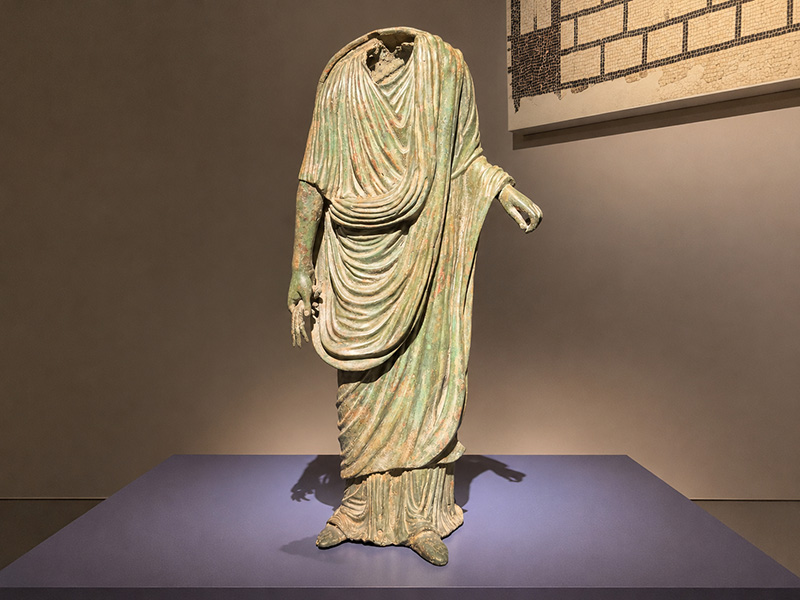
Discovered in 1895 in the street of Navarreria in Pamplona, in the heart of the ancient Roman city of Pompelo, the bronze statue represents a character dressed in a long toga, the right arm along the body holding an object in his hand, and the left arm slightly extended forward. Although the head is missing, it is in a rare state of conservation for an ancient sculpture from the Iberian Peninsula.
In 2015, the first reports retained a dating in the first half of the 2nd century, and described it as a young male figure dressed in a Roman tunic that went down to the ankles, shod with calcei and holding in his right hand a aspergiluma ritual sprinkler which was used to sprinkle water during religious ceremonies.
But in 2025, during the official presentation of the statue, a press release from the local authority’s Culture Advisor adopted another interpretation, while specifying its uncertainty. The hypothesis, defended by German researchers Hans Rupprecht Goette of the Archaeological Institute of Berlin, specialist in Roman statues in togas, and Carmen Marcks-Jacobs, professor at the Humboldt University of Berlin, identifies the statue with a young girl aged 10 to 12, dressed in a toga praetextaa white toga bordered with a purple band, worn by curule magistrates and by child citizens. It is based in particular on the length of the tunic under the toga, which would be unusual for men. As for the object placed in the right hand, German researchers interpreted it as a sheaf of ears, which would symbolize the future fertility of the young girl. Their study attributes an older date to the bronze, to the 1st century AD.
The public authorities of Navarra presented this reading to the general public, which contributes to reinforcing the rarity of the statue, making it the only bronze representation of its type known to date. The hypothesis is far from unanimous in the scientific community. Javier Andreu, professor at the University of Navarre and one of the authors of the report published in the November Papers, notably blamed the government, which, according to him, should not have presented a simple hypothesis with so much certainty. “We fear that this truth, even though it is not a truth in the present case, will be particularly difficult to qualify in the future”he writes, recalling the weight of official speeches.
For Javier Andreu, the toga depicted does not correspond to a toga praetexta. He also denies the reasoning according to which the length of the tunic would make it possible to identify a female character. According to him, it would be a tunica talarisa model supposed to cover the calceiwhich could be worn by men. For Luis Romero-Novella, co-author of the report and professor at the Complutense University of Madrid, “the upper part of the statue (…) has absolutely nothing to do with a little girl”. Its interpretation is, however, less definitive, and admits the hypothesis that the statue could correspond to a recomposition of two representations, male and female. As for Isabel Roda, from the Autonomous University of Barcelona and member of the Catalan Institute of Classical Archaeology, her article defends the idea that the statue could correspond to a genius loci, a tutelary divinity responsible for protecting a place. According to her, the sheaf of ears brings the figure closer to a fictional or symbolic representation.
The history of the statue is also turbulent. Discovered in 1895, it was entrusted to the Commission of Historical and Artistic Monuments of Navarre for study. But José Aramburu, the entrepreneur behind its discovery, claimed ownership and obtained its restitution in 1906. The sculpture then disappeared from scientific radar. She reappeared on the American art market in 1985, during a sale at Christie’s where she did not find a buyer. It was only in 2015 that it was identified again by specialists, in a private collection in the United States. After several years of negotiations, she returned to Pamplona in 2022 as part of a temporary loan to the Navarre Museum. The regional government finally acquired it in 2023 for around 575,000 euros.
The Government of Navarra announced on November 16, 2026 the loan of the sculpture to the National Museum of Roman Art in Mérida, on the occasion of the 40th anniversary of the institution. The statue will be on display from November 20, 2026 to March 31, 2027.