Seville,
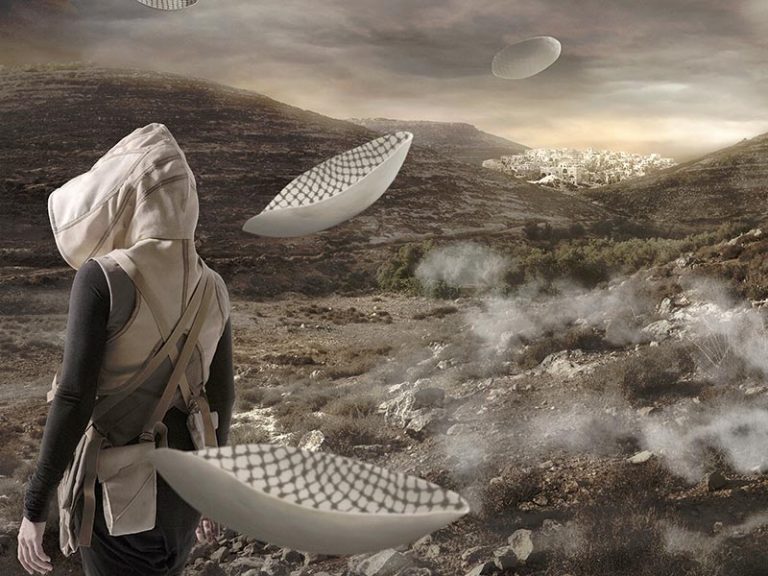
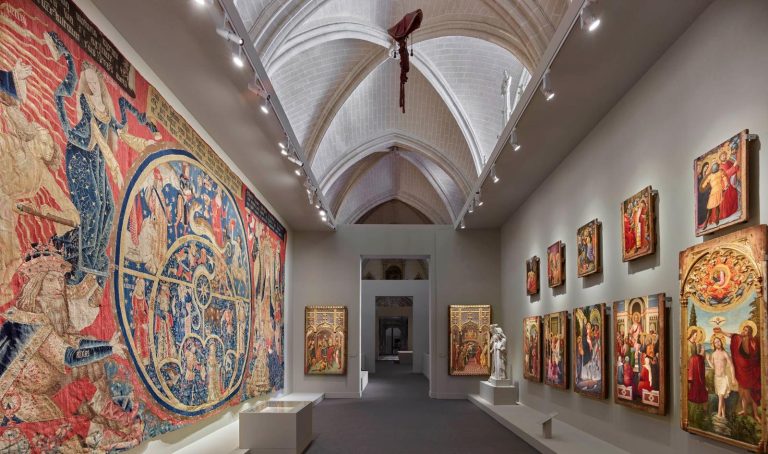
With the collaboration of the Pompidou Parisino center and after its passage through Barcelona, Valencia and Madrid, Caixaforum Sevilla presents from tomorrow, May 14, “Art and nature. A century of biomorphism”, an exhibition that examines the dialogues between creation and natural environment in the twentieth and twenty -first centuries from very diverse disciplines: from painting to architecture, through sculpture, cinema, cinema, photography and design. As expected, Surrealism, Art Povera and Land Art acquire prominence in the journey of this exhibition that, in addition to referring to the persistent attraction of artists by organic forms or microscopic life, underlines the critical perspectives that their work can open in relation to our ways of relating to the environment today.
Angela Lampe, conservative of Pompidou, would commission a project that begins by remembering how, in the first decades of the last century, the ties between nature and art were conditioned by the development of microscopic photography techniques that revealed dimensions of life until then unsuspected: those of microorganisms that could manifest virtually as abstract compositions. The assembly advances exhibiting proposals from the mid -twentieth century in which forests, landscapes and plants were an intrinsic part of creative work and ends with more recent works derived from irruption in the artistic techniques of biotechnology and new scientific technologies; In recent years, there are few authors who have used organic or biomaterial materials to generate conceptual pieces that, in some cases, evolve in time as living organisms. Especially in these last manifestations, political, ecological and social readings are clear.
The earliest pieces of “art and nature. A century of biomorphism” date from 1920, only a few years before Alfred H. Barr, then director of the MoMa of New York, introduced this term in an exhibition that this center provided to abstraction in 1936: he used it to refer to creations that did not end up fitting in the traits of abstract and geometric art of that time. Henri Laurens’s sculpture receives us Metamorphosis (1940), which evokes that the treatment of these transformations, both in human beings and in fauna and flora, has been common in all cultures, also in classical antiquity; This figure, between the human and the animal, suggests dynamism and hybridization, essential notes of contemporary art linked to its ability to modify our perception of the given.

Another great sculptor in this exhibition is Julio González, whose Cáctus II (1939) dilute the borders between nature and culture, and therefore between the material and the spiritual; It is accompanied by compositions of Tanguy and Max Ernst, of the organic forms that as soon as in 1929 filmed the neozylendés Len Lye and one of the works of Georgia O’Keeffe in which the anthropomorphic is projected in the landscape: the painting Red Yellow and Black Streak (1924). A specific chapter of the sample, by the way, of the transformation of the female body into a flower: they are part Femme Fleur of the aforementioned Laurens, Le Chapeau à Fleurs from Picasso (in this case hybridization occurs with a floral hat) or the late sculpture of Brassaï Femme-fleur (1984), of pink marble, in which that flower symbolizes the beautiful, but also sex and reproduction.
The mergers between different forms of natural life do not always acquire, however, a pleasant aesthetic, as proof L’âne pourri of Dalí, fully surreal, or Femme egorgée of Giacometti, a body made.
Apart from metamorphosis, art has also suggested correspondences. Composition Cellulaire Au Cercle Rougeby Léon Tutundjian, it is the first piece of a section in which analogies are established between the forms of the female body and the vegetables; Around them, Jean Arp worked (in the sculptures of the thirty in which it is possible to recognize body members) or Raoul Hausmann, in photographs of the same decade marked by sensuality.

Another way for the relationship between nature and art is given by mimesis: an imitation that can affect forms, structures or guiding principles of movement and in which Alexander Calder deepened, whose forms usually move as elements of the real world; Alvar Aalto, in furniture that refer to the beautiful simplicity of plants; or HESSIE, artist of the sixties and seventy recently claimed in France in whose tissues traditional knowledge is connected with that nature.
We talked about Aalto and, indeed, the design will charge prominence in this mimetic episode: the Hispanic Caixaforum teaches us a lamp in the shape of a flower from Patrick Jouin, a table inspired by Ginkgo leaves by Ross Lovegrove or a Andrew Kudless structure that refers to a colony of Balans. They also cultivated Alberto Magnelli mimesis, attending to the stones and the earth; Photographer Paul Nash, with shot songs; or Juan Daniel Fullaondo, who has created an evocative architecture of a mountain for this presentation.


Great observer of plants, could not be missing in this exhibition Paul Klee, who also theorized about the links between painting and organic forms; his Pflanzenwachstum (1921) illustrates from abstraction the process of growth of vegetation and animals … and a work of art. Kupka would be fixed, in the same period, in the evolution of pistils and stamens and, speaking of time, he has also reached Seville one of the films documented by Smithson’s Jetty spiral, almost contemporary to the work of Pino Pascali ESOPO featherswhich links writing and feathers, culture and nature again.
The Land Art, and other artistic currents developed in the sixties, came to introduce the dimension of the ephemeral in the creation: we will see the famous lettuce of Giovanni Anselmo, decomposing as the days progress; From a different perspective they have contemplated the Jeroen flowers of Rijke and Willem de Rooij, which in Bouquet III They associate them with violence, to Dutch participation in the Second Gulf War (already the promises as little last as they). For their part, Italian creators linked to Povera art approached the natural from a conceptual approach: Alberoof Penone, which alludes to the hidden tree in the industrial wooden beams, contrasting the humble of great consumption, it linked here with a wooden bank of Benjamin Graindorge halfway between the natural and the manufactured.

A last section of “Art and Nature. A century of biomorphism” collects works that appeal to the environmental risks we face, such as those of Pamela Rosenkranz, which in Leather pond (shine) He referred to the effects of cosmetics on our skin and our perception of the body itself; Tetsumi Kudo, author of a post -Nuclear garden with Flores in galad forms that we have to relate to the consequences of the Hiroshima and Nagasaki bombs; or Jeremy Deller, from which we will see the audiovisual installation Exodusabout the threat we perceive in bats following the COVID-19.

“Art and nature. A century of biomorphism”
Caixaforum Sevilla
C/ López Pintado, s/ n
Seville
From May 14 to September 7, 2025