Aura has given up operating the ancient theater of Orange, one of the most famous Roman monuments in France. The company, which succeeded Culturespaces in April 2022, initiated a procedure with the municipality for early termination of its public service delegation, initially scheduled until December 31, 2031. This decision, revealed by The Dauphiné liberated on November 3, comes after several years with significant losses.
The concession covers three sites belonging to the City: the ancient theater, built under Augustus in the 1st century and listed as a UNESCO world heritage site since 1981, the Roman Arc de Triomphe, also listed as a UNESCO site, and the Municipal Museum of Art and History, which notably preserves ancient remains and documents relating to the history of Orange. The delegation concerns the operation of the theater and the museum as well as the mediation of the Arc, but not the maintenance of this last monument.
The award of this concession to Edeis, which has since become Aura, came as a surprise in January 2022. Culturespaces, which had operated the theater and museum since 2002, had been excluded following a call for tenders. The new beneficiary, Edeis, was then mainly known for its activities in engineering, infrastructure and airport management. It operated the Nîmes airport in particular, but did not have the experience of Culturespaces in the management of historical monuments. However, in 2021, he had just won the concession for the Roman monuments in Nîmes, also to the detriment of Culturespaces.
In Orange, three candidates responded to the consultation, one of whom was rejected before the final selection. On January 31, 2022, the municipal council approved the choice of Edeis, despite the opposing votes of four elected officials from the center. The contract, concluded for nine years and nine months, was based on operation at the risk of the delegatee, remunerated by ticketing revenues and commercial activities, in return for a fee paid to the City.
Under Culturespaces, the theater and museum welcomed 165,093 visitors in 2018 and around 167,000 in 2019, before the health crisis. Attendance even reached 197,603 visitors in 2007. These results were known when Edeis took over the concession. However, as early as April 2022, the company publicly announced a target of 350,000 visitors, in particular thanks to nighttime visits and the organization of events. Aura today cites an initial hypothesis of 400,000 visitors. However, operations were already structurally fragile under Culturespaces: out of the seventeen financial years from 2002 to 2018, only three had been profitable. In 2018, the loss reached 254,000 euros, while the delegatee had paid 472,000 euros in royalties to the municipality.
Four years after her arrival, Aura recognizes an error of judgment. “The initial economic model, built on an estimated attendance of 400,000 visitors, proved to be out of step with the reality observed on the ground, around 150,000 visitors”explains the company to the Journal des Arts. The number of visitors thus represents less than 40% of the initial objective.
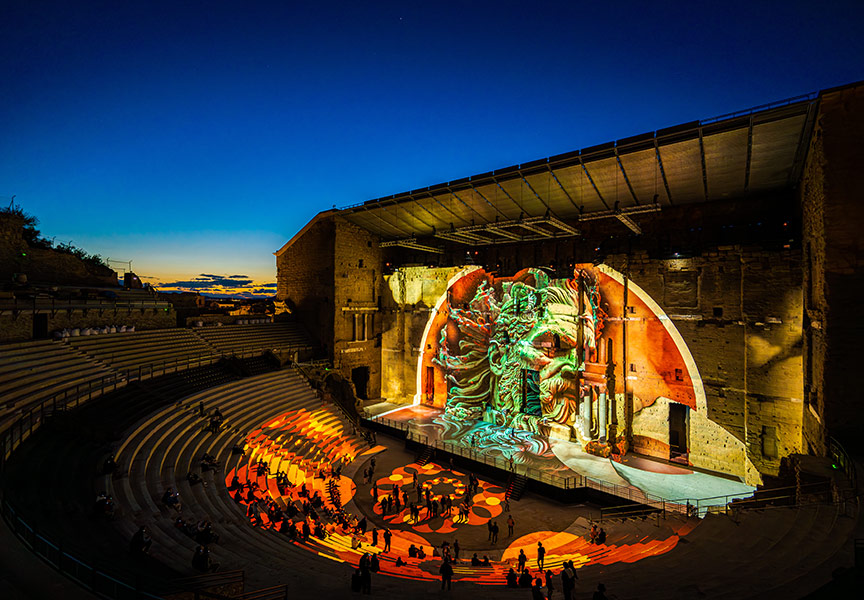
“We had a real ambition for this exceptional monument and we fully mobilized to promote it, in particular through significant investments and the development of new visitor experiences”says Aura. The company has notably invested in new mediation devices, including the Sound Odyssey, an immersive nighttime show combining video projections and sound creation, as well as in the redevelopment of reception areas.
The company’s accounts that Le Journal des Arts was able to consult give the measure of the financial failure. In 2025, its turnover stood at 2.32 million euros, compared to 2.41 million in 2024, a drop of 3.5%. Operating expenses reached 4.01 million euros, resulting in a negative operating result of 1.68 million euros. After taking into account financial charges, the net loss amounts to 1.87 million euros. Over the last two financial years, cumulative losses reached 3.66 million euros.
Investments also weighed on the accounts. In 2025, depreciation charges reached 642,000 euros. The company notably recorded 1.29 million euros in acquisitions of fixtures and installations at the ancient theater. Equity, negative at 1.43 million euros as of December 31, 2025, led the sole shareholder, on June 30, to decide to continue the activity despite equity less than half of the share capital of 150,000 euros. “Despite the efforts made, this imbalance became structural and no longer made it possible to calmly consider the continuation of exploitation”Aura recognizes.
In the meantime, Edeis separated himself from his cultural activities. In April 2026, these were grouped under the Aura brand, controlled by Trévise Participations, an investment company belonging to the Noisiez family, founder of the GSF cleaning group. The new entity took over the concessions for the monuments of Nîmes and Orange as well as those for several other tourist and heritage facilities.
A politically sensitive succession
The failure also occurs in a particular political context. The city has been ruled by the far right since 1995, but the municipal elections of March 2026 put an end to thirty-one years of domination by the Bompard family, for the benefit of the National Rally. Jacques Bompard was elected mayor in 1995, then his son Yann Bompard from November 2021 when his father was convicted of illegal taking of interests, accompanied by five years of ineligibility, which became definitive in November 2021.
Jean-Dominique Artaud, candidate of the National Rally, from the old majority won the town hall in March 2026 with 35.76% of the votes in the second round, ahead of Jacques Bompard (32.47%) and the various center candidate Carole Normani (31.77%). The new municipality therefore inherits a contract concluded by the previous team, but which included several elected officials who have now been renewed.
During the municipal council meeting on September 7, heritage assistant Marie-Thérèse Galmard spoke of a worrying financial situation, despite attendance considered encouraging. According to Aura, discussions with the municipality resulted in a “joint decision to terminate the contract early”. The financial conditions of this termination, in particular the fate of unamortized investments and any compensation, remain to be specified. However, the company does not rule out a return. “In the event of continued operation under public service delegation, Aura will present its application”she announces.
The City, for its part, did not wish to respond to numerous requests from the Journal des Arts, in particular on the proposed management methods for these sites after Aura’s withdrawal.